
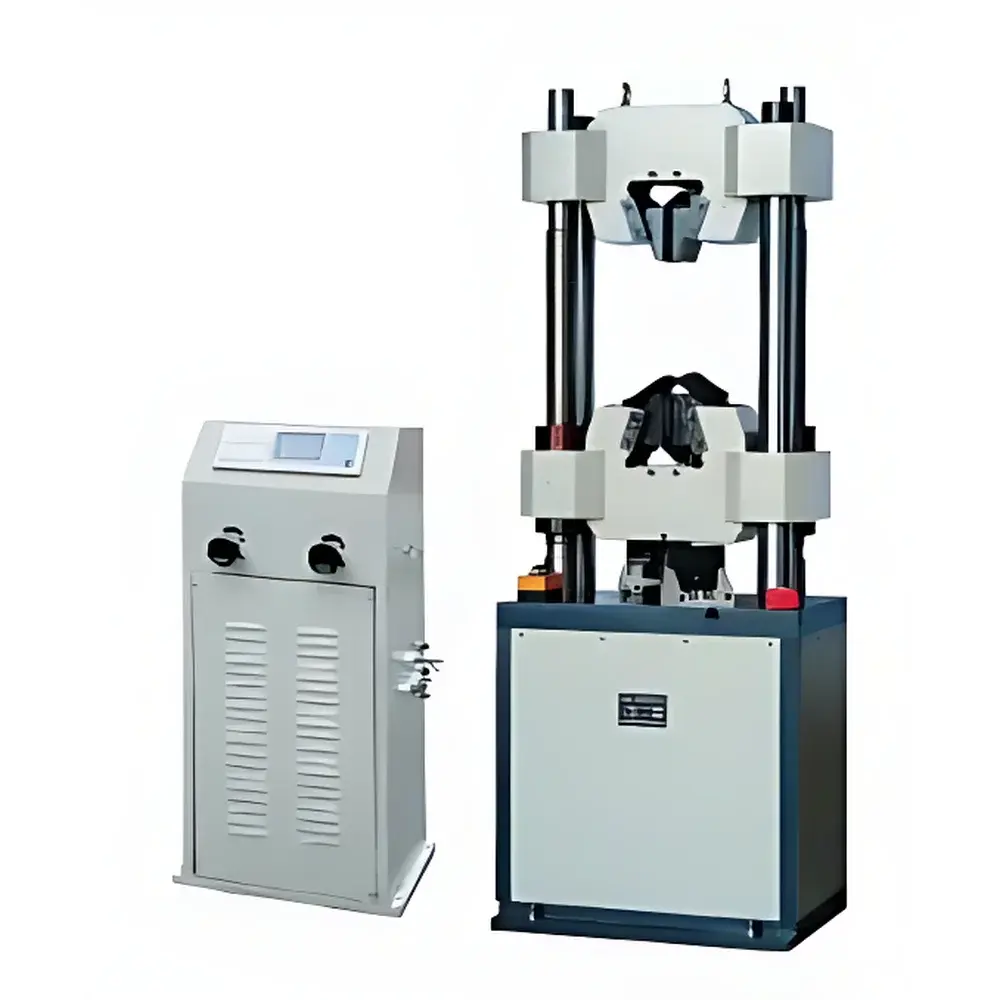
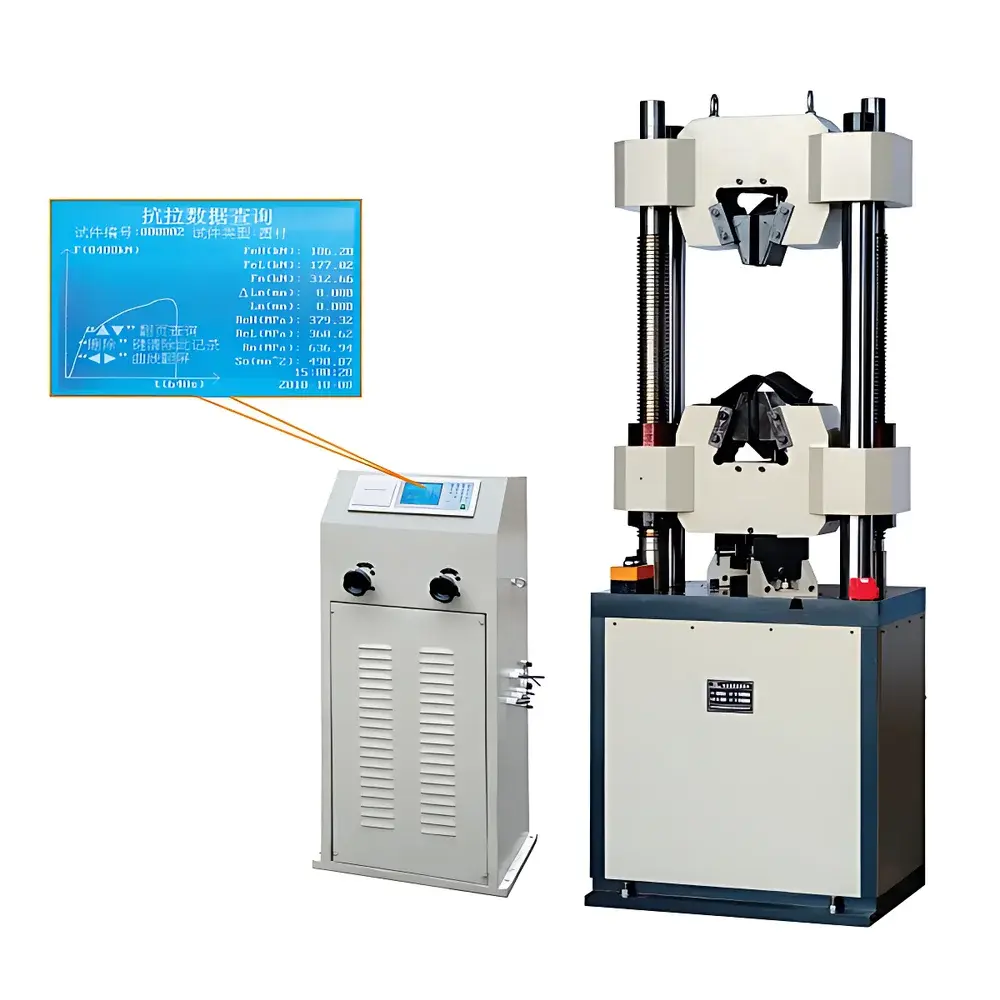
JB/WE-100B Digital Hydraulic Universal Testing Machine
| Brand | Jiubin Instruments |
|---|---|
| Origin | Shanghai, China |
| Model | JB/WE-100B |
| Test Force Capacity | 100 kN |
| Force Measurement Range | 4–100 kN |
| Force Indication Accuracy | ≤ ±1% of reading |
| Force Resolution | 0.01 kN |
| Tensile Test Space | 550 mm |
| Compression Space | 380 mm |
| Piston Stroke | 150 mm |
| Round Specimen Grip Range | Φ6–Φ26 mm |
| Flat Specimen Grip Thickness | 0–15 mm |
| Flat Specimen Max Jaw Width | 70 mm |
| Compression Platen Diameter | φ160 mm |
| Bending Span (Two-Point) | 450 mm |
| Bending Support Roller Width | 120 mm |
| Bending Support Roller Diameter | Φ30 mm |
| Piston Speed | 50 mm/min |
| Clamping Method | Manual |
| Host Dimensions (W×D×H) | 720×580×1950 mm |
| Control Console Dimensions (W×D×H) | 1000×700×1400 mm |
| Load Cell Manufacturer | Zhenhai, Ningbo |
Overview
The JB/WE-100B Digital Hydraulic Universal Testing Machine is an oil-cylinder-underneath configured mechanical testing system engineered for precision static mechanical property evaluation of metallic and non-metallic materials under uniaxial loading conditions. It operates on the principle of hydraulic force generation coupled with high-stability load cell transduction and digital signal conditioning, enabling compliant measurement of tensile strength, yield strength (upper and lower), compressive strength, flexural modulus, and fracture behavior in accordance with ASTM E8/E9, ISO 6892-1, ISO 37, ISO 604, and GB/T 228.1 standards. Its low-profile structural design—featuring a compact footprint and reduced overall height—enhances operational safety and spatial adaptability, particularly in field laboratories, construction site QA/QC units, and prefabrication quality control environments where ceiling clearance or transport logistics are constrained.
Key Features
- Hydraulic actuation system with integrated piston-driven loading frame delivering stable 100 kN nominal capacity and 4–100 kN operational range;
- Digital force measurement via calibrated 0.01 kN resolution load cell (supplied by Zhenhai Sensor Co., Ningbo), traceable to national metrological standards;
- LCD-based real-time display of force–time curve, peak load, yield point detection (for materials exhibiting distinct yielding), and programmable specimen identification input;
- Manual wedge-type gripping mechanism with dual-range round specimen jaws (Φ6–Φ13 mm and Φ13–Φ26 mm) and adjustable flat-specimen clamps (0–15 mm thickness, 70 mm max width);
- Modular accessory set including compression platen (φ160 mm), three-point bending fixture (450 mm span, Φ30 mm support rollers, 120 mm roller width), and optional shear fixtures;
- Integrated thermal-printed data output for immediate hardcopy reporting—no external PC dependency required for basic test documentation;
- Rugged steel-welded frame architecture with reinforced base plate and guided crosshead motion ensuring axial alignment fidelity and long-term repeatability.
Sample Compatibility & Compliance
The JB/WE-100B accommodates a broad spectrum of standardized and non-standard specimens across industrial and academic sectors. Metallic samples include hot-rolled steel bars, cold-drawn wires, welded joints, and fasteners conforming to ASTM A370 and ISO 6892-1 geometries. Non-metallic applications encompass cured concrete cylinders (per ASTM C39), cement mortar prisms (ASTM C109), polymer sheets (ISO 527-2), thermoset composites (ASTM D695), and ceramic tiles (ISO 10545-4). All mechanical outputs—including ultimate tensile strength (UTS), offset yield strength (Rp0.2), Young’s modulus, compressive stress at 10% strain, and bending load at deflection—are computed in accordance with internationally recognized calculation protocols. The system supports GLP-compliant recordkeeping when paired with optional audit-trail-enabled software modules and meets basic requirements for ISO/IEC 17025 accredited testing laboratories conducting routine mechanical verification.
Software & Data Management
While the JB/WE-100B operates autonomously via its embedded microcontroller and LCD interface, it is compatible with Jiubin’s optional PC-based data acquisition suite (sold separately), which provides extended functionality including multi-curve overlay, statistical batch analysis (mean, SD, CV%), customizable report templates (PDF/Excel export), and electronic signature support aligned with FDA 21 CFR Part 11 principles. Raw analog signals from the load cell are digitized at ≥1 kHz sampling rate, filtered using configurable low-pass digital filtering to suppress hydraulic noise, and time-stamped with millisecond precision. All test records—including operator ID, specimen ID, environmental notes, and calibration metadata—are stored locally on internal flash memory with write-protection options to prevent accidental overwrites. Data export is supported via USB port or RS-232 serial interface for integration into LIMS environments.
Applications
- Mechanical qualification of reinforcing steel (rebar) per ASTM A615/A706 in precast concrete plants;
- Compliance verification of structural bolts and anchor rods against ISO 898-1 mechanical property classes;
- Quality surveillance of extruded aluminum profiles used in architectural façades;
- Validation of adhesive bond strength in composite laminates and metal–polymer hybrid assemblies;
- Field-deployable verification of weld integrity in pipeline girth welds (using sub-sized coupons);
- Educational demonstration of stress–strain behavior, necking phenomena, and ductile-to-brittle transition in undergraduate materials science labs;
- Periodic in-service inspection of lifting chains, wire ropes, and rigging hardware per EN 1677 series.
FAQ
What standards does the JB/WE-100B comply with for tensile testing?
It supports execution and reporting per ASTM E8/E21, ISO 6892-1, GB/T 228.1, and JIS Z 2241, provided appropriate specimen geometry, grip alignment, and extensometer usage (if applicable) are maintained.
Is the system suitable for cyclic or fatigue testing?
No—the JB/WE-100B is designed exclusively for static monotonic loading. It lacks closed-loop servo-hydraulic control, dynamic actuator response, or waveform generation capability required for fatigue or creep testing.
Can I retrofit it with an extensometer for strain measurement?
Yes—its crosshead features standardized mounting holes compatible with clip-on or contactless extensometers (e.g., ASTM E83 Class B2). Strain data integration requires optional software upgrade and analog input module.
What maintenance intervals are recommended for hydraulic oil and seals?
Hydraulic oil should be replaced every 2,000 operating hours or biannually, whichever occurs first; piston seal inspection is advised every 5,000 cycles or annually under continuous use, per manufacturer’s service manual.
Does the machine support automatic test sequence programming?
Not natively—the onboard controller supports single-test execution only. Automated multi-step protocols (e.g., preload → ramp → hold → unload) require the optional PC-based software package and digital I/O interface.



