
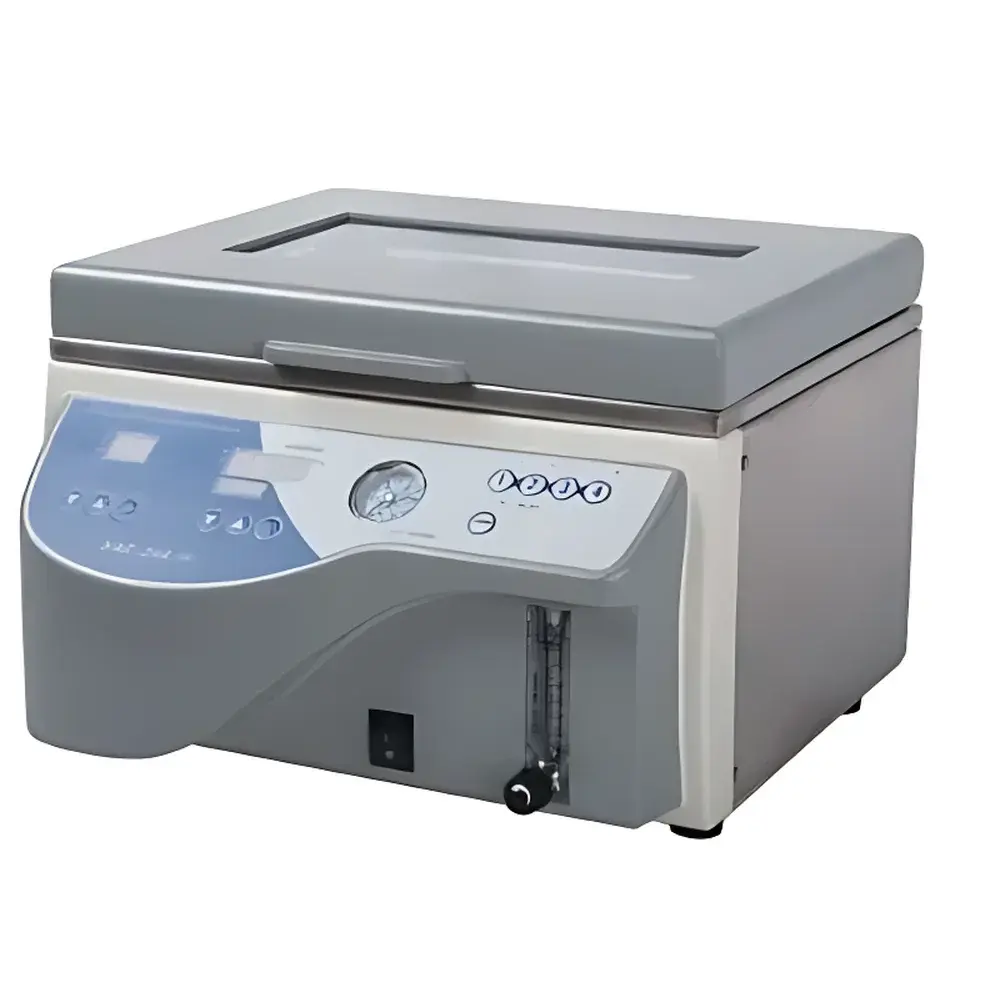
English Product Name
| Origin | Shanghai, China |
|---|---|
| Manufacturer Type | Authorized Distributor |
| Country of Origin | China |
| Model | HAC-24A |
| Power | 800 W |
| Sample Capacity | 24 × 40 mL tubes |
| Temperature Range | Ambient to 90 °C |
| Temperature Accuracy | ±1 °C |
| Timer Range | 0–99 min |
| Heating Element | PTC ceramic |
| Gas Delivery | Adjustable nitrogen flow with real-time digital display |
| Endpoint Detection | Optical fiber sensor for 0.5 mL or 1.0 mL auto-shutoff |
| Exhaust System | Integrated vapor extraction via flexible duct |
| Dimensions (W×D×H) | 400 × 420 × 270 mm |
Overview
The HAC-24A Automatic Nitrogen Evaporator is an engineered solution for precise, reproducible solvent removal in analytical and preparative laboratories. It operates on the principle of gentle, controlled nitrogen gas sweeping across the surface of liquid samples immersed in a thermostatically regulated water bath. Unlike conventional open-air evaporation or passive heating methods, this system minimizes oxidative degradation, thermal decomposition, and cross-contamination by isolating samples under inert nitrogen while maintaining consistent temperature and gas dynamics. The integration of optical fiber-based endpoint detection enables quantitative termination at predetermined residual volumes—0.5 mL or 1.0 mL—eliminating manual intervention and reducing inter-operator variability. Designed for compliance-critical environments, the HAC-24A supports method traceability and process consistency required in environmental testing, pharmaceutical QC, food safety analysis, and clinical research workflows.
Key Features
- Optical fiber endpoint sensor: Immune to electromagnetic interference and radiation; chemically resistant and thermally stable; delivers high-sensitivity detection at 0.5 mL or 1.0 mL residual volume with audible/visual alarm.
- Independent gas channel control: Each of the 24 positions features individual solenoid valve actuation and physical valve plug options, enabling selective activation and precise gas distribution.
- Digital nitrogen flow monitoring: Real-time pressure and flow rate display ensures consistent evaporation kinetics and improves recovery reproducibility across sample sets.
- PTC ceramic heating system: Provides rapid, uniform water bath temperature ramping (ambient to 90 °C) with ±1 °C stability; inherently self-regulating and fail-safe.
- Translucent front panel: Enables continuous visual monitoring of sample volume reduction without opening the chamber or disrupting nitrogen blanket.
- Vapor extraction ducting: Integrated exhaust path removes condensed water vapor and volatile analytes, preventing condensate re-deposition and maintaining sample integrity.
- Vortex-style gas delivery: Nitrogen is directed tangentially above the liquid surface—avoiding direct impingement—to enhance surface air exchange, suppress splashing, and optimize gas utilization efficiency.
- Digital timer with auto-shutdown: Programmable 0–99 minute countdown eliminates unattended operation risks and supports batch synchronization.
Sample Compatibility & Compliance
The HAC-24A accommodates standardized tube formats including 24 × 40 mL, 12 × 100 mL, or 6 × 200 mL vessels—optimized for high-volume extractions common in pesticide residue analysis (e.g., AOAC 2007.01), veterinary drug screening (EU Commission Decision 2002/657/EC), and EPA Method 525.3 applications. Its design conforms to general laboratory safety standards (IEC 61010-1) and supports GLP-compliant documentation when paired with validated SOPs. While not intrinsically 21 CFR Part 11 compliant, audit trails for timer settings, temperature logs, and endpoint events can be manually recorded or integrated into LIMS via external data capture. The absence of moving mechanical parts in the sensing mechanism enhances long-term reliability and reduces calibration drift—critical for regulated QC environments requiring annual verification per ISO/IEC 17025:2017 Clause 6.4.
Software & Data Management
The HAC-24A operates as a standalone instrument with embedded microcontroller logic—no proprietary software installation required. All operational parameters (set temperature, timer duration, endpoint threshold) are configured via intuitive front-panel keypad and LCD interface. Event logging is limited to visual indicators (LED status, buzzer alert); however, the device’s deterministic behavior—repeatable shutoff at defined volumes, stable thermal profile, and consistent gas flow—enables robust method transfer and validation. For laboratories implementing electronic records, integration with third-party data acquisition systems is feasible via analog output modules (optional) or timed image capture through the transparent viewport. The absence of cloud connectivity or firmware updates reflects its purpose-built architecture for mission-critical, low-maintenance operation in ISO 17025-accredited labs.
Applications
- Residue analysis: Final concentration step prior to GC-MS or LC-MS/MS injection in multiresidue pesticide, mycotoxin, or veterinary drug assays.
- Environmental testing: Pre-concentration of aqueous extracts from soil, sediment, or wastewater per EPA Methods 8081B, 8270D, and 525.3.
- Pharmaceutical development: Solvent removal from reaction mixtures, purification fractions, or stability study samples where oxidation sensitivity is critical.
- Clinical toxicology: Preparation of urine or plasma extracts for immunoassay or mass spectrometry-based quantification of drugs of abuse.
- Food and beverage safety: Reduction of large-volume QuEChERS extracts prior to instrumental analysis under SANTE/2023/2022 guidelines.
FAQ
Does the HAC-24A support 1.5 mL or 15 mL microcentrifuge tubes?
No—the HAC-24A is mechanically configured exclusively for 40 mL, 100 mL, and 200 mL tube formats. For smaller-volume tubes (1.5–15 mL), the HAC-I model with adjustable dual-tier rack is recommended.
Is the optical fiber sensor calibrated at the factory?
Yes—each unit undergoes functional verification at 0.5 mL and 1.0 mL thresholds using certified volumetric standards. No user recalibration is required under normal operating conditions.
Can the exhaust duct be connected to a central lab fume hood system?
Yes—the included 3-meter flexible exhaust hose terminates in a standard 32 mm ID connector compatible with most passive or active lab ventilation manifolds.
What maintenance is required for long-term reliability?
Routine cleaning of the water bath chamber and periodic inspection of silicone tubing and valve seals are sufficient. The PTC heater and optical sensor have no consumable service intervals.
Is nitrogen supply pressure regulated internally?
No—the instrument accepts inlet pressure between 0.1–0.5 MPa; users must provide an external pressure regulator and inline filter to ensure clean, stable gas delivery.



