
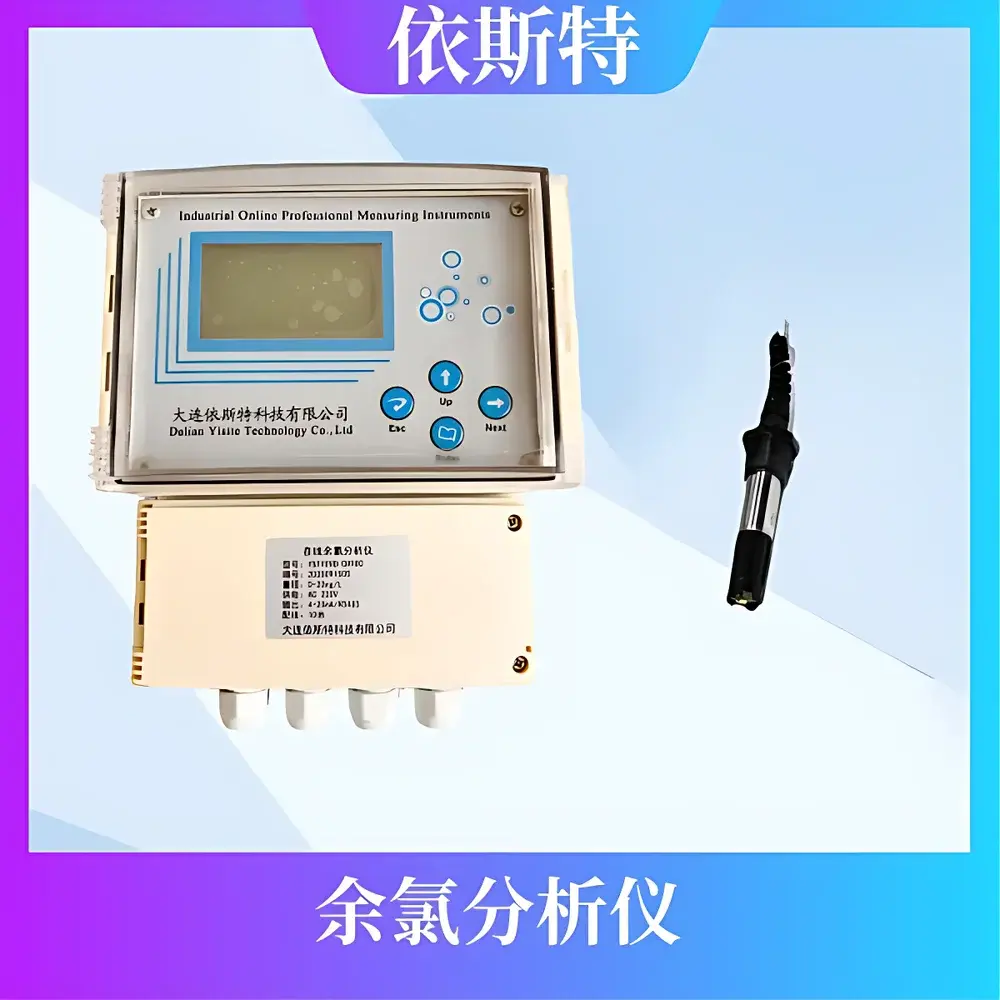
YST909B-CH980 Residual Chlorine and Chlorine Dioxide Online Analyzer
| Brand | YST (Dalian Yist Environmental Technology Co., Ltd.) |
|---|---|
| Origin | Liaoning, China |
| Model | YST909B-CH980 |
| Measurement Range | Free Chlorine 0–5 mg/L (extendable to 0–20 mg/L), Total Chlorine 0–10 mg/L (extendable to 0–50 mg/L) |
| Resolution | 0.01 mg/L |
| Accuracy | ±2% FS or ±0.02 mg/L (whichever is greater) |
| Response Time | ≤60 s (T90) |
| Operating Temperature | 0–50 °C |
| Humidity | 10–90% RH (non-condensing) |
| Power Supply | AC 220 V ±10%, 50 Hz or DC 12–24 V |
| Output Signals | 4–20 mA analog, RS485 digital (Modbus RTU protocol) |
| Ingress Protection | IP65 |
| Calibration | Automatic (programmable interval) or manual |
Overview
The YST909B-CH980 Residual Chlorine and Chlorine Dioxide Online Analyzer is an industrial-grade electrochemical monitoring system engineered for continuous, real-time measurement of free chlorine and total chlorine concentrations in municipal wastewater effluent streams. Designed specifically for post-disinfection process control in wastewater treatment plants (WWTPs), the analyzer employs amperometric sensor technology with selective membrane electrodes to quantify residual oxidants in aqueous solution. Its operational principle relies on the electrochemical reduction of hypochlorous acid (HOCl) and hypochlorite ion (OCl⁻) at a catalytic working electrode, generating a current proportional to active chlorine concentration. This method ensures high specificity in complex matrices — including turbid, high-suspended-solid, and organically loaded wastewater — without interference from common ions (e.g., nitrate, sulfate) or moderate pH fluctuations (pH 5.0–8.5). The device meets functional requirements outlined in EPA Method 334.0 and ISO 7393-2 for residual chlorine determination, supporting compliance-driven operations under national discharge permit regimes.
Key Features
- Robust dual-range measurement capability: factory-configured for 0–5 mg/L free chlorine and 0–10 mg/L total chlorine, with field-extendable upper limits (0–20 mg/L and 0–50 mg/L respectively) via firmware adjustment.
- Integrated automatic cleaning mechanism using timed air-pulse or low-pressure water jet (configurable), minimizing biofilm accumulation and sensor fouling in high-solids environments typical of secondary and tertiary effluent.
- Multi-mode calibration architecture: supports scheduled automatic calibration using standard chlorinated solutions (e.g., potassium iodide–chlorine standard), as well as manual single-point or two-point calibration with traceable reference standards.
- Wide power flexibility: accepts both AC mains (220 V ±10%, 50 Hz) and DC inputs (12–24 V), enabling deployment in control cabinets, outdoor kiosks, or solar-powered remote sites.
- Industrial communication suite: native 4–20 mA analog output for PLC integration and RS485 serial interface compliant with Modbus RTU protocol, facilitating direct connection to SCADA, DCS, or cloud-based IoT platforms without gateway hardware.
- IP65-rated enclosure with UV-stabilized polycarbonate housing and EPDM-sealed wetted parts, certified for continuous operation in ambient temperatures from 0 °C to 50 °C and relative humidity up to 90% non-condensing.
Sample Compatibility & Compliance
The YST909B-CH980 is validated for use in municipal wastewater effluents following secondary or tertiary treatment, including chlorinated, chloraminated, and chlorine dioxide-treated streams. It maintains measurement integrity across turbidity levels up to 200 NTU and suspended solids concentrations ≤ 150 mg/L — conditions routinely encountered at disinfection contact tank outlets and final effluent channels. Sensor design incorporates chemical-resistant materials (e.g., PTFE membranes, gold-plated electrodes, and 316 stainless steel flow cells) to withstand prolonged exposure to oxidizing agents and mildly corrosive wastewater matrices. While not certified to IEC 61508 or SIL-2 for safety instrumented systems, the analyzer conforms to electromagnetic compatibility (EMC) requirements per IEC 61326-1 and carries CE marking for industrial environmental monitoring applications. Data integrity aligns with GLP principles through timestamped calibration logs and audit-trail-capable configuration history (when paired with compatible host software).
Software & Data Management
The analyzer operates autonomously without embedded touchscreen or local HMI; instead, it delivers raw and processed data via standardized protocols for ingestion into centralized supervisory systems. Configuration, diagnostics, and event logging are managed remotely via Modbus register mapping — supporting read/write access to measurement values, calibration status, sensor health flags (e.g., membrane integrity, electrolyte level), and maintenance counters. When integrated with YST’s optional CloudLink Gateway or third-party IIoT middleware (e.g., Ignition, Siemens MindSphere), users gain access to trend visualization, threshold-based SMS/email alerts, historical data export (CSV/Excel), and automated report generation aligned with regulatory submission formats (e.g., NPDES Discharge Monitoring Reports). All communication channels support TLS 1.2 encryption where enabled at the network layer, satisfying baseline cybersecurity expectations for utility infrastructure.
Applications
- Real-time feedback control of chlorine dosing systems in municipal WWTPs to maintain target residual (0.2–2.0 mg/L) while minimizing over-chlorination and DBP formation.
- Compliance verification at NPDES outfall points, ensuring adherence to state-specific residual chlorine limits (e.g., <0.5 mg/L for aquatic life protection).
- Performance validation of UV/chlorine hybrid disinfection processes where residual chlorine serves as a secondary barrier indicator.
- Monitoring of reclaimed water distribution networks for landscape irrigation or industrial reuse, verifying persistent disinfectant levels during conveyance.
- Process optimization in advanced oxidation pilot studies involving chlorine dioxide or chloramine, leveraging dual-parameter capability for speciation analysis.
FAQ
What sample preparation is required prior to installation?
No filtration or pre-treatment is necessary. The analyzer is designed for direct insertion into flowing effluent streams with minimum velocity ≥0.3 m/s. A representative bypass stream with laminar flow conditioning may be used if main channel turbulence exceeds sensor tolerance.
Does the device support chlorine dioxide measurement alongside chlorine?
Yes — the CH980 variant includes a dedicated chlorine dioxide sensor module with independent calibration and signal processing, allowing concurrent quantification of ClO₂ (0–5 mg/L) and total chlorine within the same instrument housing.
How often must the sensor be calibrated in routine municipal service?
Under stable operating conditions, quarterly calibration is sufficient. However, calibration frequency should be increased to monthly during seasonal influent variability (e.g., spring runoff) or after major process upsets (e.g., nitrification failure, filter breakthrough).
Can the 4–20 mA output be assigned to different parameters (e.g., temperature or error status)?
No — the analog output is fixed to primary residual chlorine measurement. Secondary parameters (e.g., temperature, sensor voltage) are accessible exclusively via Modbus registers.
Is the analyzer suitable for seawater-influenced wastewater?
Not recommended for sustained operation in chloride concentrations >5,000 mg/L due to accelerated electrode passivation and potential membrane swelling; alternative silver/silver chloride reference electrode configurations would be required for brackish applications.
Related Products







