
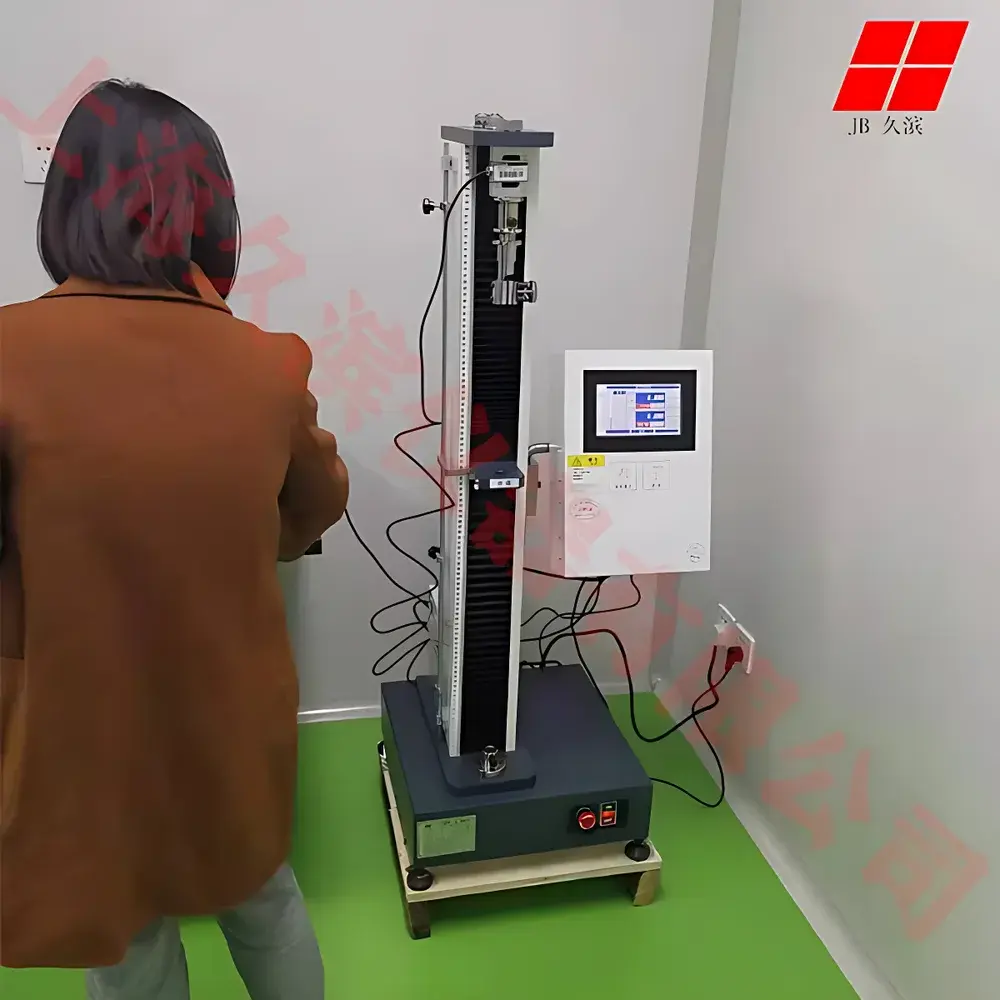
Jiubin JB-126A Fiber Optic Cable Tensile Testing Machine
| Brand | Jiubin |
|---|---|
| Origin | Shanghai, China |
| Model | JB-126A |
| Instrument Type | Electronic Universal Testing Machine |
| Force Capacity Options | 10 kN, 20 kN, 50 kN, 100 kN |
| Force Accuracy | ±0.5% or ±1% FS |
| Force Resolution | 1/200,000 |
| Displacement Resolution | 0.05 µm |
| Displacement Accuracy | ±0.5% of reading |
| Test Speed Range | 0.001–500 mm/min |
| Effective Travel (excl. grips) | 700 mm |
| Drive System | Stepper or Servo Motor with Precision Ball Screw |
| Control System | Domestic or Imported Motion Controller |
| Load Cell | High-Accuracy Domestic/Imported Strain-Gauge Sensor |
| Accuracy Class | Class 0.5 or Class 1 per ISO 7500-1 |
| Compliance | ASTM D638, ISO 527, IEC 60794-1-2, ITU-T G.652/G.657, GB/T 228.1, GB/T 16491 |
Overview
The Jiubin JB-126A Fiber Optic Cable Tensile Testing Machine is an electronically actuated universal testing system engineered for high-fidelity mechanical characterization of optical fiber cables, dielectric strength members, buffer tubes, aramid yarns, and associated composite structural elements. It operates on the principle of controlled uniaxial force application—measuring load via calibrated strain-gauge load cells and displacement via high-resolution encoder feedback—enabling precise determination of tensile properties including ultimate tensile strength (UTS), yield behavior, elongation at break, modulus of elasticity, and stress–strain hysteresis. Designed to meet the stringent dimensional stability and repeatability requirements of fiber optic component qualification, the JB-126A conforms to international test standards governing cable mechanical integrity, including IEC 60794-1-2 (section E1: Tensile Test), ITU-T G.652.D and G.657.A1/A2 specification annexes, and ISO/IEC 17025-accredited laboratory workflows.
Key Features
- Precision load measurement with dual accuracy options: Class 0.5 (±0.5% FS) or Class 1 (±1% FS) per ISO 7500-1, supported by domestic or imported high-stability load cells.
- Sub-micron displacement resolution (0.05 µm) and ±0.5% displacement linearity across full travel (700 mm, excluding grip height), ensuring reliable detection of micro-strain events during pre-yield deformation.
- Wide dynamic speed range (0.001–500 mm/min), programmable in closed-loop mode, enabling compliance with low-speed creep protocols (e.g., IEC 60794-1-2 E3) and high-rate pull-out validation.
- Modular drive architecture: configurable stepper or servo motor coupled to preloaded ball screw transmission, delivering smooth torque response and minimal backlash (<0.02°).
- Dual auto-stop logic: hardware-limit switch protection plus software-defined termination triggers (e.g., load drop >15%, displacement threshold, or time-based halt).
- Compliance-ready control firmware supporting audit trails, user-level access permissions, and parameter locking—aligned with GLP and FDA 21 CFR Part 11 data integrity expectations when paired with validated PC software.
Sample Compatibility & Compliance
The JB-126A accommodates standardized fiber optic cable specimens per IEC 60794-1-2 Annex E, including stranded loose-tube, ribbon, and central strength member configurations (e.g., FRP, steel wire, aramid). Customizable pneumatic, wedge, or vise-type grips ensure slippage-free clamping of jacketed cables (Ø0.9–12 mm) and bare fibers (125 µm–250 µm coated). Test methods executed on this platform satisfy mandatory qualification criteria in telecom infrastructure procurement (e.g., Telcordia GR-20-CORE, YD/T 901–2018), as well as material-level standards such as ASTM D638 (plastics), ISO 527 (polymeric films), and GB/T 228.1 (metallic wires). All force and displacement calibrations are traceable to national metrology institutes (e.g., NIM, CNAS-accredited labs), and system verification follows ISO 17025 clause 6.5 procedures.
Software & Data Management
The JB-126A integrates with Jiubin’s proprietary WinTest Pro software (Windows 10/11 compatible), providing real-time synchronized acquisition of load, displacement, and time-stamped event markers. Raw data exports in CSV and XML formats support third-party statistical analysis (e.g., Minitab, JMP) and LIMS integration. Software modules include automated calculation of Young’s modulus (secant/tangent), yield point identification (0.2% offset method), and hysteresis loop quantification (recovery work ratio, loss energy percentage). Audit trail functionality logs all user actions—including method edits, calibration entries, and report generation—with immutable timestamps and operator ID binding. Optional 21 CFR Part 11 compliance package includes electronic signatures, role-based authentication, and encrypted database storage.
Applications
- Qualification testing of optical fiber cables under simulated installation tension (IEC 60794-1-2 E1/E3).
- Interfacial adhesion evaluation between coating layers and glass fiber substrates via peel and pull-out tests.
- Mechanical screening of strength members (aramid, FRP, stainless steel) for tensile retention after environmental aging (e.g., thermal cycling, humidity exposure).
- Stress–strain profiling of polymer buffer tubes and jacketing materials (LSZH, PE, PVC) per ISO 1183 and ASTM D792.
- R&D validation of novel cable architectures, including bend-insensitive fibers and microduct-integrated designs.
- Quality control in production environments requiring batch-wise tensile consistency (Cp/Cpk monitoring enabled via exported datasets).
FAQ
What fiber optic cable standards does the JB-126A support?
It fully supports IEC 60794-1-2 (E1 tensile, E3 crush-tensile), ITU-T G.652.D/G.657.A1 mechanical annexes, Telcordia GR-20, and YD/T 901–2018.
Can the system perform cyclic loading or creep tests?
Yes—programmable multi-step profiles enable stepwise load hold, ramp-and-hold, and continuous creep protocols up to 100 hours, with data logging at user-defined intervals.
Is calibration certification included with delivery?
Each unit ships with a factory calibration report traceable to NIM; optional ISO/IEC 17025-certified field calibration is available upon request.
What grip types are recommended for bare 250 µm fiber testing?
Specialized low-pressure ceramic-faced grips with adjustable clamping force (0.1–2 N range) prevent fiber fracture during initial engagement.
Does the software comply with FDA 21 CFR Part 11?
The base software provides audit trail and user management; full Part 11 compliance requires the validated add-on module with electronic signature and encrypted database licensing.



