
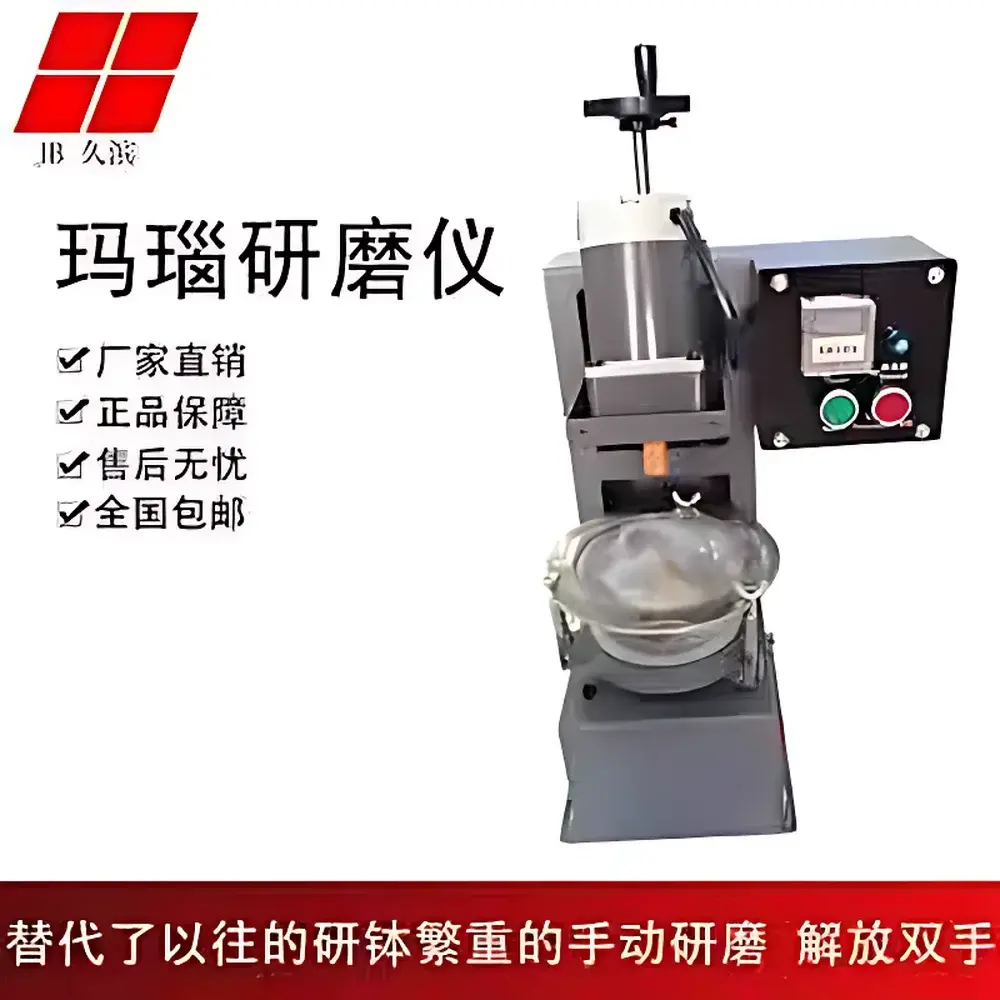
JB-120 Agate Mortar Grinder – Jiubin Instruments
| Brand | Jiubin Instruments |
|---|---|
| Model | JB-120 |
| Type | Agate Mortar Grinder |
| Origin | Shanghai, China |
| Sample Suitability | Hard & Brittle Solids |
| Output Particle Size | 0.01–0.5 mm |
| Mortar Diameter | 120 mm |
| Mortar Depth | 34 mm |
| Pestle Rotation Speed | 20–90 rpm |
| Mortar Rotation Speed | 10 rpm |
| Pestle Motor Power | 25 W |
| Mortar Motor Power | 10 W |
| Grinding Time Range | 1–900 min |
| Dimensions (L×W×H) | 240 × 240 × 500 mm |
| Weight | 12 kg |
| Voltage | 110/220 V, 50/60 Hz |
| Material | Natural Agate (Mortar & Pestle) |
Overview
The JB-120 Agate Mortar Grinder is an automated, precision-controlled laboratory grinding instrument engineered for consistent, contamination-free size reduction of hard, brittle, and chemically inert materials. Unlike conventional mortar-and-pestle setups or high-energy ball mills, this device employs a dual-axis, kinematically optimized grinding mechanism rooted in controlled quasi-conical motion: the agate mortar rotates slowly (10 rpm) about its vertical axis while the agate pestle—mounted on a spring-loaded pivot—rotates rapidly (20–90 rpm) along a conical trajectory. This geometry ensures uniform compressive shear stress across the entire sample bed, minimizing localized overheating and preferential fracture pathways. The result is highly reproducible particle size distribution (PSD), with typical output ranging from 10 µm to 500 µm, and sub-micron performance achievable under extended processing times and optimized feed conditions. Designed specifically for applications where metallic or ceramic wear debris must be avoided, the JB-120 leverages natural agate’s exceptional hardness (Mohs 6.5–7), low thermal conductivity, and chemical inertness toward acids, alkalis, and organic solvents.
Key Features
- Full agate construction (mortar and pestle) — eliminates cross-contamination and metallic leaching critical for trace-level analysis and high-purity material synthesis
- Precisely synchronized dual-speed drive system — independent control of mortar (10 rpm) and pestle (20–90 rpm) enables fine-tuning of shear-to-compression ratio
- Spring-loaded pestle assembly — maintains constant normal force against the hemispherical mortar base, ensuring stable contact pressure regardless of sample volume or wear
- Digital timer with 1–900 minute range — supports repeatable process validation and integration into standardized operating procedures (SOPs)
- Compact benchtop footprint (240 × 240 × 500 mm) and low power consumption (total ≤ 35 W) — suitable for shared lab environments and cleanroom-adjacent workflows
- Modular design with tool-free mortar access — facilitates rapid cleaning and verification between samples per ISO 17025 and GLP requirements
Sample Compatibility & Compliance
The JB-120 is validated for grinding hard, non-fibrous, non-viscous solids including silicon carbide, fused silica, borosilicate glass, pharmaceutical actives (e.g., ibuprofen, paracetamol), semiconductor-grade silicon, diamond abrasives, iodine crystals, and food-grade spices. It is not recommended for elastomers, polymers with high melt viscosity, or hygroscopic materials without pre-drying. While not certified to specific regulatory standards (e.g., FDA 21 CFR Part 11), its mechanical design and material traceability align with GMP-aligned documentation practices. Agate components comply with ASTM D7216 for mineral purity assessment, and all electrical assemblies meet IEC 61010-1 safety requirements for laboratory equipment. Users performing regulated work are advised to establish in-house qualification protocols covering installation (IQ), operational (OQ), and performance (PQ) verification.
Software & Data Management
The JB-120 operates via an embedded microcontroller interface with tactile push-button controls and LED status indicators—no external software or PC connection required. All parameters (time, pestle speed) are retained in non-volatile memory after power cycling. For laboratories requiring audit trails, optional RS-232 or USB-to-serial adapters enable time-stamped logging of start/stop events and runtime duration to external data acquisition systems. Raw timestamped logs may be imported into LIMS platforms supporting CSV ingestion, facilitating alignment with ISO/IEC 17025 clause 7.7 (result reporting) and internal quality review cycles.
Applications
- Preparation of ultra-fine abrasives for precision lapping and polishing slurries (e.g., diamond, SiC, Al2O3)
- Homogenization of high-value electronic ceramics prior to XRD, SEM-EDS, or laser diffraction particle sizing
- Size reduction of API powders for dissolution testing per USP <711> and pharmacokinetic formulation studies
- Production of reference standards with narrow PSD for calibration of dynamic image analysis or static light scattering instruments
- Grinding of geological samples (e.g., quartz, feldspar) for geochemical analysis where Fe/Ni contamination would compromise ICP-MS detection limits
- R&D-scale processing of functional food ingredients (e.g., turmeric, matcha) where thermal degradation must be minimized
FAQ
Is the JB-120 suitable for cryogenic grinding?
No. The device lacks integrated cooling capability and is designed for ambient-temperature operation only. Cryogenic applications require liquid nitrogen jackets or chilled feed systems not supported by this platform.
Can I replace the agate mortar or pestle with alternative materials?
No. Substitution compromises both performance and safety. Only factory-specified agate components ensure geometric fidelity, thermal stability, and wear resistance. Non-agate parts void warranty and invalidate calibration assumptions.
What maintenance is required?
Monthly visual inspection of agate surfaces for chipping or microfractures; biannual lubrication of motor gearboxes using ISO VG 10 synthetic grease; annual torque verification of pestle pivot fasteners per manufacturer specifications.
How do I verify grinding consistency between batches?
We recommend routine PSD analysis using laser diffraction (e.g., Malvern Mastersizer) or sieve cascade (ASTM E11) on three replicate runs per batch. A coefficient of variation (CV) ≤ 5% for D50 indicates acceptable repeatability under defined load and time conditions.
Does the JB-120 meet RoHS or REACH compliance?
Yes. Agate is a naturally occurring silicate mineral exempt from RoHS substance restrictions. Electrical components are sourced from RoHS-compliant suppliers, and full material declarations are available upon request for EU-based procurement teams.
Related Products



