
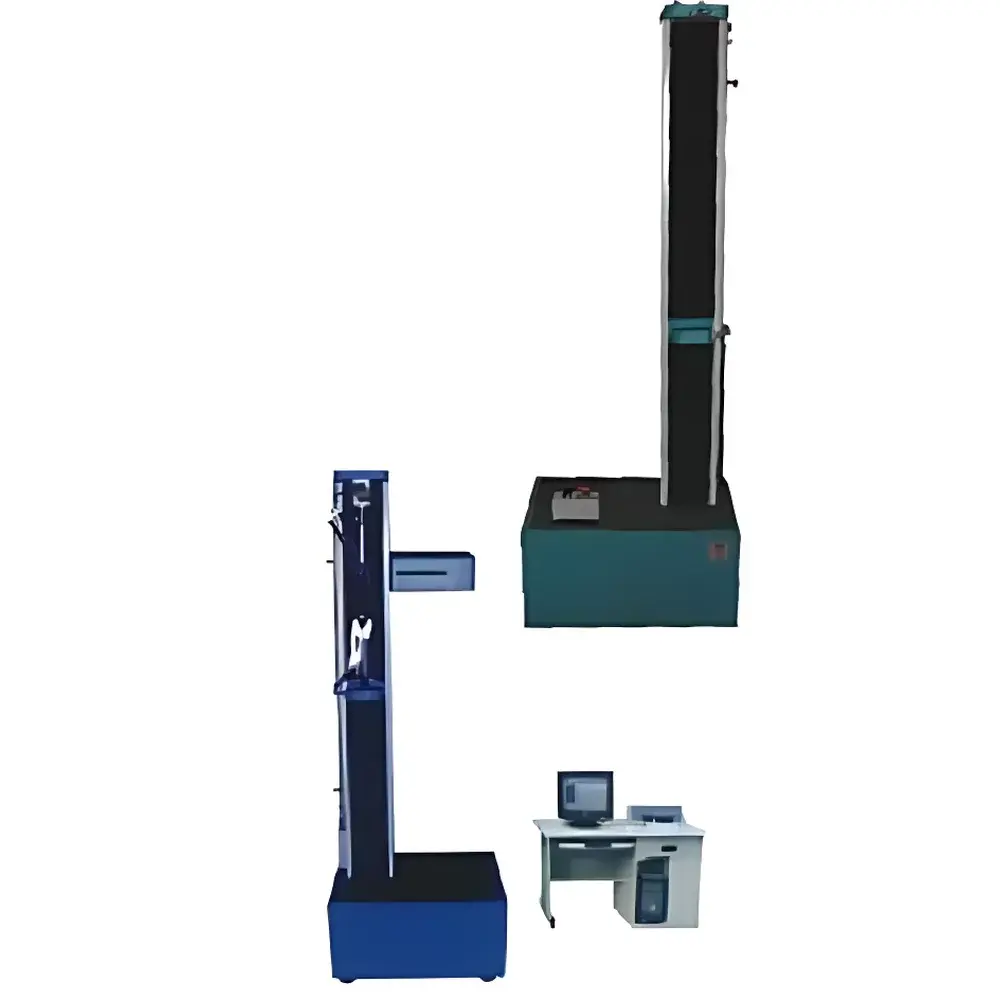
JByq JB-126A Universal Testing Machine
| Brand | JByq |
|---|---|
| Origin | Taiwan |
| Type | Electronic Universal Testing Machine |
| Model | JB-126A |
| Load Capacity | 0–200 kg (user-selectable) |
| Load Cell Accuracy | ±0.5% FS |
| Effective Test Width | 380 mm |
| Max. Stroke | 1000 mm |
| Test Speed Range | 0.001–500 mm/min (infinitely variable) |
| Displacement Accuracy | ±0.005% FS |
| Resolution | 1/200,000 |
| Control System | Japanese Servo Motor + High-Precision Taiwanese Ball Screw |
| Load Sensing | U.S.-made High-Accuracy Load Cell |
| Safety Features | Upper/Lower Mechanical Limits, Emergency Stop Switch |
| Display | Dual-mode (PC + Embedded Microcomputer) |
| Power Supply | 220 V, 50 Hz |
| Net Weight | 160 kg |
| Dimensions (W×D×H) | 450 × 450 × 900 mm |
| Unit Options | g, kg, N, kN, lb, lbf |
Overview
The JByq JB-126A Universal Testing Machine is an electromechanically integrated materials testing system engineered for precision mechanical property evaluation of metallic, polymeric, elastomeric, textile, and composite specimens. It operates on the principle of controlled uniaxial force application—measuring tensile, compressive, flexural (three-point bending), shear, peel, and tear responses under programmable displacement or load control. Designed to ASTM E4, ISO 7500-1, and GB/T 228.1 compliance frameworks, the system delivers traceable, repeatable mechanical data essential for R&D validation, QC release testing, and process qualification in manufacturing environments.
Key Features
- High-fidelity load measurement via U.S.-sourced precision load cell with ±0.5% full-scale accuracy and 1/200,000 internal resolution—ensuring metrological integrity across low-force (e.g., thin foils, fine wires) and mid-range applications (up to 200 kg).
- Japanese servo motor coupled with Taiwanese high-precision ground ball screw drive enables smooth, backlash-free motion control over a wide speed range (0.001–500 mm/min), supporting both quasi-static and dynamic-rate-sensitive characterization.
- Dual-display architecture: embedded microcomputer interface for real-time parameter monitoring and PC-based software for advanced test sequencing, curve analysis, and report generation.
- Robust structural design with reinforced base frame and vertical column assembly—optimized for long-term dimensional stability and minimal deflection during high-load compression or bending tests.
- Comprehensive safety architecture including dual mechanical end-limit switches, emergency stop circuitry compliant with IEC 60204-1, and automatic load cutoff upon specimen failure detection.
- Modular fixture compatibility—standardized T-slot crosshead and base plate accommodate ASTM- and ISO-compliant grips (tensile, compression platens, bend supports, shear fixtures) with optional extensometer integration.
Sample Compatibility & Compliance
The JB-126A accommodates specimens ranging from thin metal strips (≥0.1 mm thickness) and wire specimens (Ø0.2–5 mm) to rigid plastic bars (up to 380 mm wide × 1000 mm stroke) and laminated composites. Its configurable test space supports standard geometries per ASTM D638 (tensile plastics), ASTM E8/E9 (metals), ISO 527, ISO 178 (flexure), and ISO 14130 (peel/adhesion). The system meets fundamental requirements for GLP/GMP-aligned laboratories: audit-trail-capable software logging (optional), user-access-level controls, and calibration certificate traceability to NIST or national metrology institutes. While not pre-certified for FDA 21 CFR Part 11, its data management architecture supports validation protocols required for regulated environments.
Software & Data Management
The proprietary Windows-based testing software provides ISO 17025-aligned functionality—including customizable test methods, multi-step loading profiles (ramp-hold-relax), real-time stress-strain plotting, automatic yield point detection (0.2% offset method), modulus calculation (secant/tangent), and fracture energy integration. Raw data exports to CSV, Excel, and XML formats; graphical overlays enable comparative analysis of batch-to-batch or material-grade variations. All test events—including operator ID, timestamp, calibration status, and environmental notes—are logged with immutable timestamps. Optional PDF report generation includes header metadata, statistical summaries (mean, SD, CV%), and pass/fail flags against user-defined specification limits.
Applications
- Metallic materials: tensile strength, yield strength, elongation at break, and Young’s modulus determination for stainless steel, aluminum alloys, and cold-rolled sheet metal per ASTM E8.
- Fasteners and connectors: pull-out strength of threaded inserts, crimp joint integrity, and terminal retention force evaluation per UL 486.
- Packaging & flexible substrates: peel adhesion (ASTM D903), seal strength (ASTM F88), and puncture resistance of laminated films.
- Automotive components: rubber bushing compression set, brake pad shear strength, and seat belt webbing tensile performance.
- Electrical materials: tensile behavior of copper-clad laminates, insulation jacket elongation, and conductor bond strength verification.
FAQ
What standards does the JB-126A support out-of-the-box?
It natively implements test sequences aligned with ASTM E4 (verification), ASTM E8 (metals), ASTM D638 (plastics), and ISO 7500-1 (calibration)—with method templates modifiable to meet internal SOPs or customer-specific requirements.
Can the system be integrated into an existing LIMS or MES environment?
Yes—via TCP/IP or RS-232 serial communication, the controller supports raw data streaming and command-driven test initiation. API documentation is available for custom middleware integration.
Is third-party calibration certification included?
Factory calibration is performed using certified reference loads; NIST-traceable calibration certificates are available as an optional add-on service with annual recalibration scheduling support.
What maintenance intervals are recommended?
Lubrication of the ball screw and inspection of grip jaw surfaces every 500 operational hours; annual verification of load cell linearity and displacement encoder accuracy is advised for GLP-conforming use.
Does the software support multi-user role-based access control?
Standard configuration includes three permission tiers (Operator, Supervisor, Administrator); audit logs record all configuration changes and test deletions with user attribution.



