
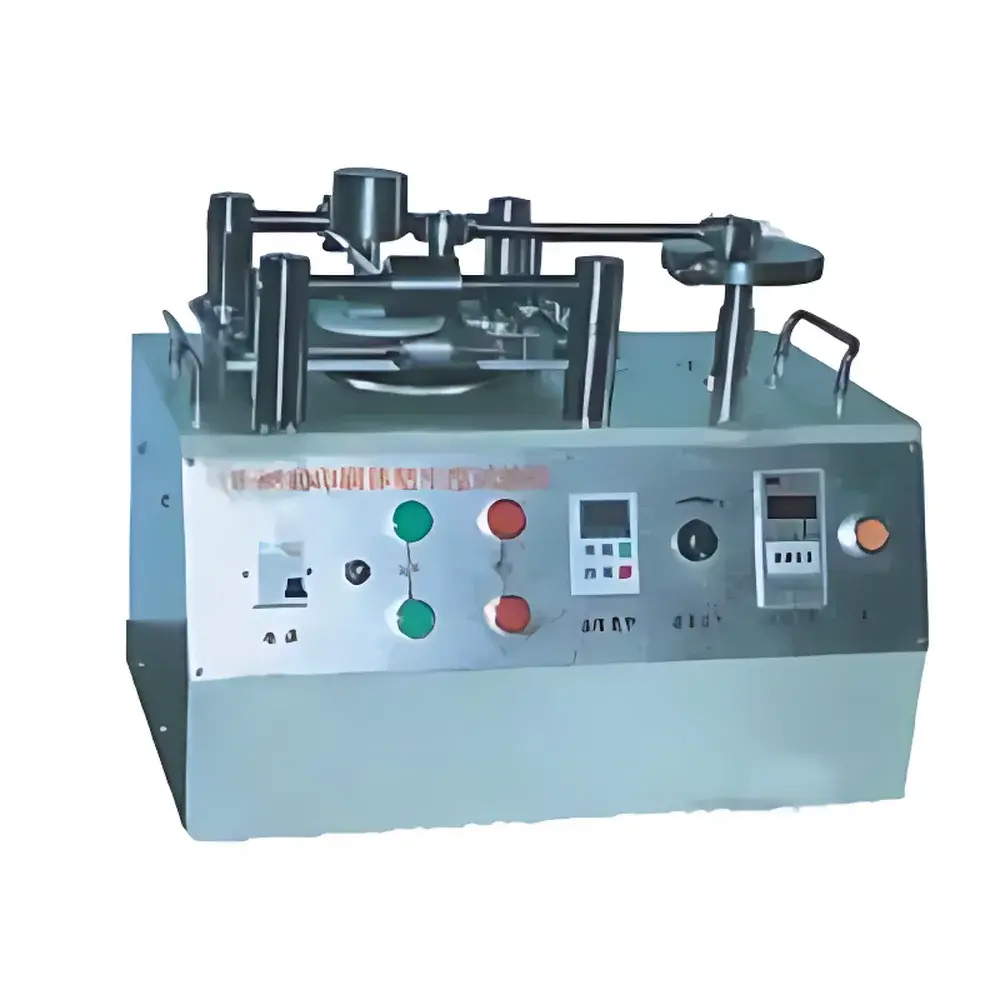
JB-362 Ink Adhesion Tester by JByq
| Brand | JByq |
|---|---|
| Origin | Taiwan |
| Model | JB-362 |
| Operating Speed | 10–40 cycles per minute (CPM), adjustable |
| Stroke Length | 40–100 mm, adjustable |
| Load Mass | 450 g ± 5 g (standard), customizable |
| Counting Function | Automatic cycle counter |
| Compliance | UL 1581 §1080, VDE 0472 Part 803 |
Overview
The JB-362 Ink Adhesion Tester is a precision-engineered mechanical abrasion device designed to quantitatively evaluate the rub resistance and surface adhesion integrity of printed markings on insulated wires, cables, and polymer-based substrates. It operates on the principle of controlled reciprocating linear motion under defined mechanical load, simulating real-world wear conditions such as handling, packaging, and installation-induced abrasion. The instrument secures a standardized 30-mm test specimen with printed surface oriented upward, then applies a calibrated friction hammer wrapped in white cotton cloth—per specified textile specifications—to execute repeated back-and-forth strokes at user-defined speed and stroke length. This method enables objective, repeatable assessment of ink cohesion, pigment binding, and substrate compatibility, supporting both pass/fail evaluation and comparative durability ranking across material batches or ink formulations.
Key Features
- Adjustable reciprocating frequency from 10 to 40 cycles per minute (CPM), enabling correlation with varying application severity levels—from low-stress labeling to high-abrasion industrial environments.
- Programmable stroke length ranging from 40 mm to 100 mm, accommodating diverse specimen geometries and standard-specific test requirements.
- Precision-machined friction hammer with nominal mass of 450 g ± 5 g; optional custom load configurations available for specialized compliance testing or R&D validation.
- Integrated digital counter with automatic cycle registration and manual reset function, ensuring traceable, auditable test records without operator intervention.
- Robust aluminum alloy frame and linear guide rail system ensure long-term dimensional stability and minimal mechanical drift over extended operational duty cycles.
- Quick-clamp specimen holder compatible with flat and cylindrical samples up to 8 mm diameter, facilitating rapid setup and minimizing alignment variability between tests.
Sample Compatibility & Compliance
The JB-362 is validated for use with insulated electrical wires (e.g., PVC, PE, TPE, XLPE), thermoplastic and thermoset cable jackets, molded plastic housings, and other non-porous polymeric surfaces bearing solvent-based, UV-curable, or thermal-transfer printed markings. Its mechanical configuration aligns with the physical test protocols defined in UL 1581 §1080 (Standard for Reference Data for Electrical Wires and Cables) and VDE 0472 Part 803 (Test Methods for Insulated Cables), specifically addressing “abrasion resistance of printed markings.” While not a fully automated environmental chamber system, it supports GLP-aligned documentation when paired with laboratory-controlled ambient temperature (23 ± 2 °C) and relative humidity (50 ± 5 % RH) conditions per ISO 291. Test reports generated using this instrument may serve as objective evidence during third-party certification audits, internal quality gate reviews, or supplier qualification processes.
Software & Data Management
The JB-362 operates as a stand-alone electromechanical tester with no embedded firmware or proprietary software interface. All operational parameters are set manually via front-panel dials and switches; cycle counts are displayed on a large LED counter. For laboratories requiring electronic data capture and audit trail functionality, the device is compatible with external USB-connected counters or programmable logic controllers (PLCs) that support TTL-level pulse input from the built-in cycle sensor output. When integrated into a validated LIMS or ELN environment, raw count data—alongside metadata such as operator ID, sample lot number, ambient conditions, and test date—can be logged in accordance with FDA 21 CFR Part 11 requirements, provided appropriate access controls and electronic signature mechanisms are implemented at the system level.
Applications
- Quality control screening of printed identification marks on automotive wiring harnesses prior to final assembly.
- Routine verification of ink adhesion performance following thermal aging or chemical exposure per ASTM D543.
- Comparative evaluation of alternative ink chemistries during formulation development for medical device tubing or aerospace-grade cables.
- Supplier qualification testing for contract manufacturers producing UL-listed wire products destined for North American or European markets.
- Root cause analysis of field failures involving illegible or smudged markings on power distribution cables exposed to abrasive conduit interiors.
FAQ
Does the JB-362 comply with ISO 12947 or ASTM D3884?
No—the JB-362 implements a fixed-load linear reciprocation method aligned with UL/VDE wire standards, not the rotary taber abrasion geometry required by ISO 12947 or the oscillating stylus approach of ASTM D3884.
Can the friction cloth be replaced with alternative materials?
Yes—while white cotton cloth (woven, 100% cotton, 120–140 g/m²) is specified in UL 1581, users may substitute other fabrics for internal R&D; however, deviation invalidates UL/VDE conformance claims unless re-validated per clause 1080.3.
Is calibration certificate included with shipment?
The unit ships with factory verification of stroke length and cycle timing accuracy; formal ISO/IEC 17025 calibration is available upon request and must be performed annually or after any mechanical maintenance affecting load or motion fidelity.
What is the maximum specimen thickness accommodated?
The clamping mechanism accepts specimens up to 3.5 mm in total height—including insulation and print layer—with full contact maintained across the 30-mm test zone.
Can the device operate continuously for >1,000 cycles without overheating?
Yes—tested continuous operation at 40 CPM for 30 minutes (1,200 cycles) shows no measurable motor temperature rise beyond 12 K above ambient, confirming thermal design adequacy for production-line deployment.



