
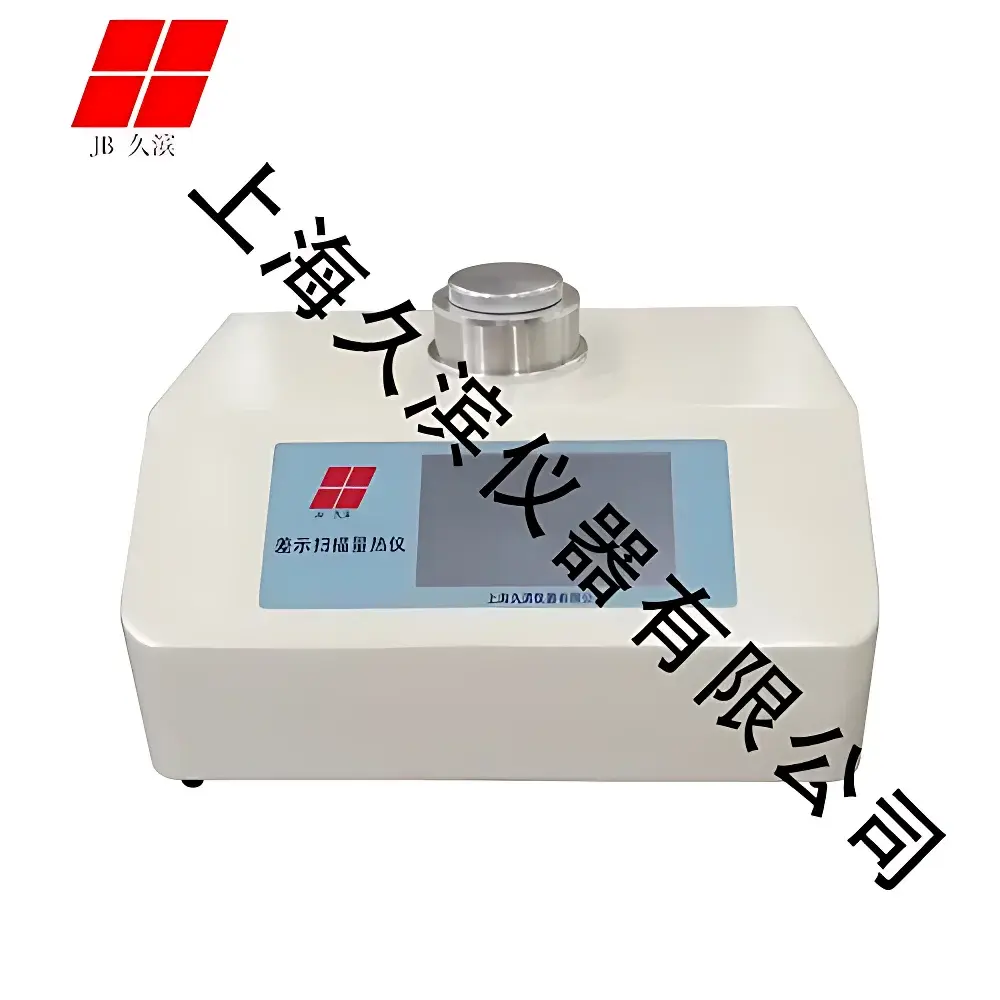
Jiubin JB-DSC-500B Differential Scanning Calorimeter (DSC) for Glass Transition Temperature (Tg) Analysis of Polymers and LED Encapsulants
| Brand | Jiubin |
|---|---|
| Model | JB-DSC-500B |
| Origin | Shanghai, China |
| Temperature Range | Ambient to 500 °C |
| Temperature Accuracy | ±0.1 °C |
| Heating/Cooling Rate | 0.1–50 °C/min (heating), 0.1–10 °C/min (cooling) |
| DSC Sensitivity | 0.1 µW |
| DSC Range | ±500 mW |
| Temperature Resolution | 0.01 °C |
| DSC Accuracy | ±1% |
| Atmosphere Control | Dual-gas (N₂/O₂) mass flow control with automatic switching |
| Interface | USB 2.0 |
| Display | 7-inch 24-bit LED touch screen |
Overview
The Jiubin JB-DSC-500B is a high-stability, microprocessor-controlled differential scanning calorimeter engineered for precise quantification of thermal transitions in thermally sensitive materials—including polymer encapsulants used in LED packaging, pharmaceuticals, food lipids, and advanced composites. Operating on the fundamental principle of heat-flux DSC, the instrument measures the differential heat flow between a sample and an inert reference as both are subjected to a controlled, linear temperature program under regulated atmosphere. This enables accurate determination of glass transition temperature (Tg), melting onset (Tm), crystallization peak (Tc), enthalpy changes (ΔH), and oxidative induction time (OIT)—critical parameters for material formulation, shelf-life prediction, and process validation in R&D and QC laboratories. The system complies with core methodology standards referenced in ASTM E794, ISO 11357-1, and USP , supporting thermodynamic characterization aligned with GLP-compliant workflows.
Key Features
- Robust furnace architecture with all-mechanical mounting—eliminating adhesive-based thermal interfaces that compromise baseline stability and introduce signal drift.
- Dual platinum resistance temperature detectors (RTDs) for independent sample and reference temperature monitoring, ensuring long-term repeatability of ±0.1 °C across repeated Tg measurements.
- Integrated digital mass flow controllers (MFCs) for seamless, programmable switching between inert (N₂) and oxidative (O₂) atmospheres; stabilization time < 3 s post-switch, with flow resolution of 1 mL/min.
- 7-inch high-resolution LED touchscreen interface (24-bit color) providing real-time visualization of sample temperature, setpoint, DSC signal, gas flow rates, and system status—no external PC required for basic operation.
- USB 2.0 communication protocol with auto-reconnect capability and deterministic latency—ensuring uninterrupted data acquisition during extended thermal cycles (e.g., multi-step isothermal holds or modulated DSC).
- Programmable temperature control modes: linear ramp, isothermal hold, cooling, and multi-segment cycling—all definable via intuitive software interface or direct touchscreen entry.
- Factory-calibrated with certified reference materials (In, Sn, Zn, Al, Ag, α-Al₂O₃); one-click temperature and sensitivity calibration routine accessible within the embedded firmware.
Sample Compatibility & Compliance
The JB-DSC-500B accommodates standard hermetic and vented aluminum crucibles (included), alumina crucibles for high-temperature or corrosive samples, and optional sealed pans for volatile or moisture-sensitive LED encapsulant resins. Sample mass range: 1–20 mg, optimized for signal-to-noise ratio in low-enthalpy transitions such as Tg in epoxy-silicone hybrid matrices. The instrument supports compliance documentation per ISO/IEC 17025:2017 for method validation, and its firmware architecture permits audit-trail generation (user log, calibration history, method versioning) suitable for FDA 21 CFR Part 11–aligned environments when paired with validated software configurations. All thermal data files are saved in vendor-neutral ASCII format (.txt) with metadata headers, enabling traceability and third-party analysis.
Software & Data Management
The bundled Windows-compatible software (v5.x) supports Windows 10/8.1/7 (64-bit), with adaptive UI scaling for desktops, laptops, and tablet displays. It provides full script-based automation: users compose custom measurement sequences using >30 atomic commands (e.g., “Set Ramp Rate”, “Hold at Temp”, “Switch Gas”, “Export Baseline”)—saved as reusable .dscprg files. Raw DSC curves are processed using baseline subtraction (tangent or spline), peak integration (onset, peak, endset), and derivative (DTA) overlays. Export options include CSV, Excel (.xlsx), and image (PNG/SVG). Data integrity safeguards include cyclic redundancy check (CRC) on all saved runs and timestamped operator ID tagging.
Applications
- Quantification of Tg depression in LED phosphor-encapsulating silicones due to plasticizer migration or moisture uptake.
- Crystallinity assessment of polyamide substrates used in COB (chip-on-board) packaging under thermal aging protocols.
- Oxidative stability evaluation of UV-curable acrylate adhesives via OIT testing at 200 °C under 50 mL/min O₂ flow.
- Polymorph screening of small-molecule phosphors (e.g., β-SiAlON:Eu) through melt-recrystallization enthalpy mapping.
- Quality control of batch-to-batch consistency in thermosetting epoxy molding compounds (EMCs) used in high-power LED modules.
FAQ
What is the minimum detectable heat flow change for Tg analysis?
The instrument achieves a DSC resolution of 0.1 µW, sufficient to resolve subtle step-changes in heat capacity associated with Tg in thin-film encapsulants (e.g., <5 µm silicone layers).
Can the system operate under vacuum or reducing atmospheres?
No—the gas handling system is configured for N₂ and O₂ only; vacuum or H₂/Ar compatibility requires optional furnace retrofitting and third-party gas panel integration.
Is the software validated for GMP-regulated environments?
The base software is not pre-validated; however, it supports IQ/OQ documentation templates and configurable electronic signatures—enabling lab-specific qualification per Annex 11 and ALCOA+ principles.
How often must temperature calibration be performed?
Annual calibration against certified standards is recommended; the built-in one-click routine allows in-house verification using supplied In (156.6 °C) and Zn (419.5 °C) references before critical qualification runs.
Does the system support modulation for reversing/non-reversing heat flow separation?
No—this is a conventional heat-flux DSC platform; modulated DSC (MDSC®) functionality is not implemented in hardware or firmware.



