
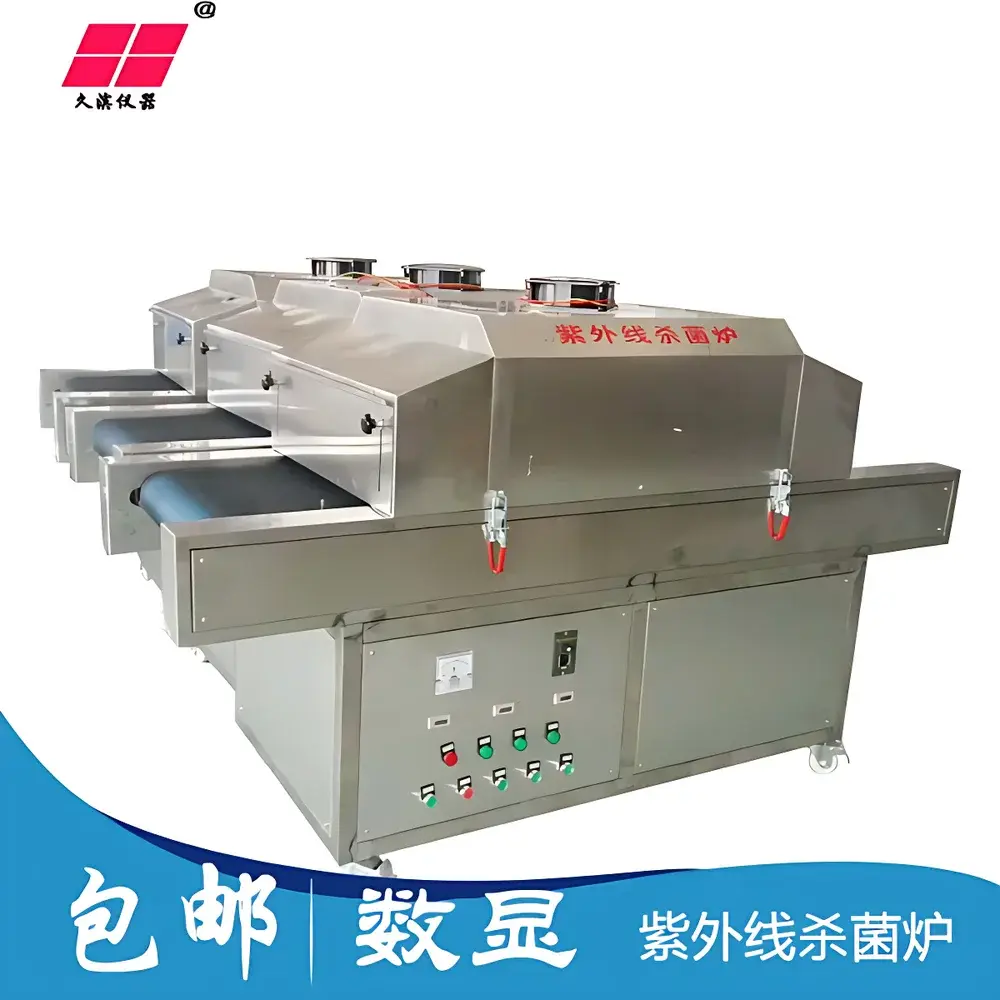
Jiubin JB-UV UV Germicidal Tunnel
| Brand | Jiubin |
|---|---|
| Model | JB-UV |
| Origin | Shanghai, China |
| Type | UV Germicidal Conveyor Tunnel |
| UV Lamp Configuration | 16 × 20 W low-pressure mercury lamps (254 nm peak) |
| Effective UV Irradiation Zone | 1000 mm |
| Conveyor Length | 2000 mm |
| Inlet/Outlet Height | 200 mm (adjustable) |
| Inlet/Outlet Width | 500 mm |
| Conveyor Height from Floor | 750 ± 50 mm |
| Lamp Tube Length | 600 mm |
| Safety Protections | Overvoltage/overcurrent protection, fault alarm indicator, motor overload protection |
Overview
The Jiubin JB-UV UV Germicidal Tunnel is an industrial-scale, conveyor-based ultraviolet disinfection system engineered for continuous surface decontamination of packaging materials, food-grade containers, utensils, and non-porous process equipment components. It operates on the principle of germicidal irradiation using short-wavelength ultraviolet-C (UVC) light at 254 nm — the peak absorption wavelength of microbial DNA/RNA — inducing thymine dimer formation and irreversible inactivation of bacteria (e.g., Escherichia coli, Salmonella spp.), yeasts, molds, and viruses. Unlike thermal or chemical sterilization methods, UVC treatment introduces no residual heat, moisture, or chemical residues, preserving product integrity, sensory attributes, and functional ingredients — particularly critical in sensitive applications such as dairy preforms, tea packaging films, beverage caps, and bakery tray liners. The JB-UV tunnel is designed for integration into cleanroom-adjacent production lines under ISO 14644-1 Class 7–8 environments and complies with core hygiene engineering principles outlined in ISO 22000:2018 and FDA Food Code §3-302.11.
Key Features
- 16 high-output, low-pressure mercury UV-C lamps (20 W each), arranged symmetrically across top, bottom, left, and right walls to ensure uniform 360° irradiation coverage within the 1000 mm active zone
- Adjustable inlet/outlet height (200 mm) accommodates varied container profiles while maintaining laminar airflow containment
- Stainless steel 304 construction (food-grade finish) with IP65-rated electrical enclosures for washdown compatibility
- Integrated safety interlocks: automatic lamp shutoff upon door opening, real-time UV intensity monitoring via calibrated photodiode sensors, and fail-safe circuitry for overvoltage, overcurrent, and motor overload conditions
- Modular conveyor system with variable speed control (0.1–1.2 m/min) enabling precise dwell time adjustment to meet log-reduction targets per ISO 15714:2019
- CE-compliant electromagnetic compatibility (EMC) and RoHS-certified lamp ballasts
Sample Compatibility & Compliance
The JB-UV tunnel is validated for use with rigid and semi-rigid non-porous substrates including PET, PP, HDPE, aluminum foil, glass bottles, stainless steel trays, and laminated cartons. It is not intended for sterilizing liquids, powders, or irregularly shaped porous items where shadowing or penetration depth limits efficacy. Device operation adheres to IEC 62471:2006 (Photobiological Safety of Lamps) and incorporates engineering controls aligned with OSHA 29 CFR 1910.97 (non-ionizing radiation hazards). All UV exposure parameters are traceable to NIST-traceable radiometric calibration standards. For regulated environments, the system supports GLP-compliant operation through optional data logging modules compliant with FDA 21 CFR Part 11 requirements (audit trail, electronic signatures, data integrity safeguards).
Software & Data Management
While the base JB-UV model operates via analog control panel with digital display (lamp runtime, conveyor speed, fault codes), optional upgrade packages include a PLC-based HMI interface with Ethernet/IP connectivity. This enables remote parameter configuration, real-time UV dose calculation (mJ/cm²) based on measured irradiance and belt speed, and automated generation of batch-specific disinfection reports — including timestamped start/stop events, cumulative lamp hours, and deviation alerts. Export formats include CSV and PDF, supporting integration into enterprise quality management systems (QMS) such as MasterControl or TrackWise. All stored data retain full ALCOA+ attributes (Attributable, Legible, Contemporaneous, Original, Accurate, Complete, Consistent, Enduring, Available).
Applications
- Prior to filling: Sterilization of empty PET bottles, glass jars, aluminum cans, and plastic caps in beverage and dairy production lines
- Post-forming: Decontamination of thermoformed trays, clamshells, and blister packs used in ready-to-eat meals and confectionery packaging
- Equipment sanitation: Surface treatment of stainless steel hoppers, feed screws, and conveyor guides during changeover in snack food and bakery facilities
- Ingredient handling: Disinfection of reusable totes, bins, and scoops in tea processing and nut roasting operations
- Regulatory alignment: Supports HACCP prerequisite programs, SQF Code Edition 9.2 Section 11.3 (Environmental Monitoring), and BRCGS Packaging Materials Issue 6 Clause 4.7.2 (Microbiological Control)
FAQ
What is the recommended UV dose for achieving a 3-log reduction of E. coli on smooth surfaces?
A minimum fluence of 6–10 mJ/cm² is typically required under controlled laboratory conditions; actual validation must be performed per ISO 15714 using site-specific geometry, reflectivity, and air velocity.
Can the JB-UV tunnel be validated for pharmaceutical primary packaging?
Yes — when operated within defined parameters and coupled with IQ/OQ/PQ protocols, it meets Annex 1 (2022) requirements for non-sterile component decontamination, provided bioburden monitoring and environmental controls are maintained.
How often must UV lamps be replaced?
Lamp output decays over time; replacement is recommended every 8,000–9,000 operational hours or when radiometric measurements fall below 70% of initial intensity, per IEC 60335-2-65.
Is ozone generation a concern with this system?
No — the JB-UV uses standard low-pressure mercury lamps with fused silica envelopes that block <185 nm emission, eliminating significant ozone production per UL 867 certification.
Does the system require external exhaust or HVAC integration?
Not inherently — the unit is self-contained and designed for ambient air recirculation; however, local ventilation may be advised in confined spaces per ASHRAE Standard 110 to maintain operator exposure below ACGIH TLV® of 0.2 µW/cm² (8-hour TWA).



