
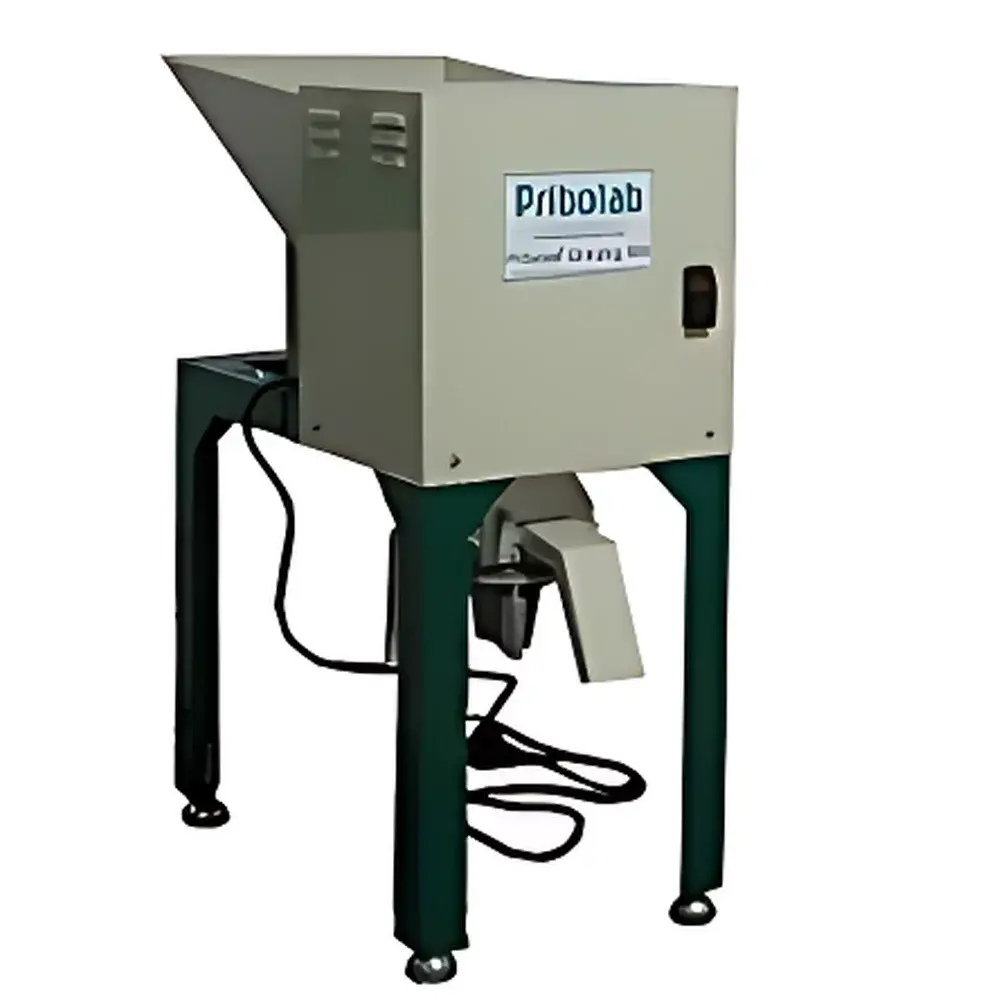
Pribolab II-300 Stainless Steel Laboratory Grinder
| Brand | Pribolab |
|---|---|
| Model | II-300 |
| Origin | Beijing, China |
| Equipment Type | Benchtop Grinding Mill |
| Sample Applicability | Hard and Brittle Materials |
| Feed Size | <20 mm |
| Output Particle Size | 0.01–0.5 mm (equivalent to 40 mesh) |
| Batch Capacity | 0.1–7.0 kg |
| Construction | 304 Stainless Steel Housing and Grinding Chamber |
| Drive System | High-Torque AC Motor with Variable Speed Control |
| Safety Compliance | CE-marked, IP54 Enclosure Rating |
Overview
The Pribolab II-300 Stainless Steel Laboratory Grinder is a robust, benchtop grinding system engineered for reproducible size reduction of hard, dry, and brittle solid samples in analytical and quality control laboratories. It operates on the principle of high-speed impact milling—utilizing rotating stainless steel hammers or blades within a sealed, corrosion-resistant grinding chamber to fracture material through mechanical shear and collision forces. Designed specifically for pre-analytical sample homogenization prior to mycotoxin analysis (e.g., aflatoxins, deoxynivalenol, zearalenone, ochratoxin A), the II-300 ensures uniform particle distribution critical for representative subsampling and quantitative extraction efficiency. Its all-stainless-steel construction (AISI 304) meets stringent hygiene requirements for food, feed, pharmaceutical, and environmental testing workflows, minimizing cross-contamination and facilitating rapid cleaning between batches.
Key Features
- High-efficiency impact grinding mechanism delivering consistent particle size distribution across batch loads of 0.1–7.0 kg
- Adjustable speed control (typically 1,500–3,000 rpm range) enabling optimization for varying sample hardness and desired fineness
- Stainless steel grinding chamber and rotor assembly resistant to abrasion and chemical exposure during routine solvent-based extractions
- Integrated safety interlock system preventing operation when the lid is not fully secured
- Low-noise enclosure compliant with ISO 4871 noise emission standards for laboratory environments
- Tool-free disassembly design for rapid access to internal components, supporting GLP-aligned maintenance logs and cleaning validation
Sample Compatibility & Compliance
The II-300 accommodates a broad spectrum of hard-to-grind matrices including cereal grains (corn, wheat, barley), oilseeds (peanuts, soybeans), medicinal herbs, soil aggregates, mineral ores, and dried biological tissues. It is routinely deployed in accredited laboratories performing AOAC Official Method 2005.08 (aflatoxin analysis in corn), ISO 15741:2016 (mycotoxin sampling and preparation), and EU Commission Regulation (EC) No 401/2006 Annex I (sampling protocols for contaminants). The grinder’s output particle size (0.01–0.5 mm, ≤40 mesh) satisfies the homogeneity criteria specified in USP for solid dosage form sampling and ASTM D7429–19 for particulate matter characterization in agricultural commodities. All wetted parts comply with FDA 21 CFR 178.3570 (indirect food additives – adjuvants and production aids).
Software & Data Management
While the II-300 is a manually operated mechanical instrument without embedded firmware or digital interface, its operational parameters—including batch ID, feed size, target mesh, grinding duration, and operator initials—are designed to be recorded in laboratory information management systems (LIMS) or electronic lab notebooks (ELN) per GLP and ISO/IEC 17025:2017 documentation requirements. Optional barcode-labeled sample trays and standardized SOP templates (available upon request) support traceability and audit readiness. For regulated environments requiring electronic records, integration with LIMS via CSV log import or custom API linkage can be implemented at the facility level.
Applications
- Preparation of homogenized grain and feed samples prior to immunoaffinity column cleanup and HPLC-MS/MS quantification of multi-mycotoxin panels
- Reduction of herbal raw materials for pesticide residue screening under SANTE/11813/2017 guidelines
- Size reduction of soil cores for heavy metal leaching studies (EPA Method 1311)
- Generation of reference powders for method validation and proficiency testing schemes (e.g., FAPAS®, AOCS Proficiency Testing)
- Consistent sample conditioning for near-infrared (NIR) calibration model development in cereal quality assessment
FAQ
What is the maximum allowable moisture content for samples processed on the II-300?
Samples should contain ≤10% moisture by weight to prevent clogging and ensure optimal grinding efficiency. Higher moisture content requires pre-drying per AOAC 950.46 or ISO 6496.
Can the II-300 be validated for GMP-compliant manufacturing environments?
Yes—the unit supports IQ/OQ documentation packages, including torque verification, particle size distribution testing (via laser diffraction per ISO 13320), and material compatibility assessments against USP . Validation protocols are available upon request.
Is the grinding chamber compatible with organic solvents used in mycotoxin extraction?
All contact surfaces are constructed from AISI 304 stainless steel, demonstrating full resistance to acetonitrile, methanol, chloroform (short-term), and aqueous buffer systems commonly employed in QuEChERS and immunoaffinity workflows.
How frequently should the grinding elements be replaced?
Under standard usage (≤20 batches/week of cereal grains), hammer sets require replacement every 6–12 months. Wear inspection is recommended quarterly using calibrated micrometers per manufacturer’s maintenance schedule.
Does the II-300 meet electrical safety standards for export to the EU and North America?
Yes—the device carries CE marking (EN 61000-6-2/6-3, EN 60204-1) and complies with UL 61010-1 third-party certification requirements for laboratory equipment sold in the United States and Canada.



