
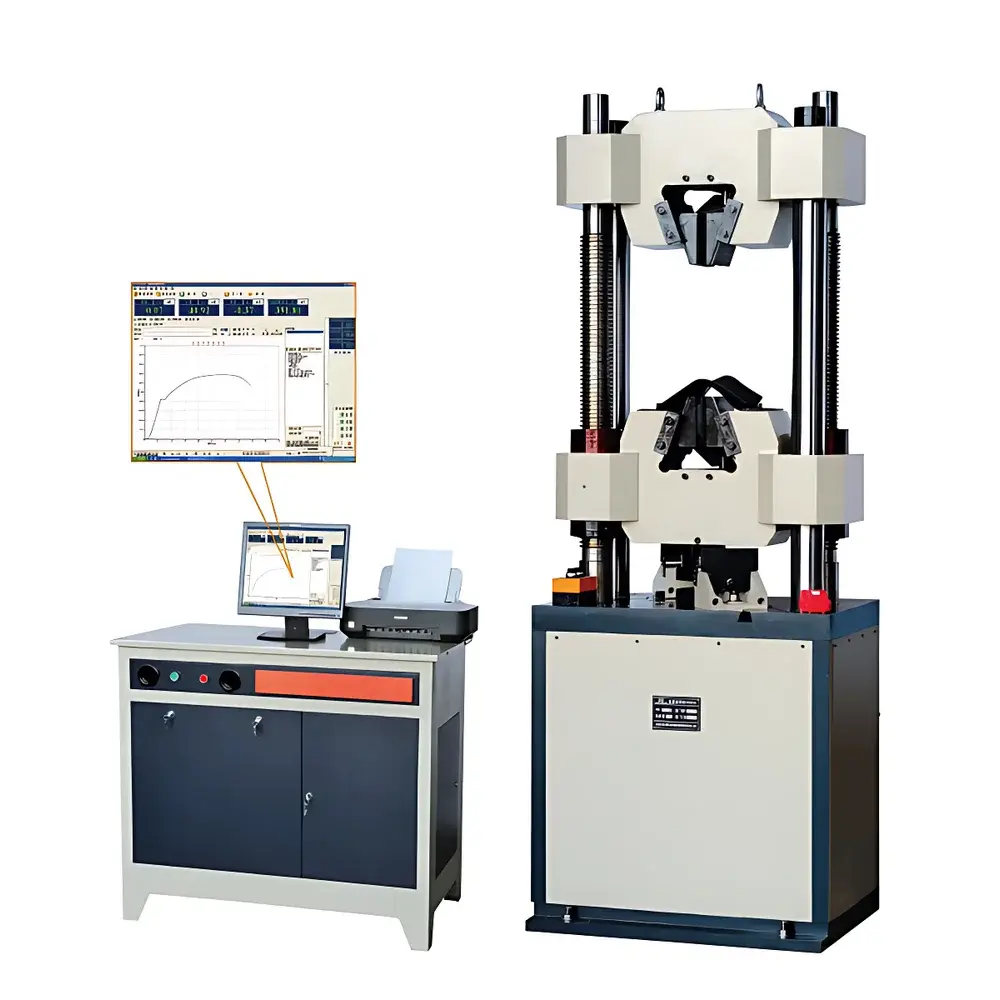
JB/WEW-100B Hydraulic Universal Testing Machine by Jiubin Instruments
| Brand | Jiubin Instruments |
|---|---|
| Origin | Shanghai, China |
| Model | JB/WEW-100B |
| Type | Hydraulic Universal Testing Machine |
| Max Test Force | 100 kN |
| Force Measurement Range | 5–100 kN |
| Force Accuracy | ≤ ±1% of reading |
| Force Resolution | 0.01 kN |
| Displacement Resolution | 0.01 mm |
| Deformation Measurement Accuracy | 0.01 mm |
| Tensile Space | 550 mm |
| Compression Space | 380 mm |
| Piston Stroke | 150 mm |
| Round Specimen Grip Range | Φ6–Φ26 mm |
| Flat Specimen Thickness Capacity | 0–15 mm |
| Flat Specimen Width | 70 mm |
| Compression Plate Diameter | φ160 mm |
| Bend Span (Two-Point) | 450 mm |
| Bend Support Roller Width | 120 mm |
| Bend Support Roller Diameter | Φ30 mm |
| Piston Speed | 50 mm/min |
| Gripping Method | Manual |
| Host Dimensions (W×D×H) | 720×580×1950 mm |
| Control Console Dimensions (W×D×H) | 1000×700×1400 mm |
Overview
The JB/WEW-100B Hydraulic Universal Testing Machine, engineered and manufactured by Jiubin Instruments in Shanghai, is a precision-engineered, oil-cylinder-underneath universal testing system designed for static mechanical property evaluation of metallic and non-metallic materials under controlled quasi-static loading conditions. Operating on the principle of hydraulic force generation and servo-controlled load application, the machine complies with core mechanical testing standards including ASTM E4, ASTM E8/E8M (tension), ASTM E9 (compression), ASTM E290 (bend), and ISO 6892-1, ISO 7500-1, and GB/T 228.1. Its dual-column rigid frame architecture ensures high axial alignment fidelity and minimal parasitic bending moments during high-force testing—critical for reproducible yield point determination and modulus calculation. The system delivers full traceability through integrated high-stability pressure transducers (Zhenhai, Ningbo), calibrated to national metrological standards, and supports both manual grip actuation and repeatable specimen positioning across tensile, compression, bend, and shear configurations.
Key Features
- 100 kN maximum test capacity with extended low-load sensitivity (5–100 kN range) enabling accurate characterization of both high-strength alloys and low-modulus polymers or composites
- High-resolution measurement subsystems: 0.01 kN force resolution, 0.01 mm displacement resolution, and 0.01 mm deformation accuracy via calibrated extensometer (YYU-25/50, Beijing Iron and Steel Research Institute)
- Dual-mode control architecture: analog hydraulic valve regulation for coarse load ramping and digital closed-loop feedback for fine load/strain control during plateau regions (e.g., yield, plastic flow)
- Modular fixture interface accommodating standardized grips—including round specimen jaws (Φ6–Φ26 mm), flat specimen clamps (0–15 mm thickness, 70 mm width), φ160 mm compression platens, and 450 mm span three-point bend fixtures
- Comprehensive real-time data acquisition: synchronized capture of load, displacement, extension, time, and derived parameters (stress, strain, modulus, Poisson’s ratio) at user-defined sampling rates
- Two-tier user permission management (Administrator / Tester) ensuring audit-ready access control per GLP/GMP operational frameworks
Sample Compatibility & Compliance
The JB/WEW-100B accommodates a broad spectrum of specimen geometries and material classes: metallic rods and sheets (steel, aluminum, titanium), engineering plastics (ABS, PC, PEEK), fiber-reinforced composites, ceramics, and elastomeric compounds. Its 550 mm tensile space and 380 mm compression height support standard ASTM and ISO specimen lengths (e.g., ASTM E8 gauge length up to 200 mm). All mechanical measurements adhere to ISO 7500-1 Class 1 verification requirements for force measurement systems. The machine’s structural rigidity and thermal stability meet ISO 5893 criteria for frame deflection under rated load. While not inherently 21 CFR Part 11 compliant out-of-the-box, its software architecture supports configurable electronic signatures, audit trails, and data immutability protocols when deployed in regulated environments under validated SOPs.
Software & Data Management
The embedded universal testing software provides an open, Excel-based reporting engine—allowing users to define custom templates, field mappings, and statistical summaries without code modification. It supports import/export of test methods, standard definitions (e.g., ISO 6892-1 Annex A), and procedural step sequences—enabling cross-laboratory method harmonization. Real-time visualization includes six synchronized plot types: Load vs. Displacement, Load vs. Extension, Stress vs. Strain, Stress vs. Displacement, Load vs. Time, and Extension vs. Time. Raw data is stored in ASCII-delimited format (.csv) with metadata headers (operator ID, timestamp, calibration ID, environmental conditions), facilitating third-party analysis in MATLAB, Python, or Minitab. Software self-diagnostic routines monitor sensor health, hydraulic pressure stability, and encoder signal integrity—logging fault codes aligned with IEC 61508 functional safety conventions.
Applications
This system serves as a primary mechanical characterization platform in quality control laboratories, R&D centers, and academic materials science departments. Typical use cases include: tensile property mapping of hot-rolled steel coils per GB/T 228.1; compressive strength validation of cementitious composites per ASTM C39; flexural modulus assessment of carbon-fiber laminates per ASTM D7264; shear strength evaluation of adhesive joints using ASTM D1002 fixtures; and cyclic preloading protocols prior to fatigue specimen preparation. Its robust construction and manual grip design make it especially suitable for high-volume routine testing in foundries, structural component suppliers, and civil engineering inspection agencies requiring long-term operational reliability under industrial workshop conditions.
FAQ
What standards does the JB/WEW-100B comply with for force calibration?
It conforms to ISO 7500-1 Class 1 and JJG 139–2014 (Chinese national verification regulation) for static force measurement systems.
Can the system perform strain-controlled tests?
Yes—when used with the supplied YYU-25/50 clip-on extensometer and enabled in closed-loop strain control mode within the software.
Is remote operation or network connectivity supported?
The base configuration uses USB-connected industrial PC; optional Ethernet-enabled PLC modules and OPC UA server integration are available upon request for factory-floor SCADA linkage.
What maintenance intervals are recommended for hydraulic components?
Hydraulic oil replacement every 2,000 operating hours or biannually; filter cartridge replacement every 1,000 hours; annual verification of pressure transducer linearity and zero drift.
Does the software support multi-language UI or localized regulatory templates?
The default interface is English; localized versions (Spanish, German, Arabic) and preconfigured templates for ASTM, ISO, and GB standards are provided as optional licensed modules.
Related Products



