
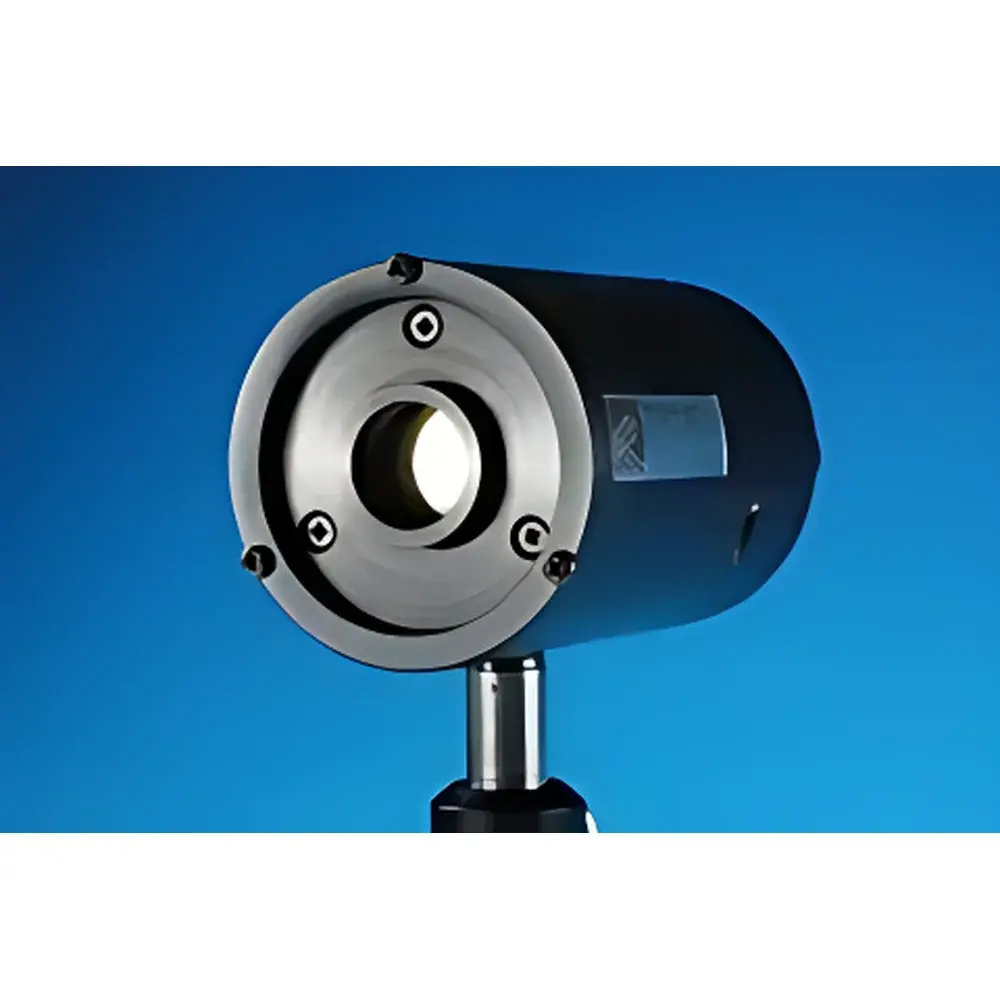
Tydex TAD-1 Thermophonic Microwave Pulse Detector
| Brand | Tydex |
|---|---|
| Origin | Russia |
| Model | TAD-1 |
| Frequency Range | 3–300 GHz |
| Pulse Width Measurement Range | 1–500 ns |
| Detection Principle | Thermophonic (RF-to-Acoustic Transduction) |
| Output Signal Type | Analog Voltage Proportional to Instantaneous RF Power |
| Compliance | Designed for Laboratory & High-Power RF Diagnostics Environments |
Overview
The Tydex TAD-1 Thermophonic Microwave Pulse Detector is a precision diagnostic instrument engineered for time-resolved measurement of high-power, short-duration electromagnetic pulses in the microwave and millimeter-wave bands. Unlike conventional diode-based or bolometric detectors, the TAD-1 operates on the thermophonic principle: incident RF energy is absorbed within a specially structured multilayer transducer, inducing rapid localized thermal expansion that launches coherent acoustic waves. These acoustic transients are converted into proportional electrical signals via integrated piezoelectric sensing—preserving the temporal fidelity of the original RF pulse waveform with sub-nanosecond rise time capability. This direct RF-to-acoustic transduction enables faithful reproduction of pulse shape, duration, and relative amplitude without distortion from saturation, nonlinear response, or frequency-dependent roll-off typical of semiconductor detectors. The TAD-1 is not a broadband power meter but a time-domain waveform capture tool—optimized for pulsed sources where temporal structure carries critical diagnostic information.
Key Features
- Wideband operation across 3–300 GHz, covering L-band through W-band, with flat spectral response enabled by impedance-matched absorber design
- Sub-1 ns intrinsic rise time, supporting accurate resolution of pulses as short as 1 ns—validated via calibrated step-response characterization
- No internal amplification or active electronics; fully passive architecture ensures immunity to electromagnetic interference (EMI) and eliminates self-generated noise floor elevation
- High peak-power tolerance (>10 kW peak, depending on pulse width and duty cycle), suitable for diagnostics of gyrotrons, magnetrons, and relativistic backward-wave oscillators
- Integrated coaxial RF input (SMA or K-type, configurable) and low-noise BNC output for direct oscilloscope coupling
- Thermally stable construction using low-expansion ceramics and gold-plated copper layers to minimize drift during repeated pulsing
Sample Compatibility & Compliance
The TAD-1 is compatible with all pulsed microwave sources emitting in the designated frequency band and delivering pulse energies ≥1 µJ (typical minimum detectable threshold). It has been routinely deployed in national laboratories for characterizing primary gyrotron oscillators, harmonic gyro-amplifiers, surface-wave oscillators, pulsed magnetrons, relativistic backward-wave oscillators (RBWOs), and klystron-based millimeter-wave sources. The detector conforms to standard laboratory safety practices for high-power RF environments and is designed for integration into shielded test benches compliant with IEC 61000-4-3 (radiated immunity) and IEEE Std 1528-2013 (RF exposure assessment). While not certified to ISO/IEC 17025 for calibration traceability, its transfer function can be empirically determined using reference calorimetric or electro-optic sampling methods per ASTM E2913-13 guidelines.
Software & Data Management
The TAD-1 requires no proprietary software or drivers. Its analog voltage output is directly compatible with any digital storage oscilloscope (DSO) supporting ≥1 GHz bandwidth and ≥5 GS/s sampling rate. For quantitative analysis, users commonly employ MATLAB, Python (with SciPy and NumPy), or LabVIEW to perform time-domain deconvolution, pulse energy integration (∫V(t)dt), and comparative waveform alignment. When used in GLP- or GMP-aligned facilities, data acquisition workflows may incorporate timestamped metadata logging, audit-trail-enabled oscilloscope firmware (e.g., Keysight Infiniium with 21 CFR Part 11 compliance option), and secure export to validated electronic lab notebooks (ELNs).
Applications
- Time-resolved characterization of gyrotron pulse envelopes in fusion plasma heating systems (e.g., ITER, W7-X auxiliary heating diagnostics)
- Verification of pulse compression and phase stability in high-power millimeter-wave radar transmitters
- Calibration cross-check for electro-optic sampling (EOS) setups operating beyond 110 GHz
- Diagnostics of breakdown thresholds and mode competition in overmoded cavity oscillators
- Validation of computational electromagnetic models (e.g., CST Studio Suite, HFSS) against measured transient waveforms
- Development testing of compact pulsed RF sources for directed-energy and communications applications
FAQ
Does the TAD-1 require external bias or power supply?
No. The TAD-1 is entirely passive and requires no electrical connection other than the signal output cable.
Can it measure continuous-wave (CW) microwave power?
No. The thermophonic mechanism relies on rapid thermal transients; CW excitation produces negligible acoustic output due to thermal equilibrium.
What is the maximum average power the TAD-1 can withstand?
Average power handling depends on pulse repetition frequency (PRF) and cooling conditions. Under forced-air convection at 10 Hz PRF and 100 ns pulse width, sustained operation up to 1 W average is typical.
Is calibration traceable to national standards?
The device is supplied with a factory characterization report including relative responsivity vs. frequency and pulse-width-dependent sensitivity curves. Traceable calibration requires user-performed comparison against a primary standard (e.g., calorimeter or EOS system) per ISO/IEC 17025 procedures.
How is the TAD-1 mounted in a waveguide or free-space setup?
For waveguide integration, custom flange adapters (WR-28 to WR-10, depending on frequency band) are available. Free-space use requires collimated beam alignment onto the active aperture (Ø3 mm) with antireflection-coated quartz window protection.





