
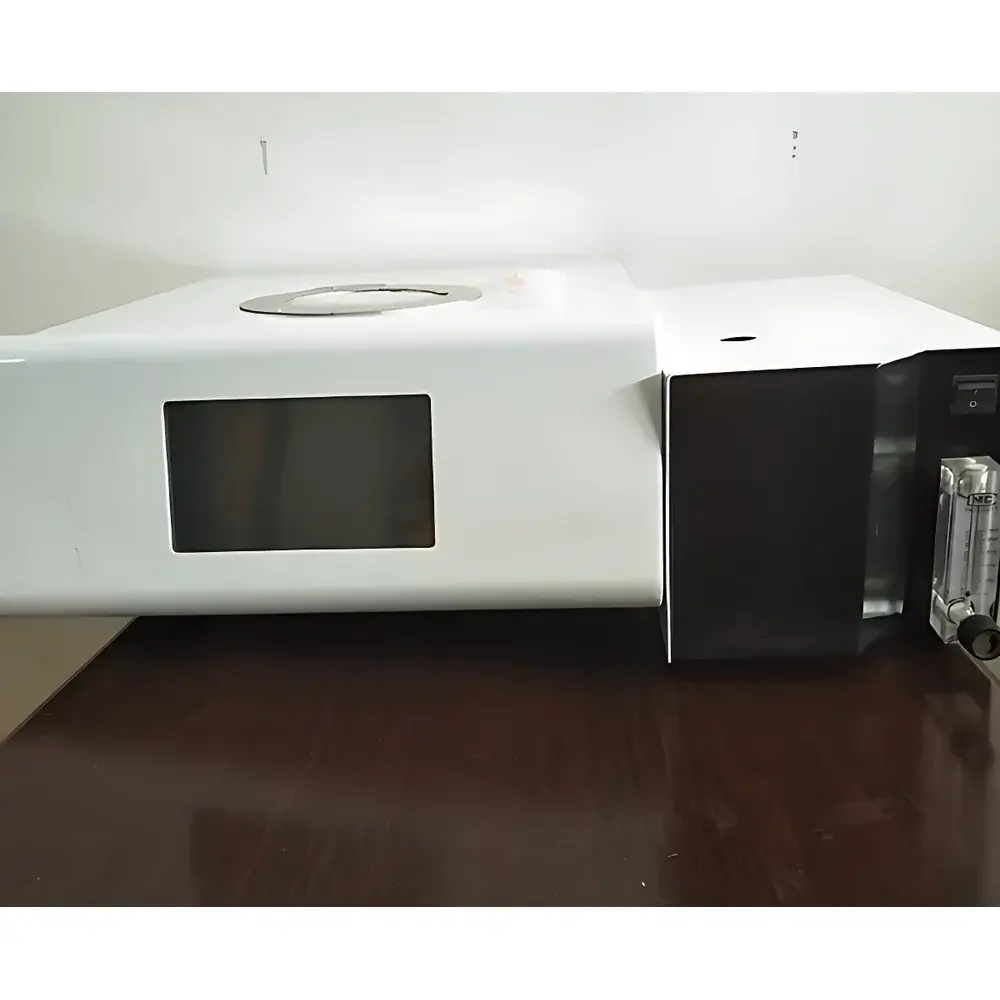
JB-TGA-101 Thermogravimetric Analyzer by Jiubin Instruments
| Brand | Jiubin Instruments |
|---|---|
| Origin | Shanghai, China |
| Model | JB-TGA-101 |
| Temperature Range | Ambient to 1150 °C (optional upgrade to 1450 °C) |
| Temperature Accuracy | ±0.1 K |
| Balance Sensitivity | 0.01 mg |
| Heating/Cooling Rate | 1–80 °C/min |
| Balance Capacity | 1 mg–2 g (expandable to 30 g) |
| Isothermal Hold Time | 0–300 min |
| Atmosphere Control | Dual-gas inlet with mass flow regulation (inert, oxidizing, reducing, static, dynamic) |
| Data Interface | USB |
| Compliance | ASTM E1131, ISO 11358, USP <41>, GLP-ready software audit trail |
Overview
The JB-TGA-101 Thermogravimetric Analyzer is a precision-engineered thermal analysis instrument designed for quantitative measurement of mass change as a function of temperature or time under controlled atmospheric conditions. It operates on the principle of high-stability microbalance detection coupled with programmable furnace control, enabling accurate determination of decomposition temperatures, thermal stability, moisture/volatile content, filler loading, oxidation onset, and reaction kinetics. The system employs a zero-balance feedback mechanism—where electromagnetic force compensation restores the balance beam to null position—ensuring long-term baseline stability and high reproducibility across repeated thermal cycles. Its dual-gas atmosphere management supports both static and dynamic purge modes, critical for distinguishing oxidative degradation from pyrolytic weight loss in polymers, pharmaceuticals, ceramics, and composites.
Key Features
- High-resolution microbalance with 0.01 mg sensitivity and 2 g standard capacity (extendable to 30 g for bulk sample analysis)
- Furnace capable of continuous operation from ambient to 1150 °C; optional high-temperature configuration certified to 1450 °C with ceramic insulation and reinforced thermocouple integration
- Precise temperature control with ±0.1 K accuracy and ≤±0.1 K short-term fluctuation over 30-minute isothermal holds
- Programmable heating/cooling rates from 1 to 80 °C/min, including multi-segment ramp-hold-cool profiles
- Integrated dual-channel mass flow controller with digital setpoint adjustment and real-time flow monitoring (0–200 mL/min per channel)
- Robust mechanical design featuring vibration-damped base, low-EMI furnace shielding, and sealed balance chamber to minimize environmental interference
- Comprehensive atmosphere flexibility: compatible with N₂, Ar, He, O₂, air, H₂/N₂ mixtures, and vacuum-compatible configurations (with optional vacuum pump interface)
Sample Compatibility & Compliance
The JB-TGA-101 accommodates solid powders, granules, thin films, fibers, and small-volume liquids using standard alumina, platinum, or quartz crucibles (100–200 µL volume). Sample mass range spans 1 mg to 2 g, optimized for signal-to-noise ratio in kinetic studies and compositional quantification. All hardware and firmware comply with fundamental requirements of ASTM E1131 (standard test method for thermogravimetric analysis), ISO 11358-1 (polymer characterization), and USP (balance performance verification). The embedded control software includes configurable audit trails, user access levels, electronic signatures, and data integrity safeguards aligned with FDA 21 CFR Part 11 expectations for regulated laboratories conducting GMP/GLP-compliant thermal stability assessments.
Software & Data Management
The proprietary TGAControl Suite provides intuitive workflow-driven operation—from method creation and real-time curve visualization to post-run kinetic modeling (e.g., Ozawa-Flynn-Wall, Kissinger, ASTM E1868). Raw TG, DTG, and temperature/time datasets are stored in vendor-neutral ASCII format with metadata embedding (operator ID, instrument serial, calibration timestamp, gas composition). USB 2.0 interface enables direct transfer to LIMS or ELN systems. Software updates are delivered quarterly via secure download portal, incorporating new compliance templates (e.g., ISO 17025 reporting modules), enhanced baseline correction algorithms, and expanded library matching for common polymer degradation signatures.
Applications
- Quantitative determination of plasticizer content and volatiles in PVC, TPU, and elastomers per ISO 3451-4
- Thermal stability screening of active pharmaceutical ingredients (APIs) and excipients under ICH Q1A(R2) guidelines
- Residue ash analysis in catalysts, battery cathode materials, and metallurgical precursors
- Decomposition kinetics modeling for flame-retardant formulations and carbon fiber prepregs
- Moisture and solvent content validation in lyophilized biologics and inhalation powders
- Filler loading assessment in rubber compounds and nanocomposites via char yield extrapolation
FAQ
What is the maximum recommended operating temperature for routine use?
The standard JB-TGA-101 is rated for continuous operation up to 1150 °C. For extended high-temperature applications (e.g., ceramic sintering studies), the 1450 °C upgrade requires specialized crucibles, recalibrated thermocouples, and modified furnace insulation—subject to factory certification.
Does the system support automatic calibration of the balance and temperature sensors?
Yes—built-in calibration routines include internal mass check (using traceable reference weights) and furnace temperature verification via NiCr-NiAl thermocouple drift monitoring against certified reference materials (e.g., Ni, Cu, Al melting points).
Can the software generate reports compliant with regulatory submissions?
All generated reports include full metadata, raw data export, operator authentication logs, and version-controlled method parameters—fully traceable for FDA, EMA, or PMDA audit readiness.
Is external cooling water required for rapid cooldown?
No—the system utilizes forced-air convection cooling and optimized thermal mass design to achieve 1000 °C → 100 °C in ≤15 minutes without auxiliary chillers or compressed air.
How is atmosphere switching managed during a single run?
The dual-gas manifold supports seamless, programmable transitions between inert and reactive atmospheres at user-defined temperatures—enabling sequential oxidative stabilization followed by reduction studies in one experiment.



