
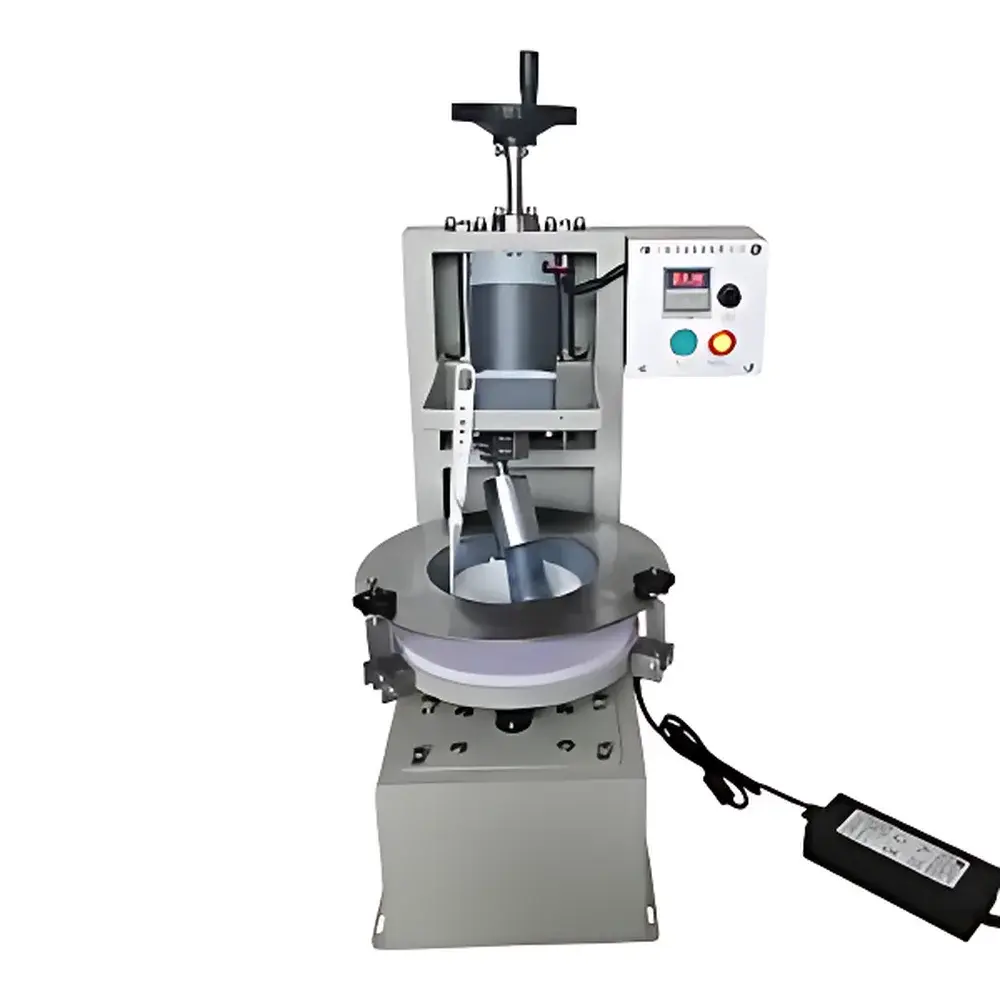
JB-200 Electric Agate Mortar Grinder by Jiubin Instruments
| Brand | Jiubin Instruments |
|---|---|
| Model | JB-200 |
| Type | Agate Mortar Grinder |
| Sample Compatibility | Hard, brittle solids (e.g., metal oxides, pigments, inorganic powders) |
| Output Particle Size | ≥0.5 mm (adjustable down to sub-micron range via extended processing) |
| Mortar Diameter | 120 mm |
| Max Batch Capacity | 100 g per cycle |
| Pestle Rotation Speed | 1–100 rpm (stepless adjustable) |
| Mortar Rotation Speed | 10 rpm |
| Pestle Motor Power | 25 W |
| Mortar Motor Power | 10 W |
| Grinding Time Range | 1–999 min (programmable) |
| Dimensions (L×W×H) | 310 × 240 × 580 mm |
| Net Weight | 18 kg |
| Input Voltage | AC 220 V, 50/60 Hz |
| Grinding Media | Natural agate (mortar and pestle) |
| Compliance | Designed for GLP-compliant laboratories |
Overview
The JB-200 Electric Agate Mortar Grinder is a precision laboratory grinding instrument engineered for controlled, reproducible size reduction of hard, brittle solid materials—particularly inorganic pigments, metal oxides, and ceramic precursors. Unlike high-energy ball mills or jet mills, this device employs a low-shear, quasi-static compression-grinding mechanism based on the geometric coupling of two polished agate hemispheres: a rotating mortar base and an eccentrically driven pestle. The pestle follows a conical trajectory while maintaining constant normal force against the mortar floor via an integrated compression spring system. This design ensures uniform stress distribution across all particles within the grinding zone, minimizing localized overheating and amorphization—critical for preserving crystallinity in pigment-grade TiO₂, Al₂O₃, or Fe₂O₃. The JB-200 is not intended for continuous industrial milling but serves as a dedicated benchtop tool for analytical sample homogenization, reference material preparation, and R&D-scale dispersion pre-treatment prior to rheological or spectrophotometric characterization.
Key Features
- High-purity natural agate grinding components (mortar and pestle), chemically inert and non-contaminating—essential for trace-level pigment analysis and pharmaceutical excipient development.
- Independent dual-motor drive system: low-speed mortar rotation (10 rpm) combined with variable-speed pestle rotation (1–100 rpm), enabling precise control over shear rate and residence time.
- Programmable grinding duration (1–999 minutes) with automatic shutdown and audible completion signal—supports unattended operation during overnight particle refinement cycles.
- Optimized kinematic geometry: pestle axis inclined at fixed angle relative to mortar centerline, generating progressive radial compression without slippage—maximizing mechanical energy transfer efficiency.
- Compact footprint (310 × 240 × 580 mm) and low power consumption (total ≤35 W), suitable for fume hood integration and shared instrumentation labs.
Sample Compatibility & Compliance
The JB-200 accepts dry or marginally damp solid samples with Mohs hardness ≤7, including titanium dioxide, zinc oxide, carbon black, ultramarine blue, iron oxide red, and synthetic mica-based pearlescent pigments. It is unsuitable for fibrous, elastic, or highly ductile materials (e.g., polymers, rubber, soft metals). All agate components are certified free of heavy-metal leachables (tested per USP and ISO 10993-12), making the system appropriate for QC labs operating under GMP Annex 11 and FDA 21 CFR Part 11 data integrity requirements. Grinding protocols may be documented with timestamped parameter logs for audit trails. The device conforms to IEC 61000-6-2 (immunity) and IEC 61000-6-4 (emission) electromagnetic compatibility standards.
Software & Data Management
The JB-200 operates via an embedded microcontroller interface with tactile membrane keypad and LCD status display. While it lacks Ethernet/Wi-Fi connectivity, all operational parameters—including start time, duration, pestle speed, and cycle count—are stored in non-volatile memory and can be exported manually via USB-C port (optional firmware upgrade). Each grinding session generates a local record file (.csv) containing timestamp, setpoints, and motor current profiles—supporting retrospective review during method validation or CAPA investigations. Integration with LIMS platforms is achievable through RS-232 serial output (available as add-on module), enabling automated metadata capture aligned with ISO/IEC 17025 clause 7.7 requirements.
Applications
- Preparation of standardized pigment suspensions for colorimetric calibration (ASTM D2244, ISO 11664-4).
- Homogenization of ceramic raw material batches prior to XRD phase quantification (ISO 21375).
- Particle size reduction of analytical reference standards for SEM-EDS mapping validation.
- Dispersion pretreatment of high-refractive-index fillers before dynamic light scattering (DLS) analysis.
- Controlled attrition of aged pigment agglomerates to assess dispersibility stability in aqueous and solvent-based ink formulations.
FAQ
Is the JB-200 suitable for wet grinding?
No—this instrument is designed exclusively for dry or low-moisture (<5% w/w) solid grinding. Introduction of solvents or binders may compromise agate integrity and void warranty.
Can I replace the agate mortar with stainless steel or zirconia?
No—mechanical and geometric specifications are calibrated specifically for agate’s density, hardness, and thermal expansion coefficient. Substitution invalidates performance claims and safety certifications.
What maintenance is required for long-term accuracy?
Monthly visual inspection of agate surfaces for microfractures; annual recalibration of timer and speed sensors by authorized service center using NIST-traceable tachometer and stopwatch.
Does the JB-200 meet CE marking requirements?
Yes—it carries CE marking per Machinery Directive 2006/42/EC and EMC Directive 2014/30/EU, verified by TÜV Rheinland (Certificate No. R 50421253 0001).
How does grinding time affect final particle size distribution?
Empirical correlation shows logarithmic decay in median particle size (D50) versus time up to ~300 min; further extension yields diminishing returns and increased risk of amorphous surface layer formation—validated via laser diffraction (ISO 13320) and BET surface area analysis.



