
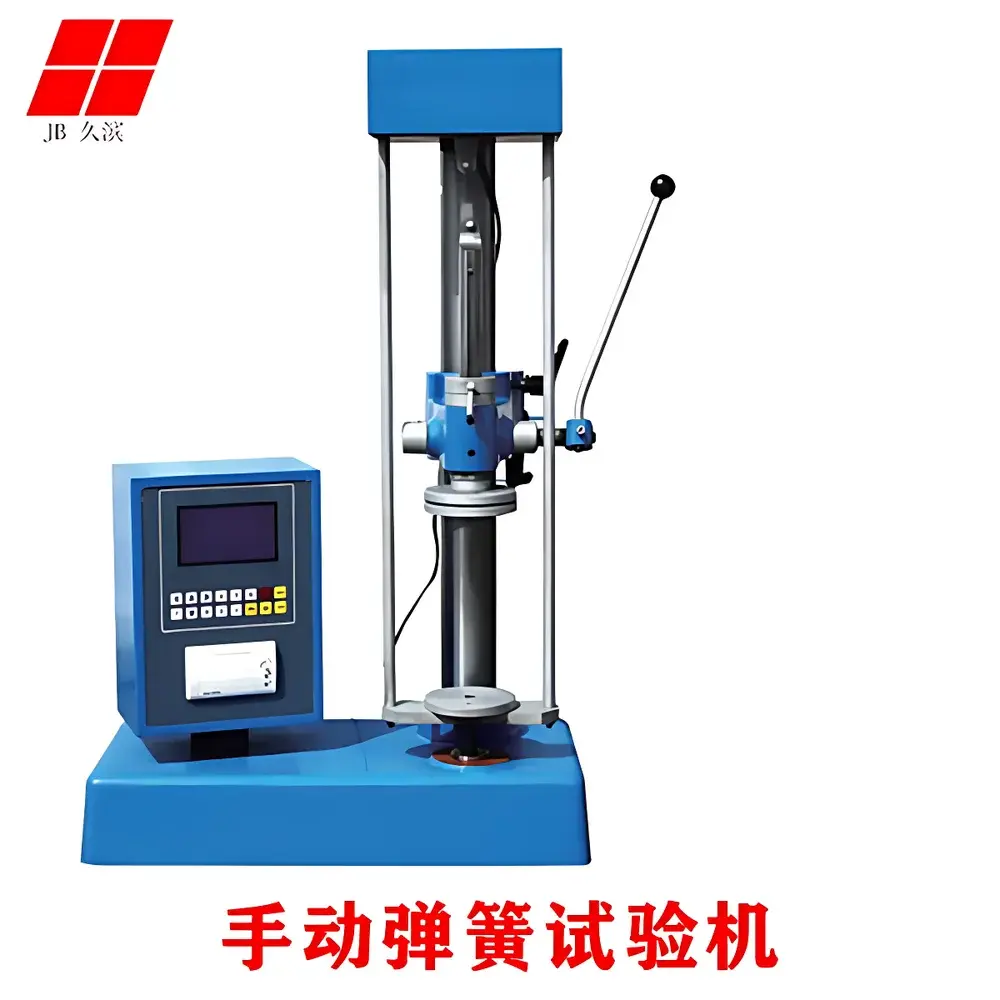
Jiubin JB-T Series Manual Spring Tension & Compression Testing Machine
| Brand | Jiubin |
|---|---|
| Origin | Shanghai, China |
| Model | JB-T Series |
| Test Force Range | 100–2000 N |
| Force Resolution | 0.02–0.1 N |
| Displacement Resolution | 0.01 mm |
| Max Travel | 80–110 mm |
| Platen Diameter | 60–110 mm |
| Open Height (Tension) | 240–270 mm |
| Closed Height (Compression) | 220–250 mm |
| Accuracy Class | Class 1 (per GB/T 2611 & JB/T 7796) |
| Drive Type | Manual Handwheel Actuation |
| Net Weight | 35–90 kg |
Overview
The Jiubin JB-T Series Manual Spring Tension & Compression Testing Machine is a mechanically actuated, force-displacement measurement system engineered for static mechanical characterization of metallic and composite springs under uniaxial loading conditions. It operates on the fundamental principle of Hooke’s Law-based quasi-static compression and tension testing, where applied load and corresponding axial deformation are measured simultaneously to determine spring stiffness (N/mm), yield behavior, set loss, and load-deflection linearity. Designed in strict compliance with national and international mechanical testing standards—including JB/T 7796-2005 (China), JIS B7738:1993 (Japan), and aligned with ISO 10243 and ASTM E4 practices—the JB-T series serves as a foundational instrument for quality control laboratories, spring manufacturing workshops, and R&D facilities requiring traceable, repeatable, and operator-controlled mechanical validation of elastic components.
Key Features
- Manual handwheel-driven loading mechanism ensures precise, stepwise force application without motor-induced vibration or thermal drift—ideal for low-speed, high-stability measurements.
- Class 1 accuracy per JB/T 7796-2005 and GB/T 2611, verified through periodic calibration using certified deadweight standards and traceable to national metrology institutes.
- Modular platen configuration supports interchangeable upper/lower platens (60 mm and 110 mm diameters) to accommodate diverse spring geometries including compression coils, tension hooks, disc springs, Belleville washers, wave springs, and multi-leaf laminated assemblies.
- Integrated digital force transducer and high-resolution linear encoder provide simultaneous acquisition of load (N) and displacement (mm) with resolution down to 0.01 mm and force resolution ranging from 0.02 N (for 100–500 N models) to 0.1 N (for 1000–2000 N models).
- Dedicated firmware implements standardized test routines per JB/T 7796, including preload conditioning, zero-point stabilization, progressive loading/unloading cycles, and automatic stiffness calculation (ΔF/Δx) over user-defined displacement intervals.
- On-device LCD display shows real-time load, displacement, test sequence ID, date/time stamp, and pass/fail status against preset tolerance bands—enabling immediate go/no-go decisions on production lines.
Sample Compatibility & Compliance
The JB-T Series accommodates a broad spectrum of spring types: helical compression/tension springs, conical (tapered) coils, spiral torsion springs, flat plate springs, constant-force springs, gas springs (static load verification only), and custom-formed elastomeric-metal hybrids. Its open-height range (240–270 mm) and compression clearance (220–250 mm) allow testing of tall tower springs and stacked disc assemblies without disassembly. All mechanical design, load frame rigidity, and sensor mounting conform to GB/T 2611 General Requirements for Testing Machines and satisfy structural integrity requirements for Class 1 static testing per ISO 7500-1. The system is compatible with GLP-compliant documentation workflows when paired with external printers or data export via RS-232 interface.
Software & Data Management
While the base JB-T model operates via embedded firmware without PC dependency, optional RS-232 serial output enables bidirectional communication with Windows-based data acquisition software (sold separately). This allows automated report generation in PDF or Excel format, inclusion of calibration certificates, operator ID, environmental temperature/humidity metadata, and audit-trail logs compliant with internal QA protocols. Exported datasets include raw time-stamped force-displacement pairs, calculated stiffness values at multiple segments, permanent set after compression, and hysteresis area quantification. Though not natively 21 CFR Part 11 compliant, the system supports integration into validated environments via third-party electronic lab notebook (ELN) platforms that manage electronic signatures and change control.
Applications
- Final inspection of automotive suspension coil springs and valve return springs prior to assembly.
- Verification of medical device spring actuators (e.g., in surgical staplers or drug delivery pens) for consistency in actuation force and travel.
- Process validation of heat-treated spring steel batches across tensile strength and relaxation behavior.
- Design validation of aerospace-grade Inconel or titanium alloy springs under ambient and elevated temperature preconditioning (when used with external environmental chambers).
- Supplier qualification testing per OEM technical specifications referencing ISO 10243 Annex A or SAE J2115.
- Educational laboratory use for mechanics of materials coursework involving elasticity, plastic deformation, and energy storage calculations.
FAQ
What standards does the JB-T Series comply with?
It conforms to JB/T 7796-2005 (China), JIS B7738:1993 (Japan), and aligns with ISO 10243 and ASTM E4 for static compression/tension testing methodology and accuracy classification.
Can it test torsion or non-axial springs?
No—the JB-T Series is strictly designed for axial (linear) tension and compression loading. Torsional stiffness requires dedicated torsion testers meeting ISO 6507 or ASTM E140 specifications.
Is calibration certification included?
Each unit ships with a factory calibration report traceable to CNAS-accredited standards; however, end-user periodic recalibration per JJG 1021 must be performed by an accredited metrology lab.
What maintenance is required for long-term accuracy?
Annual verification of load cell linearity, encoder alignment, and handwheel gear backlash is recommended; lubrication of lead screws and guideways every 6 months ensures consistent manual operation torque.
Does it support batch reporting for production line use?
Yes—via RS-232 output and optional software, users can assign batch IDs, generate summary statistics (mean, SD, Cp/Cpk), and export CSV files for SPC analysis in Minitab or JMP.



