
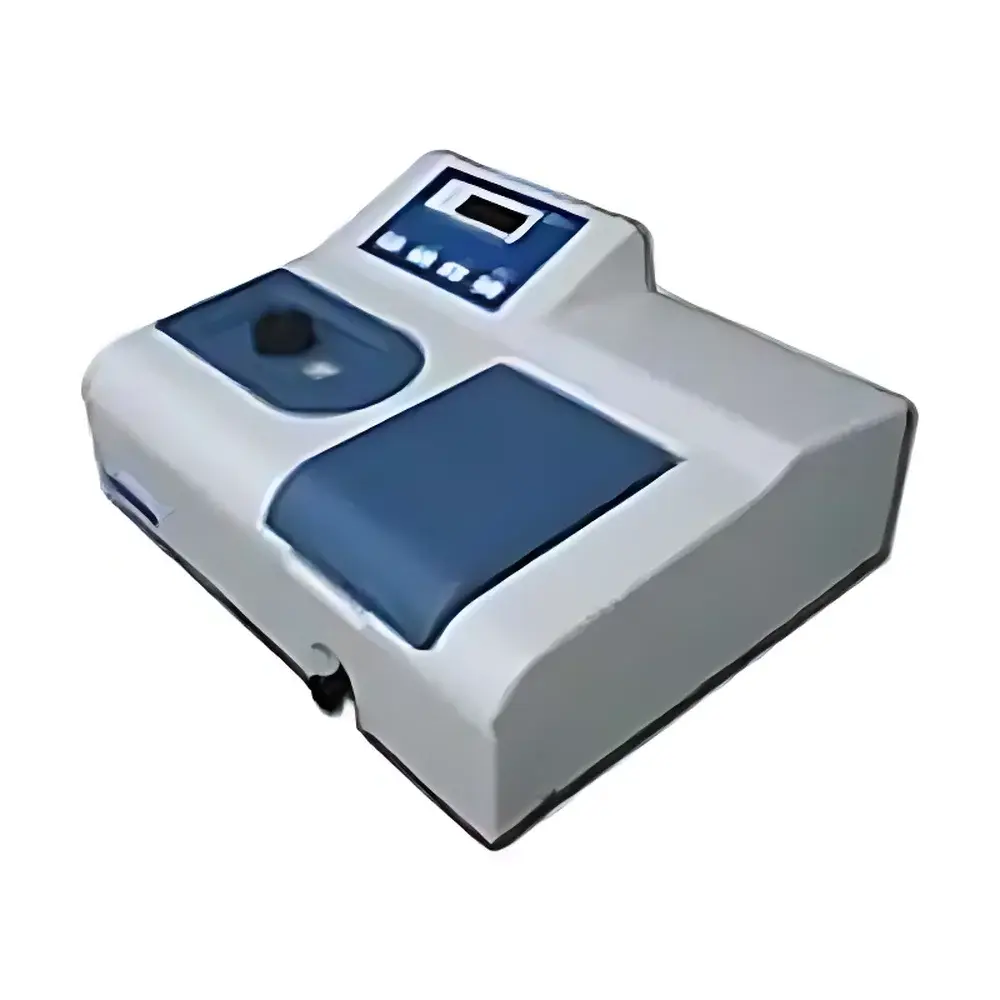
Chu Ding Technology UV752N Ultraviolet-Visible Spectrophotometer
| Brand | Chu Ding Technology |
|---|---|
| Origin | Shanghai, China |
| Manufacturer Type | Authorized Distributor |
| Product Origin | Domestic (China) |
| Model | UV752N |
| Price | USD 1,400 (FOB Shanghai) |
| Optical System | Czerny-Turner monochromator with 1200 lines/mm grating |
| Wavelength Range | 195–1020 nm |
| Spectral Bandwidth | 4 nm |
| Wavelength Accuracy | ±2 nm |
| Wavelength Repeatability | ≤1.0 nm |
| Photometric Range | 0–199.0% T, –0.3–1.999 A, 0–1999 C |
| Photometric Accuracy | ±0.5% T |
| Photometric Repeatability | ±0.3% T |
| Optical Path Length | 10 mm (standard cuvette) |
| Stray Light | ≤0.5% T at 220 nm |
| Baseline Stability | ±0.004 A/h at 500 nm (after 60-min warm-up) |
| Display | 4-digit LCD |
| Data Interface | RS-232C serial port |
| Light Sources | 6 V/10 W halogen tungsten lamp (Philips) and deuterium lamp (long-life imported) |
| Power Supply | 110–220 V AC, 50–60 Hz |
Overview
The Chu Ding Technology UV752N Ultraviolet-Visible Spectrophotometer is a fixed-wavelength, single-beam scanning instrument engineered for routine quantitative and qualitative analysis in regulated and academic laboratories. Based on the Czerny-Turner optical architecture with a 1200 lines/mm holographic grating, it delivers consistent spectral resolution across its full operational range of 195–1020 nm. The system employs dual light sources — a high-stability Philips 6 V/10 W tungsten-halogen lamp for the visible and near-IR region (340–1020 nm), and a long-life imported deuterium lamp for deep-UV coverage (195–340 nm) — enabling reliable absorbance, transmittance, and concentration measurements without manual lamp switching. Its 4 nm spectral bandwidth ensures adequate resolution for standard pharmaceutical assays, enzyme kinetics, nucleic acid quantification, and environmental contaminant screening, while maintaining robust signal-to-noise performance under ambient lab conditions.
Key Features
- Single-beam optical design with CT monochromator architecture for cost-effective, maintenance-efficient operation
- Pre-aligned, factory-calibrated deuterium and tungsten lamps with extended service life and stable output intensity
- High-contrast 4-digit LCD display supporting simultaneous readout in %T, A, and concentration (C) units
- RS-232C interface compliant with standard laboratory data acquisition protocols for integration into LIMS or custom scripting environments
- Thermally stabilized optical bench and low-drift electronics ensuring baseline stability of ±0.004 A/h after one hour of warm-up
- Stray light suppression ≤0.5% T at 220 nm — meeting minimum performance criteria for UV-based protein and DNA analysis per ISO 8577 and ASTM E275
Sample Compatibility & Compliance
The UV752N accommodates standard 10 mm pathlength quartz, glass, or plastic cuvettes (12.5 × 12.5 mm cross-section), supporting liquid-phase transmission measurements across aqueous, organic, and buffered matrices. It complies with fundamental optical safety requirements per IEC 61010-1 and electromagnetic compatibility standards EN 61326-1. While not designed for 21 CFR Part 11-compliant audit trails out-of-the-box, its RS-232C output enables traceable data capture when paired with validated third-party software solutions used in GLP/GMP environments. The instrument satisfies core performance benchmarks referenced in USP , EP 2.2.25, and ISO/IEC 17025 for spectrophotometric method verification in QC labs.
Software & Data Management
The UV752N supports optional PC-based control and reporting software (sold separately), providing wavelength scanning, kinetic measurement, multi-point calibration, and spectral overlay functions. Raw absorbance and transmittance data are transmitted via ASCII-formatted RS-232C packets at configurable baud rates (9600 default), facilitating direct import into Excel, MATLAB, or Python-based analytical pipelines. Software-generated reports include instrument ID, date/time stamps, operator ID fields, and user-defined metadata — essential for internal QA documentation and external audit readiness. No embedded database or electronic signature capability is included; all compliance-related controls must be implemented at the host system level.
Applications
This spectrophotometer is routinely deployed in pharmaceutical raw material identification (e.g., paracetamol, aspirin), clinical serum bilirubin and creatinine assays, environmental nitrate/nitrite determination (using diazotization), food additive quantification (e.g., tartrazine, sunset yellow), and polymer degradation studies via carbonyl index calculation. Its wavelength accuracy (±2 nm) and photometric repeatability (±0.3% T) meet acceptance criteria for Tier-2 analytical workflows in ISO 17025-accredited testing laboratories performing non-critical routine analysis. It is also widely adopted in undergraduate teaching labs for Beer-Lambert law validation, enzyme inhibition kinetics, and spectral fingerprinting exercises.
FAQ
Is the UV752N suitable for regulatory submissions under FDA or EMA guidelines?
No — it lacks built-in audit trail, electronic signature, and user access control features required for 21 CFR Part 11 or Annex 11 compliance. However, it may be used in non-GxP settings or as a secondary instrument where data integrity is ensured via procedural controls and validated external software.
What cuvette materials are supported for UV measurements below 220 nm?
Only fused silica (quartz) cuvettes with UV-grade transmission characteristics should be used below 240 nm. Standard optical glass or polystyrene cuvettes exhibit significant absorption and are unsuitable.
Does the instrument include wavelength calibration verification tools?
Yes — a certified holmium oxide filter (optional accessory) is recommended for periodic wavelength accuracy verification per ISO 6326-1 and NIST SRM 2034 protocols.
Can the UV752N perform kinetic or time-resolved measurements?
Yes — when operated with the optional PC software, it supports time-scan mode with adjustable interval (1–60 s) and up to 500 data points per run.
What is the typical warm-up time before achieving photometric stability?
Minimum 60 minutes is required to reach thermal equilibrium; baseline drift specification (±0.004 A/h) is guaranteed only after this period at 500 nm.
Related Products






