
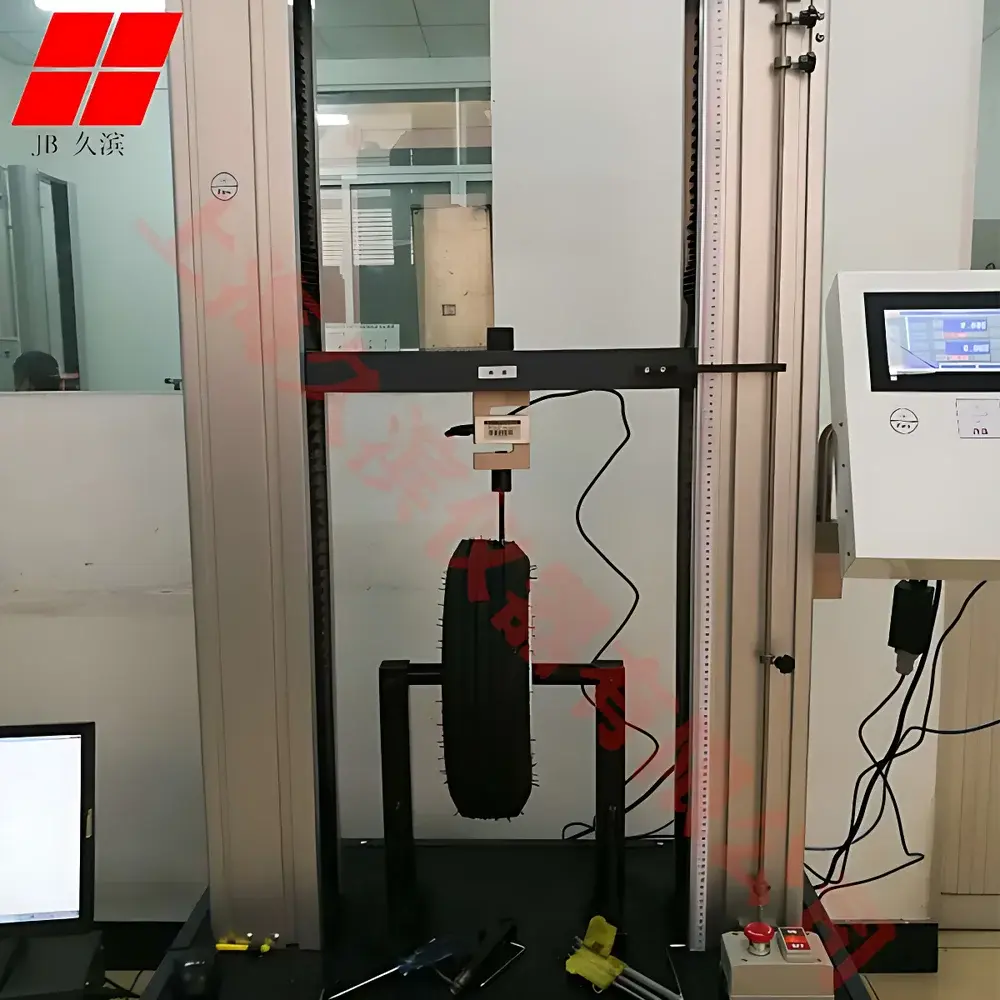
Jiubin JB-117A-L Tire Puncture Strength Tester
| Brand | Jiubin |
|---|---|
| Origin | Shanghai, China |
| Model | JB-117A-L |
| Instrument Type | Electromechanical Universal Testing Machine |
| Application Scope | Puncture energy measurement (plunger impact test) per national tire standards |
| Software | Proprietary Windows-based control & analysis platform with full source code access for customer-driven customization (no licensing or modification fees) |
| Compliance Context | Designed to support GB/T 4502–2016 (Tire Endurance and High-Speed Performance Test Methods), ISO 4892 (rubber aging), ASTM D3787 (tensile properties of rubber), and general GLP-aligned data integrity requirements |
Overview
The Jiubin JB-117A-L Tire Puncture Strength Tester is an electromechanical universal testing system engineered for high-reproducibility mechanical characterization of pneumatic tires and elastomeric components under controlled quasi-static penetration loading. It operates on the principle of force-displacement transduction using a precision load cell (rated capacity ≥ 50 kN, typical configuration) and a servo-controlled crosshead actuator, enabling accurate measurement of puncture energy—the integral of force over displacement during plunger penetration into the tread surface. This metric is critical for evaluating resistance to road hazard intrusion (e.g., nails, glass shards) and correlates directly with tire durability, carcass integrity, and safety-critical performance under real-world service conditions. The system complies with standardized test protocols defined in GB/T 4502–2016, which specifies plunger diameter selection (e.g., 6 mm, 10 mm, or 20 mm depending on tire section width), penetration speed (typically 50 ± 5 mm/min), and axial alignment tolerances (< 0.5° deviation). While optimized for tire puncture evaluation, its modular frame architecture supports interchangeable fixtures for ASTM D412 (tensile), D638 (plastics), D790 (flexural), D624 (tear), and ISO 37 (rubber tensile) test configurations.
Key Features
- High-rigidity dual-column steel frame with preloaded ball-screw drive system ensuring minimal deflection (< 0.02 mm under full load) and repeatable crosshead positioning accuracy (±0.01 mm).
- Integrated 50 kN (standard) or optional 100 kN load cell with 1/500,000 internal resolution and < ±0.5% FS linearity error per ISO 7500-1.
- Programmable crosshead speed range: 0.001–500 mm/min, adjustable in 0.001 mm/min increments, with closed-loop velocity control stability ≤ ±0.2% of setpoint.
- Dedicated puncture fixture kit including calibrated cylindrical plungers (6 mm, 10 mm, 20 mm diameters), alignment guides, and tire mounting clamps conforming to GB/T 4502 dimensional tolerances.
- Real-time force-displacement curve acquisition at up to 2 kHz sampling rate, with automatic peak detection, energy integration (mJ), and post-test slope analysis for onset-of-failure identification.
Sample Compatibility & Compliance
The JB-117A-L accommodates passenger car, light-truck, and motorcycle tires (up to 32-inch outer diameter) via adjustable cradle mounts and radial constraint fixtures that prevent lateral slippage during penetration. Non-tire applications include vulcanized rubber compounds, polymer composites, conveyor belting, and reinforced elastomeric seals. All test methods align with internationally recognized frameworks: data audit trails satisfy GLP documentation requirements; software architecture supports 21 CFR Part 11–compliant user access controls (role-based permissions, electronic signatures) when configured with optional validation packages; calibration certificates traceable to CNAS-accredited laboratories (ISO/IEC 17025) are provided with each shipment.
Software & Data Management
The proprietary JiubinTest v4.x software suite runs natively on Windows 10/11 (64-bit) and provides full IEC 62304–aligned lifecycle management. Source code is delivered to end users under perpetual license—enabling in-house modification of test sequences, report templates (PDF/Excel/XML), pass/fail logic, and statistical summaries (mean, SD, CV%, confidence intervals). Raw data files (.jtd) store metadata (operator ID, timestamp, environmental temp/humidity, calibration expiry), raw sensor streams, and processed parameters (puncture force, displacement at rupture, absorbed energy, residual deformation). Export modules support ASTM E1434-compliant data interchange and direct integration with LIMS platforms via ODBC or REST API endpoints.
Applications
- Tire development labs validating tread compound formulations against puncture resistance targets.
- Quality assurance departments performing incoming inspection of OEM-specified tire batches per PPAP requirements.
- Research institutions studying failure mechanics of multi-layer cord-rubber architectures under localized stress concentration.
- Materials suppliers qualifying alternative elastomers (e.g., guayule rubber, bio-silica composites) for regulatory submission dossiers.
- Third-party certification bodies conducting accredited testing per CCC (China Compulsory Certification) Annex 7 criteria.
FAQ
Does the JB-117A-L meet international tire testing standards beyond GB/T 4502?
Yes—it supports method adaptation for ISO 10191 (pneumatic tire endurance), JIS D 4208 (Japanese tire standards), and SAE J1269 (tread wear correlation), subject to fixture and software configuration.
Can the system perform dynamic impact puncture tests?
No. The JB-117A-L is designed exclusively for quasi-static penetration per national standard methodologies; high-speed impact testing requires drop-weight or instrumented Charpy systems.
Is source code delivery conditional upon purchase volume or service agreement?
No. Full C#/.NET source code access is included unconditionally with every unit, with no royalty, maintenance, or upgrade fees for customer-led modifications.
What calibration documentation is supplied?
Each unit ships with a factory calibration certificate (traceable to NIM, China), a CNAS-accredited verification report for load cell and displacement encoder, and step-by-step user calibration procedures compliant with ISO 9513.
How is thermal drift compensated during extended testing sessions?
The load cell incorporates temperature-compensated strain gauge bridges and real-time ambient temperature feedback; software applies ISO 7500-1–recommended thermal zero-shift correction algorithms during data reduction.



