
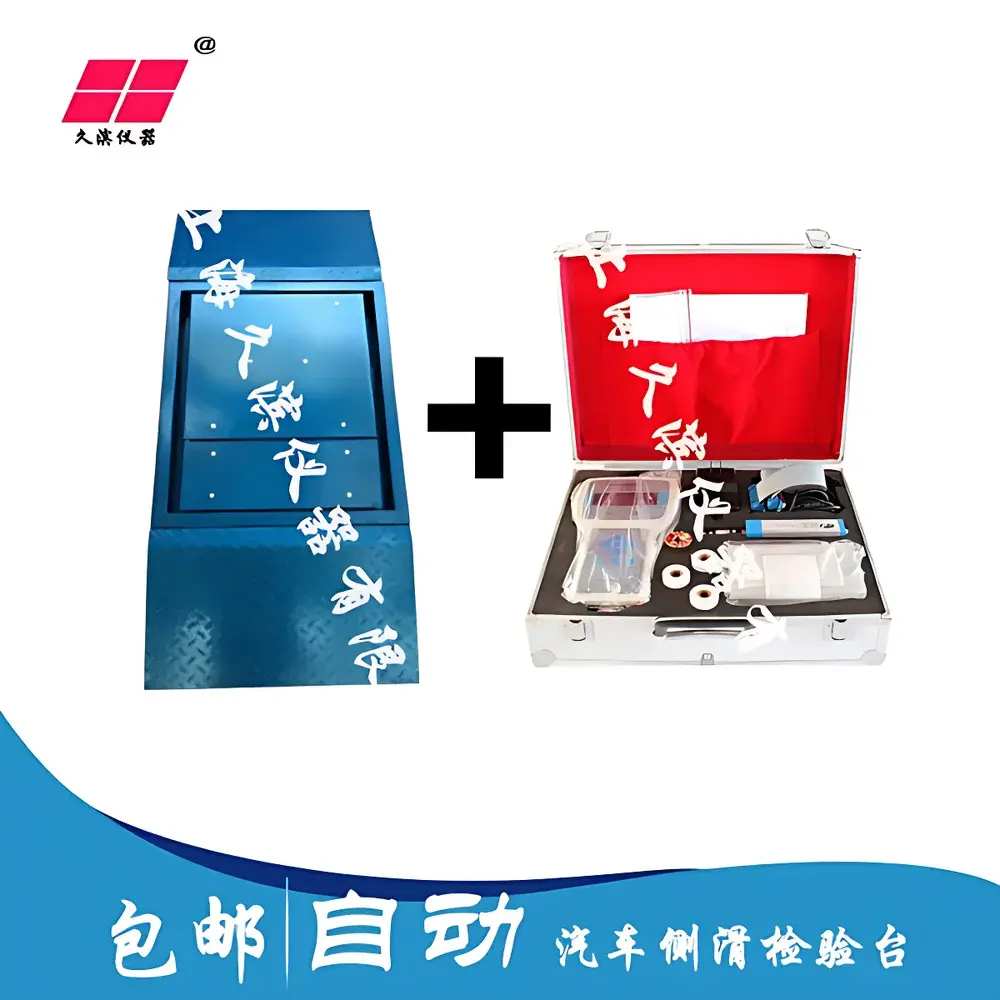
JB Instruments JB-10 Single-Plate Dynamic Wheel Alignment and Side-Slip Test Bench for Automotive Front Axle Evaluation
| Key | Brand: JB Instruments |
|---|---|
| Origin | Shanghai, China |
| Manufacturer Type | Authorized Distributor |
| Country of Origin | China |
| Model | JB-10 |
| Price | Upon Request |
| Rated Axle Load Capacity | 3 t / 10 t / 13 t (selectable configuration) |
| Measurement Range | ±10 m/km |
| Indication Error | ≤ ±0.2 m/km |
| Zero Offset Error | ±0.2 m/km |
| Sliding Plate Dimensions (L×W) | 500 mm × 700 mm |
| Bench External Dimensions (L×W×H) | 800 mm × 900 mm × 100 mm |
| Approach Ramp Dimensions | 800 mm × 500 mm |
| Compliance Standard | JT/T 507–2004 “Automotive Side-Slip Test Benches” |
Overview
The JB Instruments JB-10 Single-Plate Dynamic Wheel Alignment and Side-Slip Test Bench is an engineered metrological system designed for the quantitative assessment of front axle geometry alignment under low-speed, unloaded rolling conditions. It operates on the principle of Coulomb friction-based lateral force transduction: as a vehicle’s front wheels traverse the freely sliding plate at ≤5 km/h, the resultant net lateral force—arising from the vector summation of camber angle-induced slip and toe-in/toe-out-induced scrub—induces measurable horizontal displacement of the calibrated sliding plate. This displacement, normalized to the plate’s longitudinal length (500 mm), yields the side-slip value expressed in millimeters per kilometer (m/km)—a dimensionless ratio directly traceable to ISO 8855 and SAE J670E definitions of wheel alignment interaction effects. The JB-10 is not a static caster/camber gauge; rather, it functions as a dynamic compliance verifier for regulatory and maintenance-level safety inspections, delivering repeatable, operator-independent output for fleet certification, MOT-equivalent audits, and workshop-level diagnostic validation.
Key Features
- Single-plate architecture with precision-ground linear bearing guides ensures minimal hysteresis and <0.05 mm mechanical backlash over 10⁶ operational cycles.
- High-stability strain-gauge-based displacement transducer, temperature-compensated (−10 °C to +50 °C), delivers analog output with <0.1 mV/V sensitivity and integrated low-pass filtering (cutoff: 10 Hz) to suppress road-induced vibration noise.
- Modular load rating options (3 t, 10 t, or 13 t nominal axle capacity) accommodate passenger vehicles, light commercial vans, and medium-duty chassis-cab platforms without structural retrofitting.
- DC12V isolated control interface eliminates ground-loop interference and complies with IEC 61000-6-2 immunity requirements for industrial electromagnetic environments.
- Integrated mechanical lockout pin system secures the sliding plate during non-testing periods, preventing unintended drift and preserving zero-point calibration integrity.
- Low-profile bench design (100 mm height) minimizes ramp transition discontinuity, reducing dynamic loading artifacts during wheel entry/exit—critical for maintaining measurement fidelity per JT/T 507–2004 clause 5.3.2.
Sample Compatibility & Compliance
The JB-10 is validated for use with all pneumatic-tired, two-axle motor vehicles having front-wheel steering geometry compliant with GB 7258–2017 (China’s Technical Conditions for Safe Operation of Motor Vehicles) and aligned with global alignment tolerance frameworks including ISO 21893-1 (Off-road machinery) and ECE R79 (Steering equipment for M/N category vehicles). Its ±10 m/km full-scale range covers the statutory limits defined in national inspection protocols: e.g., ≤±5 m/km for passenger cars (GB 38900–2020), ≤±7 m/km for light trucks. All mechanical components conform to GB/T 19001–2016 (ISO 9001) manufacturing controls. Calibration certificates are issued with NIST-traceable reference standards, and periodic verification follows the procedures outlined in JJF 1147–2006 (Calibration Specification for Automotive Side-Slip Test Benches).
Software & Data Management
The JB-10 interfaces via RS-232 or optional USB-to-serial adapter with third-party inspection management software (e.g., AutoInspect Suite, LabVantage LIMS modules) supporting ASTM E2655–21 data formatting conventions. Raw voltage outputs (0–5 V DC) are digitized using a 16-bit A/D converter with programmable gain (1×/10×/100×), enabling configurable resolution down to 0.01 m/km. Audit trails record timestamped test events, operator ID, vehicle VIN (manually entered), and environmental metadata (ambient temperature, humidity). Data export supports CSV and XML schemas compliant with GLP documentation requirements. While the base unit does not embed onboard storage, optional Ethernet-enabled controllers (JB-10-ETH variant) provide TLS 1.2–secured remote diagnostics and firmware updates aligned with IEC 62443-3-3 cybersecurity guidelines.
Applications
- Routine safety inspection stations performing mandatory annual or biennial vehicle certification per China’s Road Traffic Safety Law Article 13.
- Fleet maintenance depots verifying post-alignment correction efficacy before return-to-service—particularly after suspension component replacement (control arms, tie rods, struts).
- Automotive technical schools conducting hands-on alignment theory labs, correlating side-slip readings with camber/toe adjustment sequences.
- Third-party type-approval laboratories validating OEM alignment specifications against production tolerances (e.g., deviation from target toe ±0.05° equivalent to ~0.8 m/km at 500 mm baseline).
- Research institutes studying tire–road interaction models where side-slip serves as a boundary condition input for Pacejka Magic Formula parameterization.
FAQ
What is the maximum permissible axle weight for the JB-10 test bench?
The JB-10 is available in three structural configurations: 3 t (for passenger vehicles only), 10 t (light/medium commercial), and 13 t (heavy-duty chassis). Exceeding the rated capacity invalidates calibration and risks permanent deformation of the sliding plate guide rails.
Does the JB-10 require periodic recalibration—and if so, how often?
Yes. Per JT/T 507–2004 Section 7.2, verification must occur prior to daily operation using certified gauge blocks, with full recalibration by an accredited metrology lab every 12 months or after 5,000 test cycles—whichever occurs first.
Can the JB-10 be integrated into an automated inspection line?
Yes. Digital I/O signals (pass/fail relay outputs, ready status) and Modbus RTU protocol support enable synchronization with conveyor control systems and central inspection databases without custom firmware modification.
Is the sliding plate surface treated for wear resistance?
The 12-mm-thick steel plate undergoes QPQ salt-bath nitriding, achieving ≥600 HV surface hardness and corrosion resistance per ISO 9227 neutral salt spray testing (1,000-hour rating).
How is zero-point stability maintained during ambient temperature fluctuations?
The transducer incorporates dual-temperature-sensing elements (RTD pairs) feeding real-time compensation coefficients into the signal conditioning circuit, limiting thermal zero drift to <0.05 m/km/°C across the operational range.





