
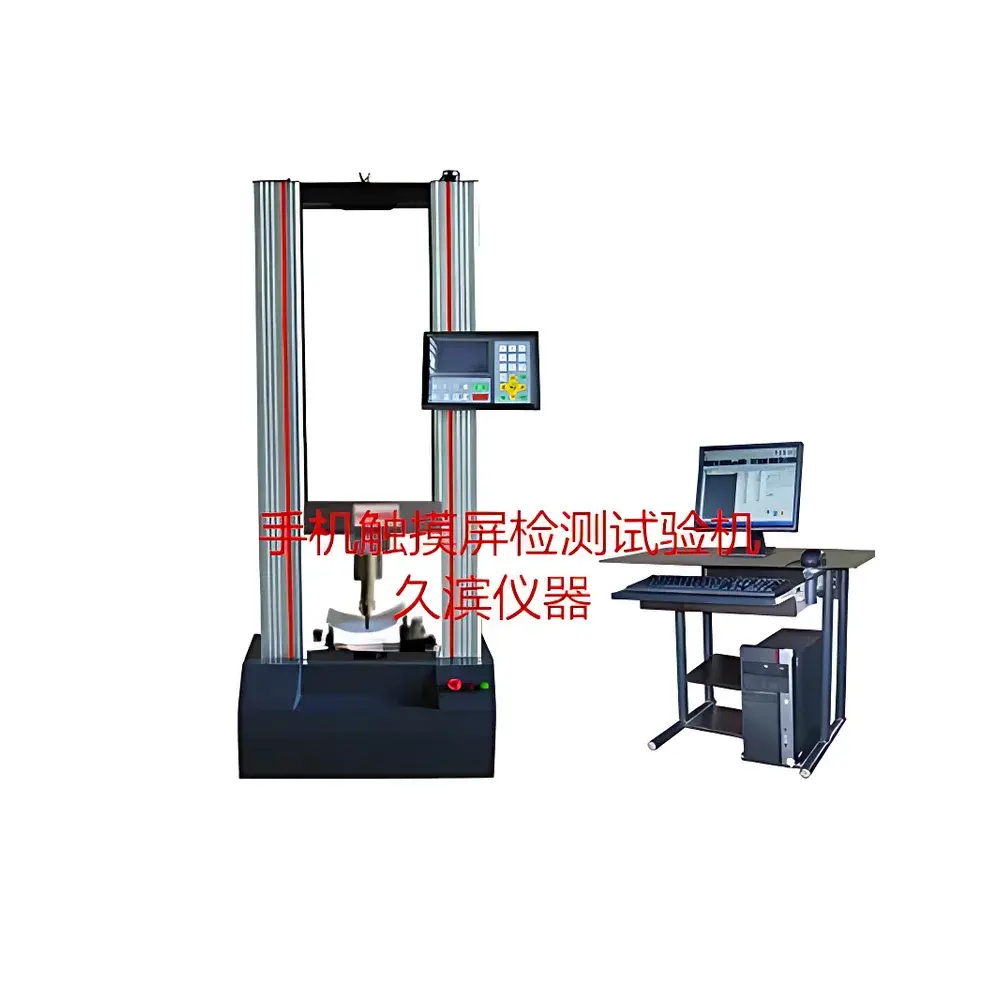
Jiubin Instruments JB-C Touchscreen Glass Mechanical Testing System
| Brand | Jiubin Instruments |
|---|---|
| Origin | Shanghai, China |
| Manufacturer Type | Authorized Distributor |
| Country of Origin | China |
| Model | JB-C |
| Price | Upon Request |
| Max Load Capacity | 5 kN |
| Force Accuracy | ±0.5% FS |
| Displacement Resolution | 0.001 mm |
| Speed Range | 0.001–500 mm/min |
| Effective Test Height | 800 mm |
| Effective Test Width | 370 mm (customizable) |
| Force Resolution | 1/500,000 |
| Power Supply | AC 220 V, 50 Hz |
| Weight | ~320 kg |
Overview
The Jiubin Instruments JB-C Touchscreen Glass Mechanical Testing System is an electromechanical universal testing machine engineered for high-precision static mechanical characterization of rigid and brittle optical substrates used in consumer electronics. It operates on the principle of controlled displacement or load application via a servo-driven crosshead, enabling standardized quasi-static mechanical testing—including three-point bending, four-point bending, compression, and tensile deformation—on tempered glass, chemically strengthened glass, LCD cover lenses, OLED encapsulation substrates, and other thin-film or laminated display components. Designed to meet the stringent dimensional stability and repeatability requirements of display R&D labs and quality control departments, the system complies with ISO 6892-1, ASTM C1499, ASTM E337, GB/T 16491, and JIS R3205 test methodologies. Its modular architecture supports traceable calibration, GLP-compliant data integrity, and integration into regulated manufacturing environments where mechanical reliability of touch interfaces directly impacts end-user safety and device longevity.
Key Features
- Panasonic AC servo motor and digital speed control system for smooth, low-noise actuation across the full speed range (0.001–500 mm/min)
- Taiwan ABBA high-carbon ground ball screw assembly with preloaded nut, ensuring axial stiffness >2.5 × 10⁵ N/mm and minimal backlash
- Korean Tae-Kyung hardened chrome-plated linear guide rods (HRC ≥60), coupled with Taiwan Yida bellows dust protection for extended service life under cleanroom or production-floor conditions
- Transcell precision load cell (optional capacities: 500 N, 1 kN, 2 kN, or 5 kN), factory-calibrated to ISO 376 Class 0.5 accuracy
- Auto-ranging force and displacement measurement with 1/500,000 internal resolution and real-time dynamic display of load–displacement, stress–strain, and time-series curves
- Multi-mode closed-loop control: constant rate of extension (CRE), constant load, constant displacement, and position hold—with programmable ramp rates and dwell segments
- Integrated safety architecture including dual-limit mechanical stops, emergency stop button, overload cutoff, software-based force/displacement over-travel protection, and transparent safety enclosure
- Modular hardware design allowing dual-load-cell configuration for seamless transition between low-force micro-bending and high-load structural validation
Sample Compatibility & Compliance
The JB-C accommodates flat, rigid specimens up to 370 mm wide and 800 mm tall, with dedicated four-point bending fixtures optimized for 0.3–2.0 mm thick display glass substrates (e.g., Gorilla Glass®, Dragontrail™). Specimen mounting uses non-marring ceramic-coated grips and adjustable support spans compliant with ASTM C1499 Annex A1 for flexural strength evaluation. All mechanical and electrical subsystems conform to IEC 61000-6-2 (EMC immunity) and IEC 61000-6-4 (EMC emission) standards. The system supports audit-ready documentation per FDA 21 CFR Part 11 when configured with UTM software’s electronic signature and audit trail modules. Calibration certificates are traceable to NIM (National Institute of Metrology, China) and include uncertainty budgets aligned with ISO/IEC 17025 requirements.
Software & Data Management
The UTM Control Suite is a Windows-native application (compatible with Windows 10/11 x64) featuring bilingual UI (English/Chinese), unit-swappable parameters (N/kN, MPa/psi, mm/in), and context-sensitive wizard-guided test setup. It natively implements ASTM D638, ISO 527-2, GB/T 2567, and EN 1288-3 calculation routines for flexural modulus, fracture load, and normalized stress distribution. Raw data exports to CSV, Excel, or XML; graphical outputs support PNG, SVG, and PDF formats with embedded metadata (operator ID, timestamp, environmental conditions). Report templates comply with ISO 14644-1 cleanroom documentation conventions and may be customized using built-in XSLT editors—no third-party licenses required. Firmware and software updates are delivered free-of-charge for the product’s operational lifetime, with version-controlled release notes archived on Jiubin’s secure customer portal.
Applications
- Flexural strength and modulus measurement of cover glass under simulated drop impact loading profiles
- Compression testing of OLED stack assemblies to assess delamination thresholds under thermal cycling
- Static indentation resistance evaluation of anti-fingerprint coated surfaces per ISO 1518-1
- Interlayer adhesion quantification in laminated touch sensor stacks (ITO/PET/glass)
- Quality gate testing for incoming raw material batches against supplier specifications (e.g., Corning® specification sheets)
- Process validation of chemical tempering parameters via controlled bend-to-fracture protocols
- Comparative analysis of edge-strengthened vs. center-strengthened glass variants under identical fixture geometry
FAQ
Does the JB-C support automated test sequence execution for unattended operation?
Yes—predefined test methods can be queued, scheduled, and executed with automatic specimen ejection signaling (via optional I/O module) and pass/fail logic based on user-defined acceptance criteria.
Can test data be exported directly to LIMS or MES platforms?
Yes—the software provides ODBC-compliant database connectivity and RESTful API endpoints for bidirectional integration with laboratory information management systems and enterprise manufacturing execution systems.
Is the system suitable for ISO 17025-accredited laboratories?
Yes—when paired with documented calibration records, uncertainty budgets, and validated software configuration, the JB-C meets technical requirements for accredited mechanical testing of optical materials.
What is the recommended maintenance interval for the ball screw and guide system?
Jiubin recommends lubrication and visual inspection every 500 operational hours; full recalibration is advised annually or after any mechanical shock event exceeding 5 g.
Are custom fixtures available beyond the standard four-point bending set?
Yes—Jiubin offers engineering consultation and CNC-manufactured fixtures for specialized geometries, including radial compression, spherical indentation, and multi-axis constrained bending configurations.



