
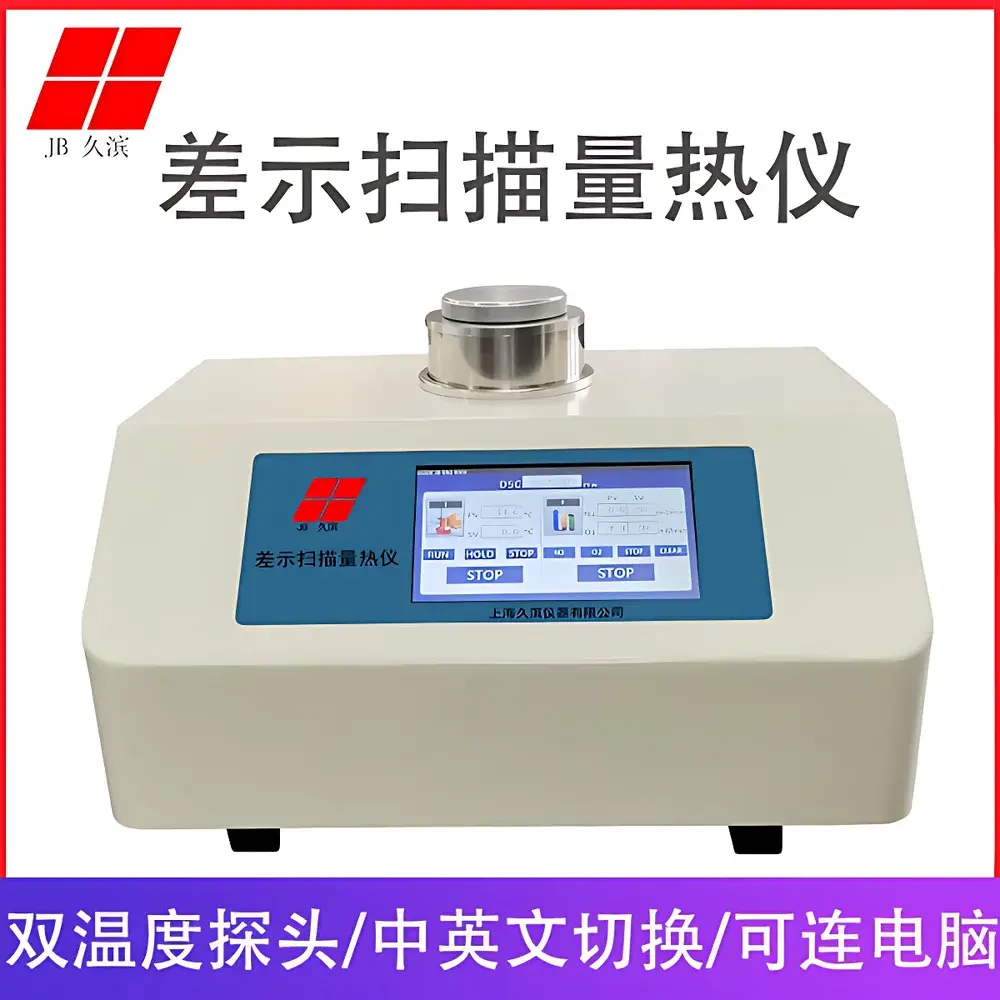
Jiubin JB-DSC-500B Thermal Flow-Type Differential Scanning Calorimeter
| Brand | Jiubin |
|---|---|
| Origin | Shanghai, China |
| Model | JB-DSC-500B |
| Instrument Type | Heat-Flow DSC |
| Temperature Range | Ambient to 500 °C |
| Temperature Accuracy | ±0.1 °C |
| Heating/Cooling Rate | 0.1–80 K/min |
| Sample Capacity | Single-sample configuration |
| Compliance | Designed for ASTM E794, ISO 11357, and USP <1163> thermal analysis workflows |
Overview
The Jiubin JB-DSC-500B is a precision-engineered heat-flow-type differential scanning calorimeter optimized for quantitative thermal transition analysis of polymeric, elastomeric, and composite materials. It operates on the fundamental principle of measuring differential heat flow between a sample and an inert reference as both are subjected to identical, controlled temperature programs. This enables high-reproducibility detection of endothermic and exothermic events—including glass transitions (Tg), melting points (Tm), crystallization onset (Tc), oxidative induction time (OIT), and specific heat capacity (Cp)—with resolution sufficient for QC release testing and R&D-grade material characterization. Its robust sensor architecture, coupled with active furnace temperature control and low thermal mass crucibles, ensures minimal baseline drift and excellent signal-to-noise ratio across the full operating range (ambient to 500 °C). The instrument is calibrated traceably to NIST-certified indium and zinc standards, supporting compliance with GLP and GMP documentation requirements.
Key Features
- Heat-flow detection geometry with dual-sensor thermal compensation for enhanced baseline stability and long-term measurement consistency
- Programmable linear heating and cooling rates from 0.1 to 80 K/min, enabling rapid method development and accelerated aging studies
- Temperature accuracy of ±0.1 °C verified across the entire operational range using certified reference materials
- Integrated auto-calibration routine for temperature and enthalpy, reducing operator dependency and minimizing inter-lab variability
- Compact benchtop design with low power consumption (<300 W) and passive air cooling—no external chiller required for standard operation
- Modular furnace assembly allowing field-replaceable sensor units and simplified maintenance under ISO 9001 service protocols
Sample Compatibility & Compliance
The JB-DSC-500B accommodates standard aluminum, gold-coated aluminum, and hermetically sealed stainless-steel crucibles (40 µL volume), supporting solid polymer pellets, rubber vulcanizates, cured composites, and powdered additives. Sample mass range: 1–25 mg, optimized for signal fidelity without thermal lag artifacts. The system meets essential performance criteria outlined in ASTM E794 (melting and crystallization temperatures), ISO 11357-1 through -7 (general DSC principles and polymer-specific applications), and USP (thermal analysis for pharmaceutical excipients and polymers). Data acquisition and reporting modules support audit-trail generation per FDA 21 CFR Part 11 when deployed with validated software configurations.
Software & Data Management
Controlled via Jiubin Thermal Analysis Suite (JTAS) v4.2, a Windows-based application compliant with IEC 62304 Class B software safety standards. JTAS provides real-time curve overlay, multi-step dynamic ramp/hold programming, automatic peak identification (onset, peak, endset), and Cp calculation using the sapphire method. Raw data is stored in vendor-neutral ASCII (.csv) and universal .tdms formats; metadata includes instrument ID, calibration history, user login, timestamp, and environmental conditions. Export modules support direct integration into LIMS platforms (e.g., LabWare, Thermo Fisher SampleManager) and statistical process control (SPC) dashboards. All software updates undergo regression testing against ISO/IEC 17025 validation templates.
Applications
- Quantification of Tg shifts in thermoplastic elastomers (TPEs) following plasticizer migration or UV exposure
- Determination of degree of cure in silicone rubber compounds via residual exotherm integration
- Oxidative stability assessment of polyolefins using OIT under oxygen purge (ASTM D3895)
- Batch-to-batch consistency verification of engineering thermoplastics (e.g., PEEK, PPS) in automotive supply chains
- Thermal degradation profiling of flame-retardant additives in PVC formulations
- Supporting ICH Q5C stability studies for polymer-based drug delivery systems
FAQ
What reference materials are recommended for routine calibration?
Indium (Tm = 156.6 °C, ΔHf = 28.45 J/g) and zinc (Tm = 419.5 °C, ΔHf = 106.6 J/g) are primary standards; calibration is performed at both points annually or after major maintenance.
Is nitrogen purge mandatory for all measurements?
A controlled inert atmosphere (N2 or Ar, 20–50 mL/min) is required for oxidation-sensitive samples and quantitative Cp work; ambient air may be used for preliminary Tg screening of stable thermoplastics.
Can the JB-DSC-500B perform modulated DSC (MDSC®)?
No—this is a conventional single-heating-rate heat-flow DSC platform; MDSC capability requires proprietary temperature modulation hardware not included in this model.
What is the typical turnaround time for sensor recalibration service?
Factory-certified recalibration with NIST-traceable documentation is completed within 5 business days of receipt at the Shanghai service center.
Does the system support GLP-compliant electronic signatures?
Yes—when operated with JTAS v4.2 in “validated mode” and integrated with a qualified identity management system, full 21 CFR Part 11 electronic signature and audit trail functionality is enabled.



