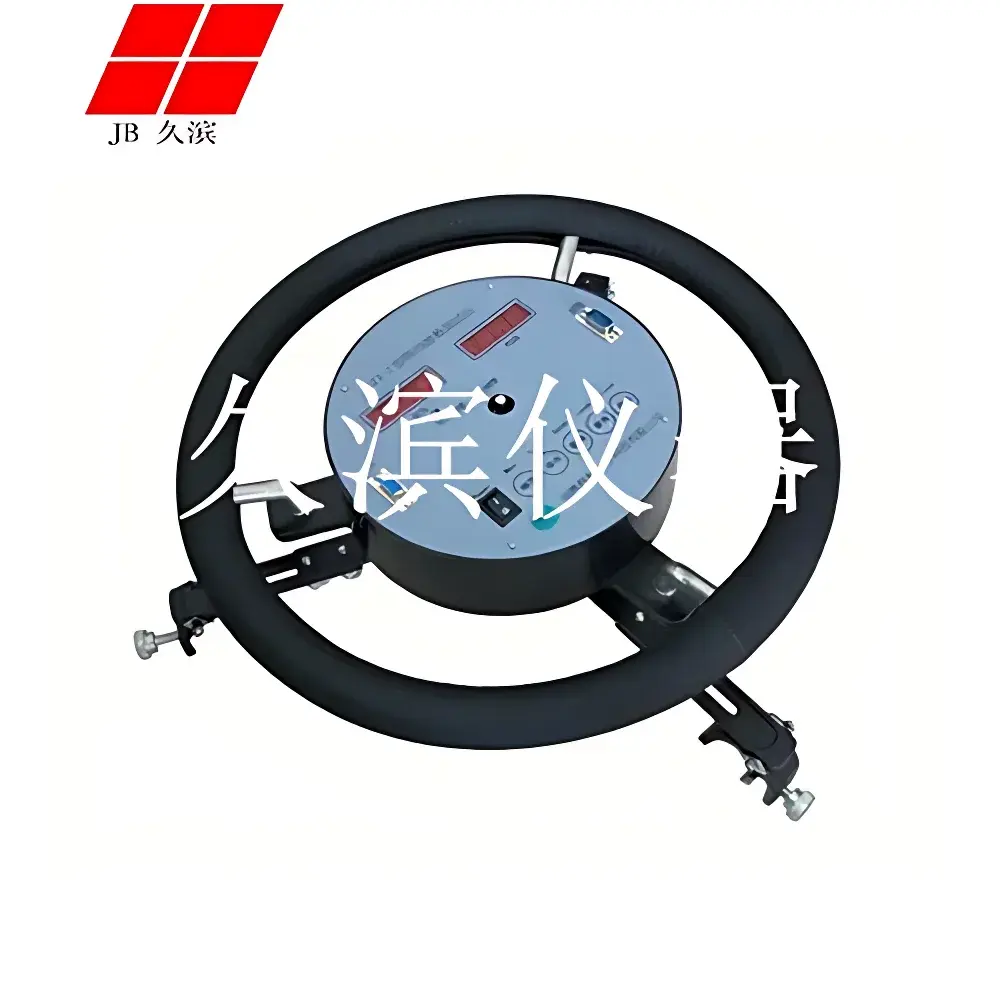
JB-311 Steering Parameter Tester by Jiubin Instruments
| Brand | Jiubin Instruments |
|---|---|
| Origin | Shanghai, China |
| Manufacturer Type | Authorized Distributor |
| Region of Manufacture | Domestic (PRC) |
| Model | JB-311 |
| Pricing | Available Upon Request |
| Power Supply | DC 9.6 V (8× Ni-MH rechargeable battery) |
| Torque Range | −200 to +200 N·m |
| Angular Range | −1080° to +1080° |
| Torque Resolution | 0.1 N·m |
| Angle Resolution | 0.1° |
| Torque Accuracy | ±2% F.S. |
| Angle Accuracy | ±3° |
| Communication Interface | Standard 9-pin RS232 (TXD: Pin 3, RXD: Pin 2, GND: Pin 5) |
| Baud Rate | 9600 bps |
| Data Format | 8 data bits, 1 stop bit, no parity |
| Max Cable Length | 30 m |
| Dimensions | Ø400 × 200 mm |
| Mounting Diameter Range | Ø320–Ø480 mm (optional extended range: Ø380–Ø550 mm) |
Overview
The JB-311 Steering Parameter Tester is a microprocessor-based instrumentation system engineered for quantitative evaluation of steering system performance in wheeled vehicles—including passenger cars, commercial trucks, agricultural tractors, and construction machinery. It operates on the principle of real-time dual-channel acquisition of torque and angular displacement applied to the steering wheel, enabling precise characterization of static and dynamic steering behavior. The instrument integrates a 32-bit high-performance microcontroller and a 12-bit Σ-Δ analog-to-digital converter to ensure stable signal conditioning and low-noise digitization of mechanical inputs. Designed for field-deployable use as well as laboratory-based validation, the JB-311 complies with fundamental requirements for mechanical test instrumentation per ISO 13849-1 (safety-related control systems) and supports traceable measurement practices aligned with ISO/IEC 17025 principles when operated within a calibrated environment.
Key Features
- Simultaneous bidirectional acquisition of steering torque and angular position—capturing both clockwise and counterclockwise values during a single test cycle.
- Onboard non-volatile memory capable of storing up to 100 complete test records, each containing timestamped torque-angle pairs and derived parameters (e.g., free-play angle, breakaway torque).
- High-contrast Chinese-character LCD display with intuitive menu navigation—optimized for operation under variable ambient lighting conditions encountered in workshop or outdoor testing environments.
- Integrated rechargeable power system: eight high-capacity nickel-metal hydride (Ni-MH) cells providing nominal 9.6 V DC output, supporting continuous operation for ≥4 hours per full charge.
- Standardized RS232 serial interface compliant with EIA/TIA-232-F specifications—enabling seamless integration with host PCs, data loggers, or custom QA/QC software platforms for automated reporting and database archiving.
- Mechanically robust housing with concentric mounting ring design (standard Ø320–Ø480 mm; optional Ø380–Ø550 mm), ensuring secure coupling across diverse steering column diameters without slippage or misalignment.
Sample Compatibility & Compliance
The JB-311 is compatible with all conventional manual and hydraulic power-assisted steering systems found on rigid-axle and independent front suspension architectures. It accommodates both flat-bottom and sport-style steering wheels via adjustable clamping geometry. While not certified to SAE J2877 or ISO 11452-8 for EMC immunity, its analog signal path incorporates passive filtering and shielded internal routing to minimize electromagnetic interference in typical service bay environments. For regulatory compliance documentation, users are advised to perform periodic verification against national metrological standards (e.g., JJG 539–2016 for torque measuring instruments in China) and maintain calibration logs per internal quality management procedures (e.g., IATF 16949 Clause 7.1.5.2).
Software & Data Management
Raw measurement data is transmitted via ASCII-formatted packets over RS232 at 9600 bps, structured for direct parsing into spreadsheet applications or proprietary analysis tools. Each data frame includes header identification, absolute time stamp (derived from internal RTC), torque value (N·m), angle value (°), and status flags indicating direction, saturation, or memory write events. No proprietary driver or closed-source application is required—users may implement Python, MATLAB, or LabVIEW scripts for real-time visualization or batch post-processing. Audit trails are maintained manually; while the device does not support FDA 21 CFR Part 11 electronic signatures or GLP audit logging natively, exported datasets retain sufficient metadata to satisfy basic traceability requirements in Tier-2 supplier quality audits.
Applications
- Determination of steering free play (dead zone) per ISO 7400:2014 — quantifying angular displacement before measurable torque transmission begins.
- Breakaway torque measurement during static turn-in tests on parked vehicles, supporting OEM durability specification validation (e.g., GMW14872 Section 5.3.2).
- Dynamic steering effort profiling across full lock-to-lock sweeps, used in comparative benchmarking of EPS tuning strategies.
- Post-repair verification of steering gear backlash and hydraulic assist responsiveness in after-sales service centers.
- Educational demonstration of steering system hysteresis and frictional losses in automotive engineering laboratories.
FAQ
What is the maximum allowable rotational speed during dynamic testing?
The JB-311 does not impose an explicit rotational speed limit; however, accurate resolution of torque and angle is maintained up to 120°/s based on internal sampling rate and ADC settling time.
Can the device be recalibrated in-house?
Yes—calibration requires traceable torque and angular references (e.g., Class M1 deadweight torque calibrator and autocollimator). Full procedure documentation is provided in the English-language user manual (Rev. 3.2, included with shipment).
Is USB connectivity supported?
No—only RS232 serial interface is implemented. A USB-to-RS232 adapter meeting FTDI chipset specifications may be used for connection to modern laptops.
Does the instrument meet IP rating requirements for workshop use?
It carries no formal IP classification; however, its sealed front-panel LCD and conformally coated PCBs provide resistance to dust ingress and incidental moisture typical of indoor maintenance facilities.
How is battery health monitored?
Low-battery condition triggers a persistent icon on the LCD and reduces sampling frequency by 25% to preserve measurement integrity until recharging.