
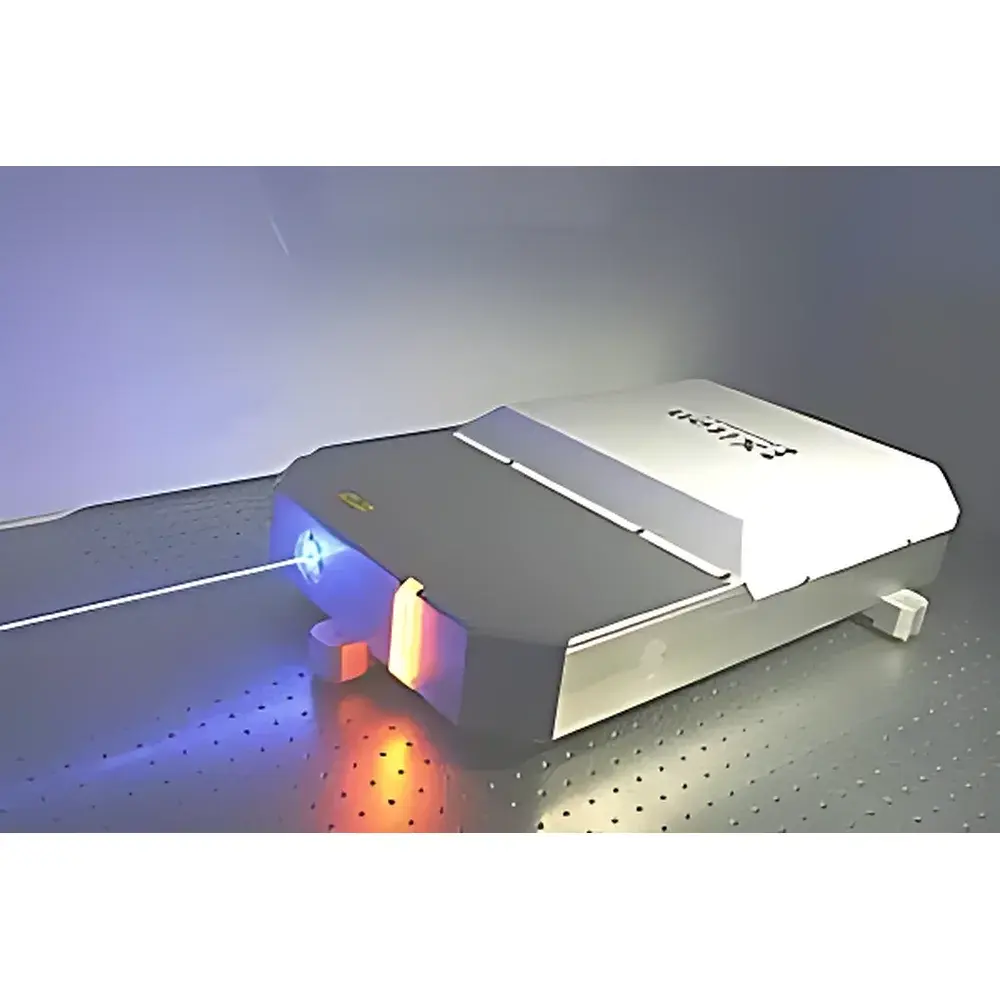
Xiton SLM Series Single-Frequency Nanosecond Laser System
| Brand | Xiton |
|---|---|
| Origin | Germany |
| Product Type | Solid-State Q-Switched Laser |
| Wavelength Options | 1064 nm, 532 nm, 355 nm, 266 nm, 193.368 nm |
| Spectral Linewidth | <80 MHz (1064/532/355 nm), <100 MHz (193.368 nm) |
| Pulse Width | <12 ns (1064 nm), <10 ns (355 nm), <8 ns (213 nm), 6–8 ns (193.368 nm) |
| Repetition Rate | 8–15 kHz |
| Beam Quality (M²) | <1.2 (1064 nm), ≤1.6 (193.368 nm) |
| Pulse-to-Pulse Stability (σ) | <0.3% (all models, measured at 10 kHz) |
| Average Power | ≥8.0 W (1064 nm), ≥4.0 W (532 nm), ≥2.0 W (355 nm), ≥100 mW (213 nm), ≥10 mW (193.368 nm) |
| Pulse Energy | 800 µJ (1064 nm), 400 µJ (532 nm), 200 µJ (355 nm), 10 µJ (213 nm), 1.6 µJ (193.368 nm) |
Overview
The Xiton SLM Series is a family of industrial-grade, single-longitudinal-mode (SLM), Q-switched solid-state nanosecond lasers engineered for high spectral purity, exceptional temporal stability, and diffraction-limited beam quality. Based on master oscillator–power amplifier (MOPA) architecture with intra-cavity frequency-selective elements—including etalons and injection seeding—each model delivers narrow-linewidth (<80 MHz typical, 2 m at 1064 nm) and minimal phase noise, the SLM Series operates across five fundamental and harmonic wavelengths: 1064 nm (Nd:YAG fundamental), 532 nm (second harmonic), 355 nm (third harmonic), 266 nm (fourth harmonic), and 193.368 nm (fifth harmonic via ArF excimer-pumped Raman shifting or direct F₂ excimer conversion). All variants maintain strict pulse-to-pulse energy stability (σ < 0.3% RMS, measured over 10⁴ shots at 10 kHz), enabling reliable operation in metrology, coherent lidar, nonlinear spectroscopy, and UV lithography mask inspection.
Key Features
- Single-longitudinal-mode (SLM) output with linewidth <80 MHz (1064/532/355 nm) and 2 m and minimal mode competition effects
- Nanosecond pulse generation with pulse widths ranging from <12 ns (1064 nm) to 6–8 ns (193.368 nm), optimized for efficient nonlinear conversion and time-resolved detection
- Diffraction-limited beam quality: M² < 1.2 at 1064 nm; ≤1.6 at deep-UV wavelengths, facilitating tight focusing and high spatial resolution in ablation and imaging systems
- High-repetition-rate operation from 8 to 15 kHz, with factory-optimized thermal management and active cavity stabilization for long-term power consistency
- Integrated temperature-controlled harmonic generation modules with automatic phase-matching alignment feedback, supporting stable multi-wavelength switching without realignment
- Ruggedized OEM-compatible housing with RS-232/USB/Ethernet interfaces, TTL/Analog modulation inputs, and interlock-ready safety circuitry compliant with IEC 60825-1:2014 Class 4 requirements
Sample Compatibility & Compliance
The SLM Series is compatible with standard optical tables, vacuum-compatible beam paths (for 193 nm and 213 nm variants), and commercial interferometric measurement platforms. Its UV output meets ISO 10110-7 surface quality specifications for optical component testing and supports ASTM E1727-22 (Standard Practice for UV Laser-Based Surface Inspection). Harmonic modules are sealed and purged with synthetic air or nitrogen to prevent ozone-induced degradation and hydrocarbon contamination—critical for sustained 193 nm operation. All systems comply with CE marking directives (EMC 2014/30/EU, LVD 2014/35/EU), RoHS 2011/65/EU, and conform to laser safety standards per EN 60825-1:2014. Optional FDA 21 CFR Part 11-compliant audit trail logging is available for GMP-regulated environments requiring traceable parameter history.
Software & Data Management
Xiton Control Suite v3.2 provides full remote configuration, real-time monitoring, and automated calibration routines via Ethernet or USB 2.0. The software supports script-driven pulse train sequencing (including burst mode), synchronized external trigger latency compensation (<50 ns jitter), and export of timestamped pulse energy logs in CSV/HDF5 formats. Built-in diagnostics include cavity alignment status, crystal temperature drift alerts, and harmonic conversion efficiency trending. For integration into automated test benches, a comprehensive SCPI command set and Python/C++ SDKs are provided, enabling seamless interoperability with LabVIEW, MATLAB, and custom PLC-based control architectures. All parameter changes are logged with user ID, timestamp, and checksum-verified configuration snapshots—fully auditable under GLP/GMP workflows.
Applications
- Coherent Doppler wind lidar (CDWL) and differential absorption lidar (DIAL) requiring narrow linewidth and high pulse stability
- Time-of-flight mass spectrometry (TOF-MS) ionization sources, particularly for MALDI and resonance-enhanced multiphoton ionization (REMPI)
- Deep-UV photomask inspection and semiconductor wafer defect review at 193 nm and 213 nm
- Nonlinear optical parametric amplification (OPA) pumping and ultrafast seed source generation
- Precision interferometry, holographic recording, and optical coherence tomography (OCT) requiring long coherence length and low phase noise
- Calibration of photodetectors, radiometers, and single-photon avalanche diodes (SPADs) across UV–NIR spectral bands
FAQ
What is the maximum achievable pulse energy at 193.368 nm?
Maximum pulse energy is 1.6 µJ at 10 kHz repetition rate; higher energies may be attainable at reduced repetition rates with optional cavity-dumping configurations.
Is vacuum compatibility available for the 193 nm variant?
Yes—optional UHV-compatible flange mounts (CF-40 or KF-25) and differential pumping ports are offered for integration into vacuum chambers down to 10⁻⁷ mbar.
Can the laser be synchronized to an external clock signal?
Yes—TTL and LVDS external trigger inputs support synchronization with jitter <50 ns; optional OCXO-referenced internal clock upgrade enables sub-10 ps timing stability.
Does the system support remote firmware updates?
Yes—secure over-the-air (OTA) updates are supported via authenticated HTTPS endpoints; all firmware images are cryptographically signed and validated prior to installation.
Are custom wavelength combinations possible beyond the standard SLM model lineup?
Yes—Xiton offers application-specific harmonics engineering services, including hybrid OPO/SHG designs and tailored cavity-length stabilization for nonstandard wavelengths between 193–1064 nm.





