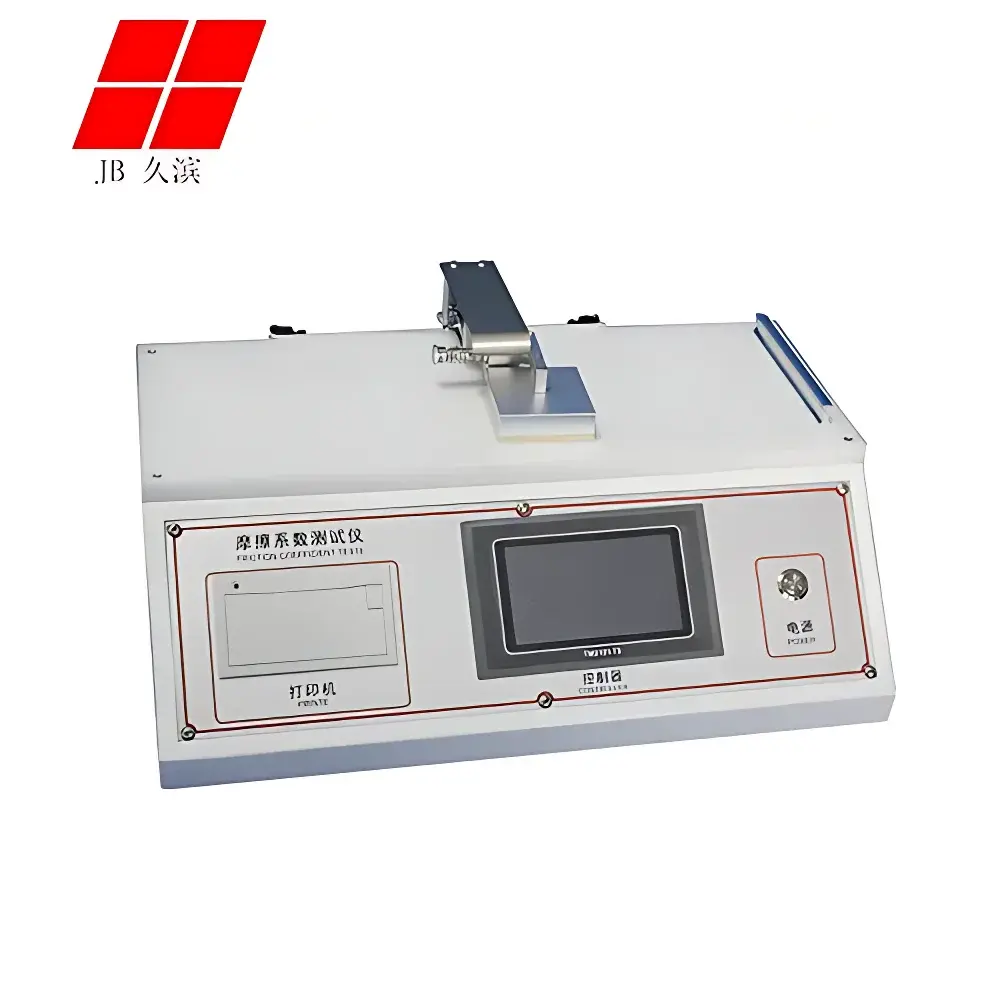
Jiubin JB-3009 Coefficient of Friction Tester for Thin Films and Packaging Materials
| Brand | Jiubin |
|---|---|
| Model | JB-3009 |
| Load Range | 0–5 N |
| Accuracy Class | 0.5 |
| Traverse Distance | 70 mm / 150 mm |
| Standard Sled Mass | 200 g |
| Test Speed | 100 mm/min |
| Operating Temperature | 10–40 °C |
| Relative Humidity | 20–70 % RH |
| Power Supply | AC 220 V, 50 Hz |
| Dimensions (L×W×H) | 400 × 300 × 180 mm |
| Weight | 10 kg |
Overview
The Jiubin JB-3009 Coefficient of Friction Tester is a precision-engineered instrument designed for the quantitative determination of static (μs) and kinetic (μk) coefficients of friction in thin, flexible materials—particularly plastic films, laminates, coated papers, and packaging substrates. It operates on the fundamental principle of horizontal sled-on-plane measurement: a standardized sled of known mass is pulled across a stationary sample surface at a controlled linear velocity, while a high-resolution load cell measures the tangential force required to initiate motion (static friction) and sustain steady sliding (kinetic friction). The resulting ratio of frictional force to normal load yields the dimensionless coefficient value. This method aligns with well-established tribological test paradigms used across global packaging R&D, quality control, and regulatory compliance laboratories.
Key Features
- Multi-standard compliance: Pre-configured test protocols for GB/T 10006, ISO 8295, ASTM D1894, TAPPI T816, and GB/T 17200—enabling seamless method selection and cross-laboratory data comparability.
- Dual-mode friction assessment: Independent selection of static-only, kinetic-only, or combined static-to-kinetic transition tests—critical for evaluating seal integrity, pouch opening behavior, and conveyor line performance.
- Microprocessor-controlled drive system: A low-inertia, belt-driven translational mechanism ensures stable 100 mm/min traverse velocity with minimal vibration, minimizing signal noise and enhancing repeatability (RSD < 2.5% per ASTM D1894 repeatability criteria).
- Integrated digital interface: Backlit LCD display presents real-time force curves, peak/plateau values, pass/fail indicators, and statistical summaries—including automatic detection of stick-slip events and quantitative dispersion analysis across replicate trials.
- Flexible sled configuration: Accepts standard 200 g sleds per ISO/ASTM requirements, with mechanical adaptability for user-defined masses—supporting customized pressure loading for specialty applications such as medical device packaging or high-barrier metallized films.
- Data retention & reporting: Onboard memory stores up to six complete test sessions with timestamped results; supports statistical grouping, mean ± SD calculation, and direct thermal printout in customizable report formats compliant with internal QA documentation standards.
Sample Compatibility & Compliance
The JB-3009 accommodates flat, non-porous specimens up to 100 mm wide × 200 mm long—including biaxially oriented polypropylene (BOPP), PET, PE laminates, aluminum foil composites, wax-coated board, synthetic leather, and elastomeric gaskets. Its design meets essential metrological requirements for GLP environments: traceable force calibration (via NIST-traceable weights), temperature/humidity monitoring integration capability, and mechanical stability under ambient lab conditions (10–40 °C, 20–70 % RH). While not inherently 21 CFR Part 11-compliant, its deterministic output format and audit-ready print logs support alignment with FDA-regulated packaging validation workflows when paired with documented SOPs and external electronic lab notebook (ELN) systems.
Software & Data Management
The instrument operates autonomously via embedded firmware—no PC dependency required for core operation. All test parameters (speed, dwell time, sled mass, pass/fail thresholds) are configured via membrane keypad navigation. Raw force-time datasets are visualized in real time and archived locally with metadata (operator ID, date/time, standard selected, sample ID). Export functionality is limited to thermal printouts; however, ASCII-formatted data can be manually transcribed into LIMS or Excel for further statistical processing (e.g., ANOVA, control charting per ISO 7870-2). For regulated environments, users may implement supplementary procedural controls—such as dual-operator verification and manual logbook entries—to satisfy ALCOA+ data integrity principles.
Applications
- Packaging development: Optimizing anti-block additives in polyolefin films; validating slip agent efficacy in heat-seal layers; benchmarking matte vs. glossy surface finishes for automated filling line compatibility.
- Regulatory submission support: Generating friction data for ISTA 3A/3E transport simulation reports and EU Directive 94/62/EC packaging conformity assessments.
- Failure analysis: Diagnosing root causes of jamming in vertical form-fill-seal (VFFS) machinery or inconsistent peel initiation in medical blister packs.
- Raw material qualification: Screening incoming rolls of kraft paper, metallized CPP, or fluoropolymer-coated release liners against supplier specifications.
- Consumer product testing: Quantifying tactile glide properties of cosmetic applicator surfaces, contact lens blister packaging, and pharmaceutical foil lids per USP guidance.
FAQ
What standards does the JB-3009 natively support?
It includes built-in test modes for GB/T 10006, ISO 8295, ASTM D1894, TAPPI T816, and GB/T 17200—with selectable units, dwell times, and calculation algorithms matching each standard’s requirements.
Can the instrument measure both static and kinetic COF in a single run?
Yes. The firmware automatically detects the maximum breakaway force (μs) and subsequent average sliding force (μk) within one continuous 150 mm traverse, per ISO 8295 Clause 7.3.
Is calibration traceable to national standards?
Force calibration uses certified deadweights traceable to China NIM; users are advised to perform annual verification using accredited third-party services for ISO/IEC 17025 compliance.
Does it support variable test speeds?
No—the JB-3009 operates exclusively at 100 mm/min, consistent with the majority of referenced standards for film and sheet materials.
How is environmental conditioning addressed?
The unit itself does not include climate control; users must conduct tests in an environment maintained within 10–40 °C and 20–70 % RH, as specified in GB/T 2918 and ISO 291 for thermoplastic material conditioning.