Jiubin JB- Wire Winding Tester
| Brand | Jiubin Instruments |
|---|---|
| Origin | Taiwan, China |
| Manufacturer Type | Authorized Distributor |
| Country of Manufacture | China |
| Model | JB- |
| Pricing | Available Upon Request |
| Wire Diameter Range | Aluminum 1.25–6.00 mm, Steel 1.25–3.80 mm |
| Mandrel Diameter Range | 1.25–19.00 mm |
| Spindle Speed | 8 rpm |
| Right Spindle Axial Travel | 40 mm |
| Total Gear Ratio | 173.75 |
| Motor | 0.75 kW, 1500 rpm |
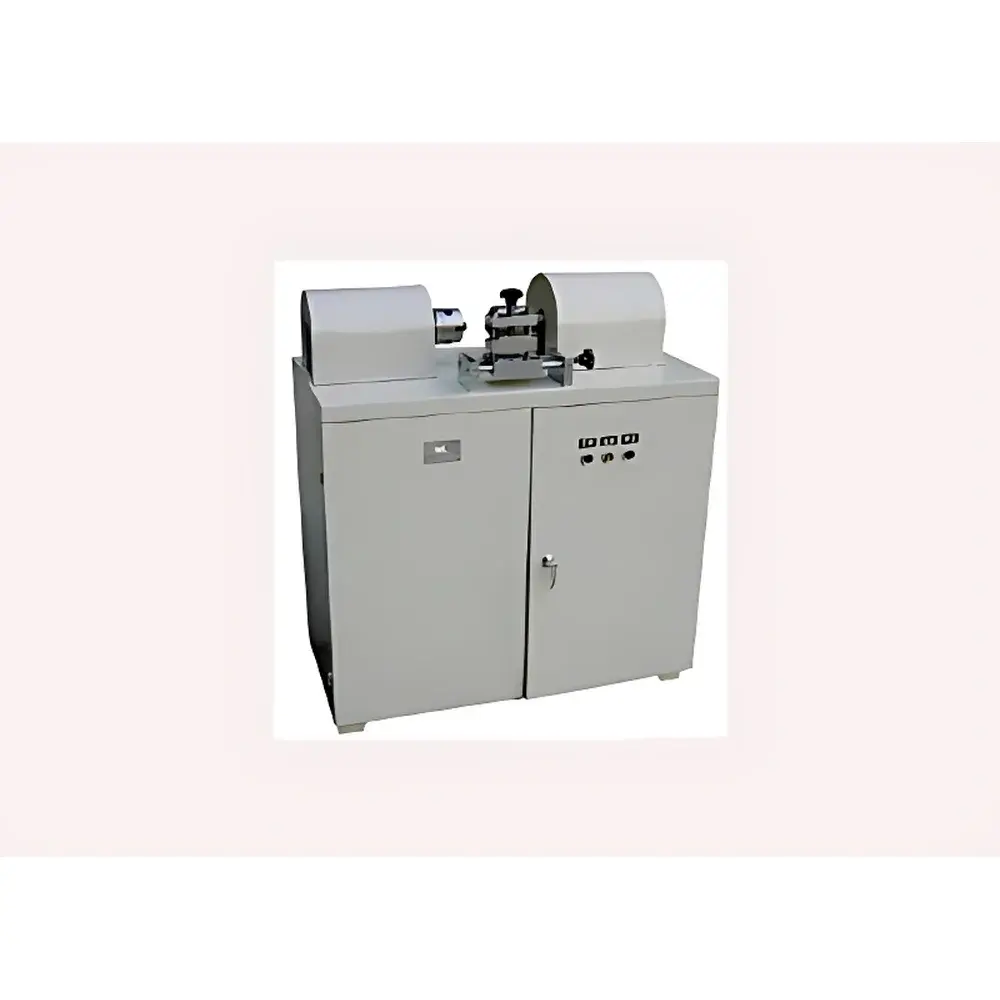
| Overall Dimensions | 810 × 400 × 1400 mm |
Overview
The Jiubin JB- Wire Winding Tester is a precision mechanical testing instrument engineered for standardized mandrel-based winding evaluation of bare metallic conductors—primarily aluminum and steel wires—according to internationally recognized electrical and materials testing protocols. It operates on the principle of controlled, uniform helical winding under defined tension-free conditions, where the test specimen is wound tightly around a cylindrical mandrel at a fixed rotational speed and axial feed rate. This method assesses ductility, surface integrity, adhesion consistency (in coated variants), and resistance to cracking or flaking during plastic deformation. The device complies with the structural and procedural requirements of GB/T 4909.7–1985 (“Test Methods for Bare Wires – Part 7: Winding Test”), which remains widely referenced in quality assurance workflows across wire & cable manufacturing, power transmission component suppliers, and third-party certification laboratories in Asia-Pacific markets. Its robust cast-iron base, gear-driven spindle train, and calibrated axial displacement mechanism ensure high repeatability across sequential tests—critical for batch release decisions and incoming material inspection.
Key Features
- Fixed-speed spindle rotation at 8 rpm, synchronized with precise 40 mm axial travel of the right spindle head to achieve consistent pitch and layer alignment.
- Interchangeable mandrels spanning 1.25–19.00 mm diameter range, enabling compliance testing across multiple conductor sizes and standard mandrel-to-wire diameter ratios (e.g., 1×, 2×, 3×, 4×).
- Dual-material capability: validated for aluminum wires (1.25–6.00 mm) and steel wires (1.25–3.80 mm), supporting comparative mechanical behavior analysis under identical test conditions.
- 0.75 kW induction motor with 1500 rpm nominal speed, coupled through a 173.75:1 reduction gearbox to deliver stable low-speed torque essential for controlled winding without slippage or overshoot.
- Statically rigid frame (810 × 400 × 1400 mm) with vibration-damped mounting, minimizing positional drift during multi-turn winding cycles and ensuring geometric fidelity of coil formation.
- Manual clamping system with quick-release collets for rapid specimen loading/unloading—designed for operator safety and minimal setup time between test runs.
Sample Compatibility & Compliance
The JB- Wire Winding Tester accommodates straight, annealed, or tempered bare metallic wires meeting dimensional tolerances specified in IEC 60228, ASTM B3, ASTM B193, and GB/T 3953. It supports mandatory mandrel ratio configurations required by GB/T 4909.7–1985—including 1×, 2×, 3×, and 4× mandrel diameters relative to wire nominal diameter—and permits visual pass/fail assessment per Clause 5.2 (no cracks, splits, or separations after unwinding). While GB/T 4909.7 is the primary reference, the mechanical configuration aligns with functional equivalents in EN 60851-5 and JIS C 3102-7, facilitating cross-standard verification. The instrument does not incorporate force sensing or real-time strain monitoring; therefore, it is intended for qualitative conformance testing—not quantitative mechanical property derivation.
Software & Data Management
The JB- is a manually operated, non-digitalized mechanical tester with no embedded microcontroller, data logging interface, or PC connectivity. All operational parameters—including mandrel selection, wire diameter input, winding direction, and number of turns—are set and verified physically prior to test initiation. Result documentation follows traditional laboratory practice: operators record mandrel ID, wire lot number, observed defects (per GB/T 4909.7 Section 6), and pass/fail determination in bound paper logbooks or LIMS-integrated electronic forms. For regulated environments operating under GLP or ISO/IEC 17025, users are advised to implement supplementary procedural controls—including equipment calibration records (mandrel diameter verification via micrometer), operator training logs, and annual mechanical verification of spindle speed and axial travel accuracy using traceable metrology tools.
Applications
- Quality control of stranded and solid-core bare aluminum and steel conductors used in overhead transmission lines, grounding systems, and busbar fabrication.
- Incoming inspection of wire stock from upstream metallurgical suppliers prior to drawing, stranding, or insulation extrusion processes.
- Process validation for heat treatment parameters (e.g., annealing temperature/time), where changes in ductility directly affect winding performance.
- Technical support for failure analysis when field-installed cables exhibit premature cracking or delamination during installation bending.
- Educational use in materials science and electrical engineering laboratories to demonstrate ductility–hardness relationships in metallic alloys.
FAQ
Does the JB- Wire Winding Tester meet ASTM or ISO winding test standards?
It is primarily designed to fulfill GB/T 4909.7–1985. While its mechanical configuration permits adaptation to certain clauses of ASTM B279 and ISO 6892-1 Annex G (for mandrel geometry), formal compliance requires user-side validation against those standards’ specific procedural and reporting requirements.
Is speed adjustment possible beyond 8 rpm?
No—the gearbox and motor combination are fixed-ratio and non-variable. Altering speed would invalidate conformance to GB/T 4909.7–1985, which specifies 8 ± 0.5 rpm as the nominal winding rate.
Can coated or insulated wires be tested on this instrument?
The JB- is intended exclusively for bare conductors. Insulated wires require different mandrel surface finishes, tension control, and peel-force evaluation methods not supported by this platform.
What maintenance is required to ensure long-term measurement reliability?
Monthly inspection of gear train lubrication, mandrel surface finish (absence of nicks or burrs), and spindle runout (<0.05 mm TIR); annual verification of motor speed with a handheld tachometer and axial travel distance with a calibrated depth gauge.
Is technical documentation available in English?
Yes—Jiubin Instruments provides an English-language operation manual, GB/T 4909.7–1985 translation summary, and calibration checklist upon request, supporting international lab integration and audit readiness.