
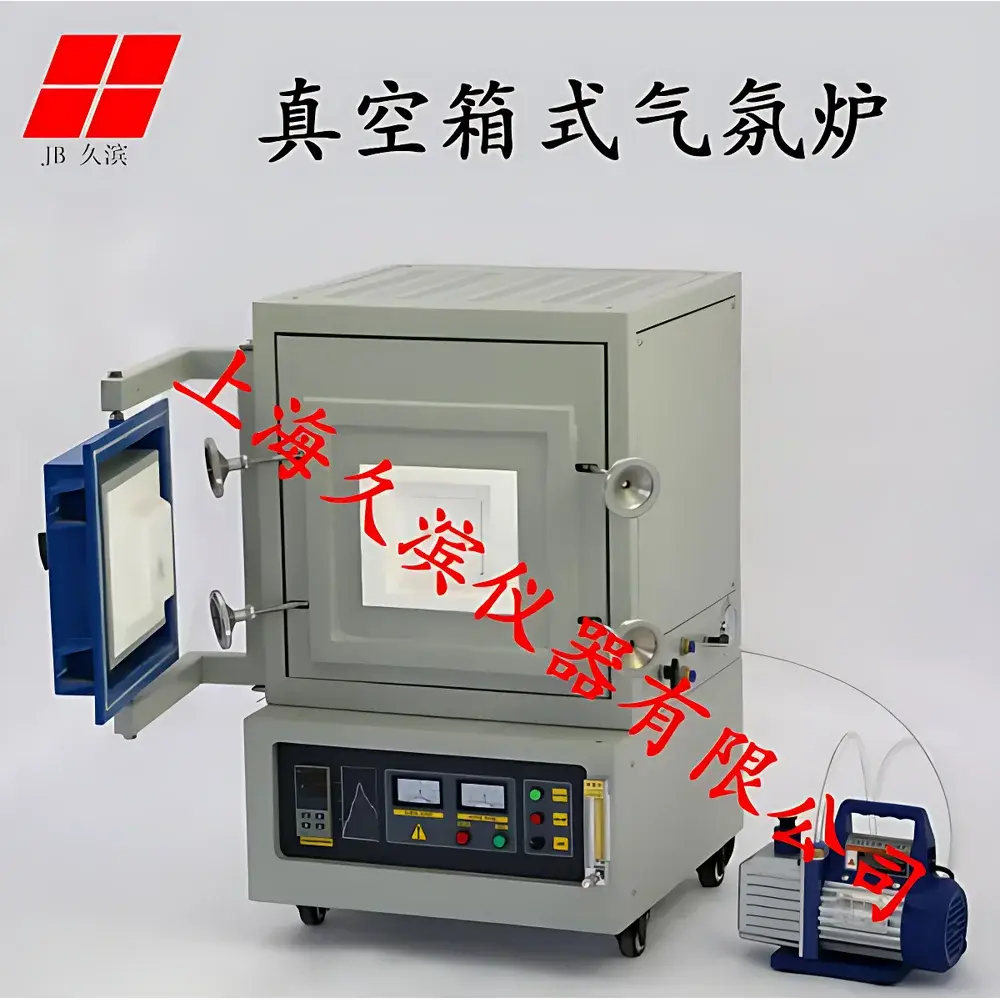
Jiubin JB Series High-Temperature Vacuum Box Furnace
| Brand | Jiubin Instruments |
|---|---|
| Origin | Shanghai, China |
| Model | JB Series |
| Instrument Type | Box-Type Furnace |
| Max Temperature | 1650 °C |
| Temperature Uniformity | ±1 °C |
| Heating Element | Silicon Molybdenum (MoSi₂) Rods |
| Internal Chamber Dimensions | 600 × 400 × 300 mm (D × W × H) |
| Power Rating | ~20 kW |
| Voltage | 380 V AC |
| Thermocouple Type | Type B (PtRh30–PtRh6) |
| Vacuum Level (Cold) | –0.1 MPa |
| Gas Inlets | 2 independent ports with float-type flowmeters (0–2 L/min) |
| Insulation Material | High-purity polycrystalline alumina ceramic fiber (>92% Al₂O₃) |
| Control System | Yudian intelligent programmable PID controller (30-segment ramp-soak profile, auto-tuning, ±1 °C accuracy) |
| Safety Protections | Over-temperature, thermocouple break, over-current, over-voltage, and deviation alarm |
Overview
The Jiubin JB Series High-Temperature Vacuum Box Furnace is an engineered solution for controlled thermal processing under inert, reducing, or vacuum atmospheres in research laboratories and materials development facilities. Designed around a robust dual-sided MoSi₂ heating architecture and a high-integrity polycrystalline alumina ceramic fiber chamber, this furnace delivers stable, repeatable operation up to 1650 °C—optimized for routine use at ≤1550 °C to ensure long-term element life and thermal stability. Its integrated vacuum system achieves –0.1 MPa cold vacuum level, while two independently regulated gas inlets support precise atmosphere control with optional inert (Ar, N₂), oxidizing (O₂), or reactive (CO) environments. The furnace complies with fundamental safety and electromagnetic compatibility requirements for laboratory-grade electrical heating equipment (IEC 61000-6-3, IEC 61000-6-4), and its structural design adheres to mechanical integrity principles for high-temperature containment.
Key Features
- Dual-sided silicon molybdenum (MoSi₂) rod heating configuration ensures uniform axial and radial temperature distribution across the 600 × 400 × 300 mm working chamber.
- Polycrystalline alumina ceramic fiber insulation (Al₂O₃ > 92%) provides exceptional thermal retention, rapid cooldown capability, and resistance to thermal shock during repeated cycling.
- Yudian intelligent PID controller with 30-segment programmable ramp-soak profiles, self-tuning capability, and real-time deviation monitoring enables fully autonomous thermal protocols without operator intervention.
- Type B (PtRh30–PtRh6) thermocouples—certified for high-temperature stability and low drift—integrated at multiple positions to support both control and verification measurements.
- Front-loading door with precision-machined planar surface and embedded silicone gasket delivers leak-tight sealing under vacuum and gas pressure conditions.
- Comprehensive safety suite includes over-temperature cutoff, thermocouple failure detection, current/voltage anomaly response, and temperature deviation alarms—all logged with timestamps for audit readiness.
- Modular gas delivery interface with two independent float-type flowmeters (0–2 L/min range) allows concurrent or sequential introduction of dissimilar process gases with visual flow verification.
Sample Compatibility & Compliance
This furnace accommodates standard crucibles (alumina, graphite, molybdenum, tungsten carbide) and flat substrates up to 150 mm in diameter. It supports ASTM C1271 (high-temperature flexural strength testing), ISO 5659-2 (fire growth index under radiant heat), and USP (glass container hydrolytic resistance validation) when configured with appropriate fixtures and procedural controls. While not certified to GLP or GMP out-of-the-box, its data logging, parameter traceability, and alarm history meet baseline requirements for regulated thermal validation workflows. All electrical components conform to CE marking directives for low-voltage equipment (LVD 2014/35/EU) and EMC (2014/30/EU).
Software & Data Management
The embedded Yudian controller supports RS485 Modbus RTU communication for integration into centralized lab monitoring systems (e.g., LabVIEW, Ignition SCADA). Temperature setpoints, actual readings, alarm events, and power consumption are timestamped and exportable via USB or serial interface as CSV files. Optional PC-based software (sold separately) enables remote profile editing, real-time graphing, and automated report generation compliant with internal QA documentation standards. Audit trail functionality—including user login, parameter changes, and alarm acknowledgments—is configurable to align with 21 CFR Part 11 expectations where electronic records are retained.
Applications
- Sintering of advanced ceramics (ZrO₂, SiC, AlN) and refractory metal powders under vacuum or controlled partial pressure.
- Heat treatment of high-performance alloys (Inconel, Hastelloy) requiring precise soak times at ≥1400 °C.
- Thermal gravimetric analysis (TGA) pre-conditioning and ashing protocols for catalysts and composite precursors.
- Crystal growth annealing of single-crystal substrates (sapphire, silicon carbide) with minimized thermal gradient-induced stress.
- Atmosphere-controlled oxidation/reduction studies of battery cathode materials (e.g., NMC, LFP) during phase transformation characterization.
- Calibration reference furnace applications where traceable, uniform high-temperature fields are required for secondary thermocouple verification.
FAQ
What is the recommended maximum continuous operating temperature?
The furnace is rated for 1650 °C, but continuous operation above 1550 °C accelerates MoSi₂ element aging and compromises long-term repeatability; 1550 °C is advised as the practical upper limit for routine use.
Can this furnace be integrated into an automated production line?
Yes—via RS485 Modbus RTU, it supports PLC-level coordination for start/stop commands, profile selection, and status polling; however, full automation requires external interlocks for vacuum pump sequencing and gas purge validation.
Is the vacuum system included as standard equipment?
Yes—a mechanical vacuum pump is supplied as part of the standard configuration, achieving –0.1 MPa at ambient temperature; ultimate vacuum and pumping speed depend on chamber conditioning and seal integrity.
How is temperature uniformity validated across the chamber?
Uniformity is verified per ASTM E220 using three calibrated Type B thermocouples placed at geometric center and opposing corners during a stabilized 1500 °C soak; typical deviation is ≤±3 °C over the usable zone.
What maintenance is required for the MoSi₂ heating elements?
Elements require no scheduled replacement but should be inspected visually for cracking or sagging after 200–300 cycles above 1400 °C; avoid thermal shock by limiting ramp rates to ≤10 °C/min during critical transitions.
Related Products



