Jiubin JB-JM5 Stone Chipping Resistance Tester for Automotive Radiators
| Brand | Jiubin Instruments |
|---|---|
| Origin | Shanghai, China |
| Manufacturer Type | Authorized Distributor |
| Country of Origin | China |
| Model | JB-JM5 |
| Price Range | USD 7,000 – 14,000 |
| Operating Pressure Range | 0–0.8 MPa (adjustable) |
| Test Temperature | Ambient (optional low-/high-temperature chamber available) |
| Air Hose Internal Diameter | 15 mm / 20 mm |
| Air Reservoir Volume | 136 L |
| Nozzle Tube Internal Diameter | 30 mm / 53 mm |
| Specimen Orientation Angles | 45°, 54°, 90° (flat specimens) |
| Sound Pressure Level | ≤120 dB(A) |
| Duty Cycle | Continuous operation capable |
| Impact Media | Gravel, crushed stone, calibrated abrasive particles |
| Feed Rate Control | Electromagnetic vibratory feeder |
| Airflow Pressure Regulation | Manual needle valve |
| Required External Compressor | ≥2 m³/min at 0–0.8 MPa |
Overview
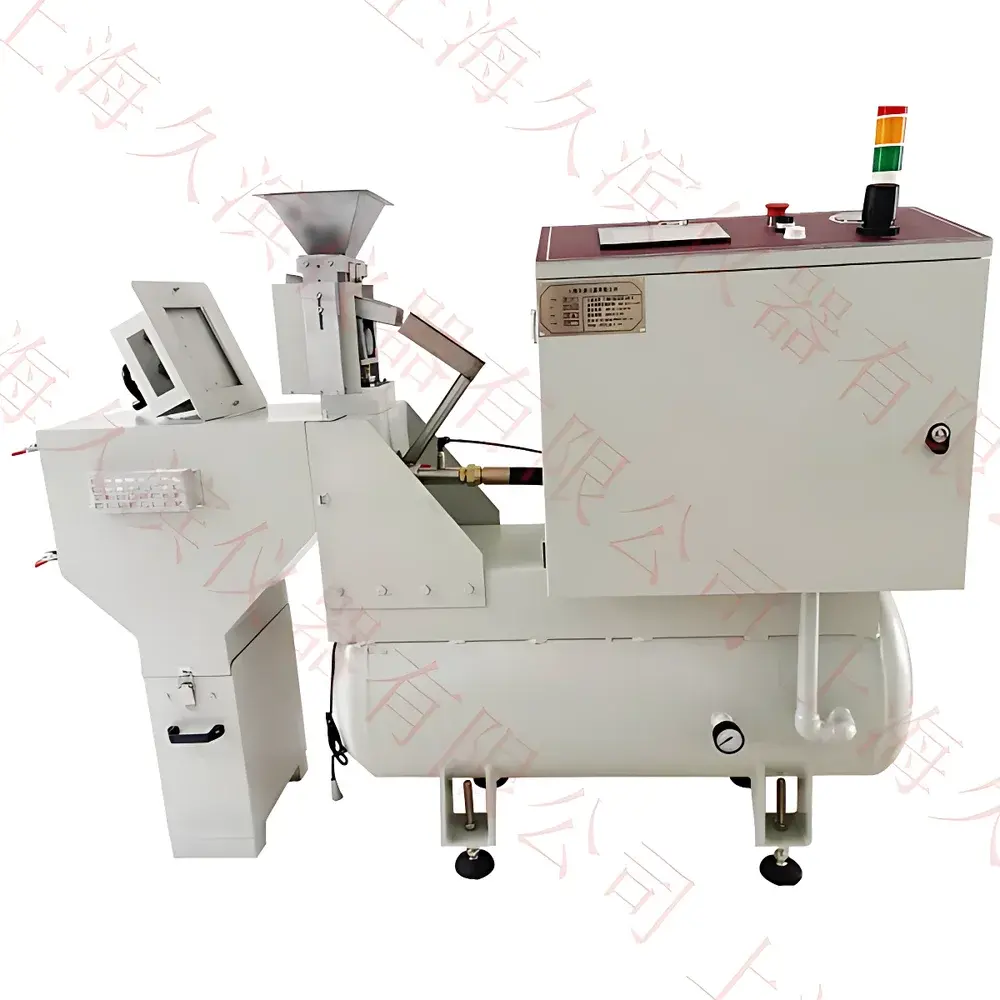
The Jiubin JB-JM5 Stone Chipping Resistance Tester is an engineering-grade impact simulation system designed specifically for evaluating the mechanical durability of automotive thermal management components—particularly radiators, heat exchangers, and associated protective coatings—under high-velocity gravel and stone impact conditions. Based on the principle of controlled pneumatic propulsion, the instrument accelerates standardized abrasive media (e.g., ASTM D3170-compliant gravel or ISO 20567-1-specified crushed stone) through a precisely dimensioned nozzle to replicate real-world under-hood and road-spray exposure. Unlike generic impact testers, the JB-JM5 integrates configurable impact geometry, regulated mass flow dynamics, and repeatable kinetic energy delivery—enabling quantitative assessment of coating delamination, substrate erosion, solder joint integrity, and fin deformation resistance in aluminum or brass radiator cores. The system operates in accordance with core automotive OEM test specifications including GMW14872, Ford CETP 00.00-L-467, and VW TL 226, while supporting method development aligned with SAE J2527 and ISO 20567-2.
Key Features
- Modular impact chamber with interchangeable nozzles (30 mm and 53 mm ID) to accommodate varying particle size distributions and kinetic energy profiles
- Three-axis adjustable specimen mounting platform enabling precise angular alignment (45°, 54°, 90°) per OEM requirements; optional 3D enclosed test volume for non-planar radiator core samples
- Stainless-steel air reservoir (136 L) with pressure stabilization circuitry ensuring consistent impulse delivery across extended test cycles
- Electromagnetically driven vibratory feeder with stepless amplitude control for reproducible impact media feed rate (0.5–5 kg/min typical range)
- Manual precision needle valve for fine-tuned regulation of propelling air pressure (0–0.8 MPa), traceable via calibrated analog gauge
- Integrated acoustic enclosure design compliant with ISO 7779 for noise mitigation; operational sound level ≤120 dB(A) at 1 m distance (hearing protection required)
- Robust structural frame fabricated from powder-coated carbon steel, rated for continuous-duty industrial laboratory environments
Sample Compatibility & Compliance
The JB-JM5 accommodates full-size automotive radiator assemblies (up to 800 × 600 × 150 mm), cut core specimens, coated fin strips, and epoxy-bonded header plates. Its modular fixture system supports both flat-panel evaluation (per ASTM D3170 Annex A1) and three-dimensional component testing under dynamic orientation. All test procedures are structured to support audit-ready documentation per IATF 16949 and ISO/IEC 17025 requirements. The system’s mechanical calibration protocol—covering nozzle wear verification, pressure decay measurement, and feed-rate linearity validation—is documented in accordance with GLP principles. While not inherently certified, the JB-JM5 configuration satisfies functional equivalency criteria referenced in Ford WSK-M2G323-A2, BMW GS 90031, and Toyota TSL-0100G for stone chip resistance validation.
Software & Data Management
The JB-JM5 operates as a hardware-controlled test station without embedded firmware or proprietary software. All operational parameters—including total exposure time, cumulative media mass delivered, average pressure reading, and ambient temperature—are manually recorded using standardized test logs (e.g., AIAG CQI-9 Appendix D templates). For laboratories requiring digital traceability, optional integration with external PLC-based data acquisition systems (e.g., National Instruments CompactRIO or Siemens SIMATIC S7-1200) enables timestamped logging of pressure transducer output, feeder current draw, and cycle counter signals. Such configurations support 21 CFR Part 11-compliant electronic records when deployed with validated audit trail modules and role-based user authentication.
Applications
- Quantitative ranking of anti-chip coating formulations applied to aluminum radiator fins and tanks
- Evaluation of solder joint cohesion strength in brazed core assemblies subjected to repeated micro-impact loading
- Comparative analysis of epoxy adhesive performance between plastic end tanks and metal core structures
- Validation of hydrophobic or ceramic-reinforced surface treatments against abrasive wear under turbulent airflow conditions
- Pre-validation screening of new fin pitch designs for resistance to stone-induced bending fatigue
- Root cause analysis of field-reported radiator leaks linked to localized coating failure near mounting brackets
FAQ
Is an air compressor included with the JB-JM5?
No. A dedicated oil-free rotary screw or piston-type air compressor delivering ≥2 m³/min at 0.8 MPa is required and must be supplied by the end user.
Can the JB-JM5 perform tests at sub-zero or elevated temperatures?
The base configuration operates at ambient laboratory conditions. Optional climate-controlled test chambers (-40°C to +85°C) are available as accessories and integrate mechanically with the 3D test enclosure.
What gravel specifications are recommended for calibration?
ASTM D3170 Type A gravel (4.75–9.5 mm, angular, basaltic) or ISO 20567-1 Grade 2 crushed stone (5–10 mm) are standard. Particle size distribution must be verified quarterly per ISO 9276-2.
Does the system meet ISO 17025 calibration requirements?
The JB-JM5 itself is not a measuring instrument but a mechanical test apparatus. Its pressure transducers and feed-rate meters require third-party calibration per ISO/IEC 17025 by an accredited lab; calibration certificates are provided upon request for each component.