
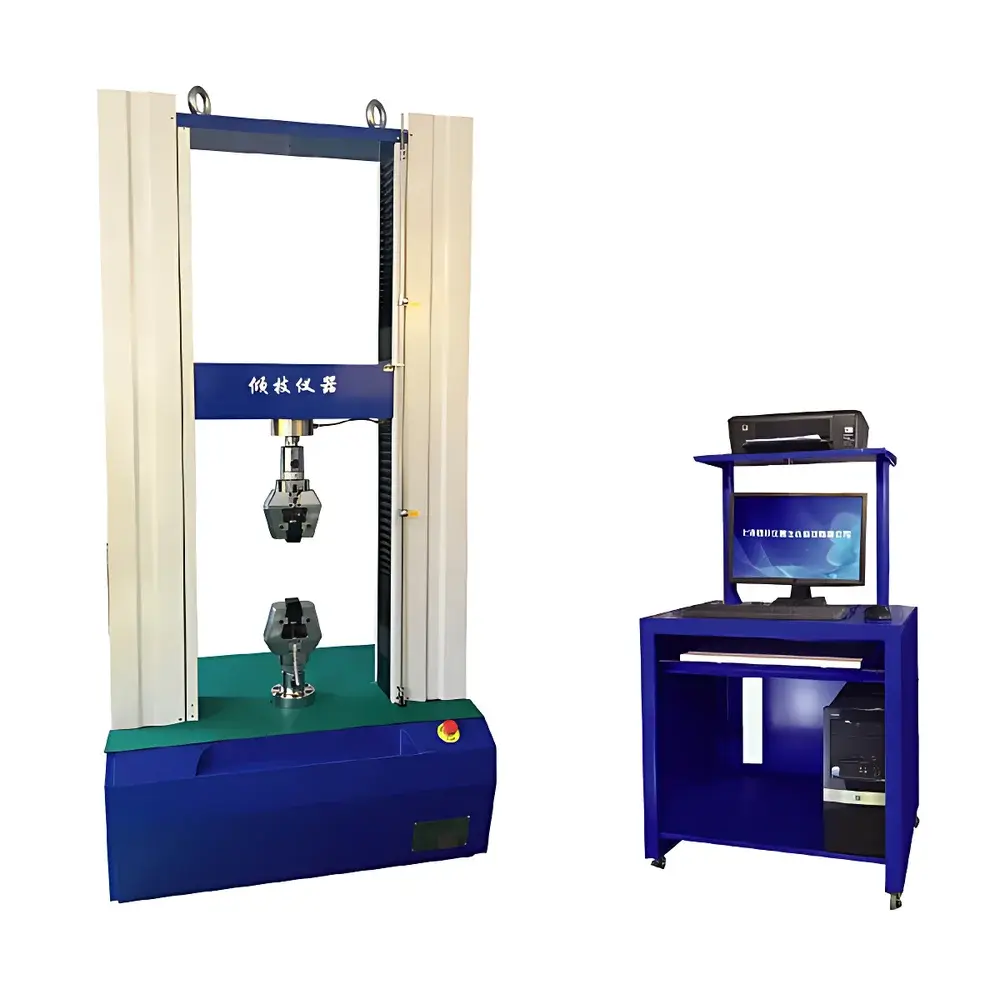
QJ212 Universal Testing Machine for Tensile, Compression and Flexural Testing of Metallic Materials
| Origin | Shanghai, China |
|---|---|
| Manufacturer Type | Authorized Distributor |
| Origin Category | Domestic (PRC) |
| Model | QJ212 |
| Price | USD 8,600 (FOB Shanghai) |
| Instrument Type | Electromechanical Universal Testing Machine |
| Load Capacity Options | 10–500 kN |
| Effective Test Width | 500 mm |
| Max. Stroke (Tensile) | 600 / 800 mm |
| Test Speed Range | 0.001–1000 mm/min |
| Force Resolution | ±1/250,000 full scale (no range switching) |
| Speed Accuracy | ±0.5% of indicated value |
| Displacement & Strain Measurement Accuracy | ±0.5% of indicated value |
| Safety Features | Electronic limit protection, overload protection at 110% capacity, manual/auto return, dual-speed crosshead control |
| Dimensions (W×D×H) | 1000 × 680 × 2450 mm |
| Weight | 1250 kg |
Overview
The QJ212 Universal Testing Machine is an electromechanical static testing system engineered for high-precision mechanical characterization of metallic materials under uniaxial loading conditions. It operates on the principle of servo-controlled electromechanical actuation, applying controlled axial force via a precision ball-screw-driven crosshead to measure load–displacement response in tension, compression, and three-point or four-point bending configurations. Designed to meet the metrological rigor required in quality control laboratories, R&D facilities, and third-party certification centers, the system complies with fundamental mechanical testing standards including ISO 6892-1 (tensile testing of metals), ISO 15630-1 (reinforcing steels), ASTM E8/E8M, ASTM E9 (compression), ASTM E290 (flexure), and DIN EN 10002-1. Its fully integrated Windows-based control architecture enables real-time acquisition, visualization, and post-processing of force, displacement, and extension data—supporting both open-loop speed control and closed-loop strain or stress rate regulation per standard-defined protocols.
Key Features
- Modular load frame architecture supporting interchangeable load cells from 10 kN to 500 kN, all calibrated to ISO 7500-1 Class 0.5 accuracy
- High-resolution force measurement system with ±1/250,000 full-scale resolution and no internal range switching—ensuring consistent sensitivity across the entire capacity span
- Electromechanical drive system delivering smooth, low-noise motion from 0.001 mm/min to 1000 mm/min, with speed accuracy maintained within ±0.5% of setpoint
- Dual-mode crosshead positioning: fine-adjustment jog control and high-speed return function for rapid specimen setup and cycle recovery
- Integrated electronic limit switches and programmable overload cutoff (110% of selected load cell capacity) for operator and equipment safety
- Rigid C-frame construction (1250 kg mass) with 500 mm effective test width and up to 800 mm vertical stroke—accommodating standard and extended-length metallic specimens per ASTM E8 and ISO 6892
- Real-time dynamic curve rendering with multi-curve overlay, zoom, pan, and annotation tools—enabling immediate visual validation of yield point, UTS, modulus, and fracture behavior
Sample Compatibility & Compliance
The QJ212 accommodates standardized metallic test specimens—including flat sheet, round bar, wire, and welded joints—as defined in ISO 6892-1, ASTM E8/E8M, and GB/T 228.1. Grip systems support wedge-action, pneumatic, and hydraulic options (available as accessories) for optimal clamping of high-strength alloys without slippage or premature failure. Bending fixtures conform to ASTM E290 geometry requirements (span-to-depth ratios, roller diameters, support clearances). All hardware and firmware are designed to support audit-ready documentation per GLP and GMP environments. While the base system does not include FDA 21 CFR Part 11-compliant user access controls, optional software modules provide electronic signatures, audit trails, and role-based permissions for regulated manufacturing and testing labs.
Software & Data Management
The embedded Windows-based control software provides native support for test method scripting, parameter templates, and automated report generation in PDF, Excel, and XML formats. Raw data files (.tdms or .csv) retain full timestamped metadata—including environmental conditions (if connected to optional external sensors), operator ID, calibration status, and machine configuration. Curve analysis functions include automatic yield strength determination (0.2% offset method), tangent modulus calculation, elongation at break, and reduction in area. Data editing is permitted only with full traceability: any manual adjustment triggers an immutable audit log entry recording time, user, action type, and pre/post values. Exported reports embed digital signatures and comply with ISO/IEC 17025 documentation requirements for accredited testing laboratories.
Applications
- Tensile property evaluation of structural steels, aluminum alloys, titanium grades, and stainless steels per ISO 6892-1 and ASTM E8
- Compressive strength and modulus testing of cast iron, sintered metals, and high-density metal matrix composites
- Flexural rigidity and fracture toughness assessment of metallic foils, thin-walled tubes, and additively manufactured lattice structures
- Quality conformance verification for aerospace fasteners, automotive suspension components, and medical implant-grade alloys
- Material qualification and lot-release testing in foundries, rolling mills, and Tier-1 component suppliers operating under AS9100 or IATF 16949
- Research-scale mechanical testing in university metallurgy and materials science departments conducting fatigue precursor studies or microstructure–property correlation work
FAQ
What international standards does the QJ212 support out-of-the-box?
The system includes pre-configured test methods for ISO 6892-1, ASTM E8/E8M, ASTM E9, ASTM E290, and DIN EN 10002-1. Custom method development is supported via the built-in scripting interface.
Is third-party calibration certification included with delivery?
Yes—a NIST-traceable certificate of calibration (covering load, displacement, and speed axes) is provided upon shipment. Optional UKAS or DAkkS-accredited calibration services are available upon request.
Can the QJ212 be integrated into a laboratory information management system (LIMS)?
Yes, the software supports OPC UA and TCP/IP-based data export protocols, enabling seamless bidirectional integration with major LIMS platforms including LabWare, Thermo Fisher SampleManager, and STARLIMS.
What maintenance is required during the first year of operation?
Routine maintenance includes monthly lubrication of the ball screw, quarterly verification of grip alignment, and annual recalibration of the load cell and encoder—services covered under the standard one-year comprehensive warranty.
Are bending fixtures and extensometers supplied as standard equipment?
Three-point bending fixtures are included; four-point and specialized fixtures (e.g., for pipe or coil testing) are optional. Contact-type extensometers (e.g., 25 mm gauge length, ±1% accuracy) are available as configurable accessories—not bundled by default.



