
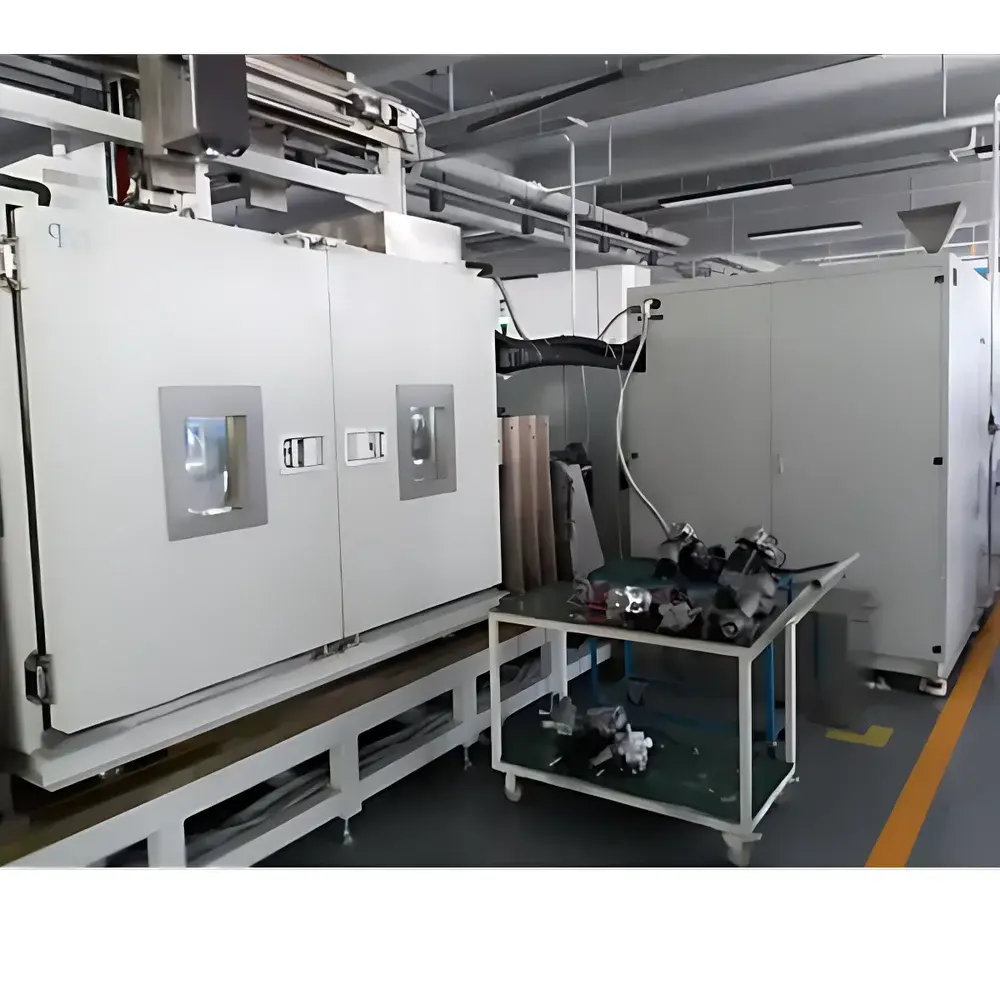
Qingji QJCK-395A High-Low Temperature Water Immersion Environmental Test Chamber
| Brand | Qingji |
|---|---|
| Origin | Shanghai, China |
| Model | QJCK-395A |
| Chamber Type | Integrated High-Low Temperature + Water Immersion (Cold/Hot Water Spray & Thermal Cycling) |
| Compliance | GB/T 28046.4–2011, VW 80000:2009–10 |
| Application Scope | Automotive Component Validation, Aerospace Sealing Integrity Testing, IPX9K-Grade Enclosure Evaluation, GLP/GMP-Compliant Environmental Reliability Assessment |
| Temperature Range | –40 °C to +150 °C (typical standard configuration) |
| Water Spray Parameters | Adjustable flow rate (14–16 L/min), nozzle pressure 8–10 MPa, water temperature controllable from 5 °C to 85 °C |
| Internal Volume | 395 L |
| Control Accuracy | ±0.5 °C (temperature), ±3% RH (when humidification enabled) |
| Cooling/Heating Rate | ≥3 °C/min (average, 25 °C to –40 °C), ≥2 °C/min (25 °C to +150 °C) |
| Structural Material | Inner chamber — SUS316L stainless steel |
| Safety Features | Over-temperature cut-off, high-pressure water leakage detection, emergency stop with mechanical interlock, dual-circuit water supply monitoring |
Overview
The Qingji QJCK-395A High-Low Temperature Water Immersion Environmental Test Chamber is an integrated reliability validation platform engineered for simultaneous thermal cycling and controlled water immersion exposure. Unlike conventional thermal chambers or standalone water spray systems, the QJCK-395A implements a unified chamber architecture where programmable temperature profiles (–40 °C to +150 °C) are synchronized with high-pressure, temperature-regulated water jetting—enabling precise replication of real-world environmental stressors such as road splash under freezing conditions, engine bay thermal shock during rain ingress, or marine-salt-laden wave impact on vehicle electronics housings. Its design follows the physical principles of combined thermal-mechanical stress application: rapid thermal transients induce material contraction/expansion while pressurized water penetration tests sealing integrity, gasket resilience, and condensation resistance at phase-change boundaries. This dual-stress methodology aligns with accelerated life testing (ALT) frameworks used in automotive functional safety (ISO 26262) and aerospace DO-160 Section 16 compliance pathways.
Key Features
- Single-chamber integration eliminates cross-contamination risk and calibration drift between separate thermal and hydraulic subsystems.
- Independent water temperature control (5–85 °C) coupled with high-pressure spray nozzles (8–10 MPa, 14–16 L/min) enables simulation of IPX9K-compliant hot-water jetting per DIN 40050-9 and ISO 20653:2013.
- Triple-layer insulation (SUS316L inner liner, 120 mm polyurethane core, reinforced outer casing) ensures thermal stability ≤±0.5 °C over full operating range and minimizes energy consumption during extended thermal soak cycles.
- Programmable multi-segment test profiles support complex sequences: e.g., –40 °C soak → ramp to +85 °C → initiate 70 °C water jetting at 10 MPa for 30 s → hold at +23 °C/50% RH for recovery assessment.
- Real-time data logging includes chamber air temperature, water inlet/outlet temperature, spray pressure, and door interlock status—all timestamped with UTC synchronization for audit-ready traceability.
Sample Compatibility & Compliance
The QJCK-395A accommodates samples up to 600 mm × 600 mm × 600 mm (W×D×H) with standardized mounting fixtures compatible with ISO 16750-4, GB/T 28046.4–2011 (Road vehicles — Environmental conditions and testing for electrical and electronic equipment), and VW 80000:2009–10 (Volkswagen standard for component climatic testing). It supports evaluation of enclosures rated IP6K9, NEMA 4X, and MIL-STD-810H Method 512.5 (Immersion). All operational parameters comply with GLP and GMP Annex 11 requirements for electronic record integrity, including user-access-controlled parameter locking, electronic signature capability, and immutable audit trails for temperature setpoints, spray activation timestamps, and alarm events.
Software & Data Management
The embedded controller runs Qingji’s Q-TestSuite v3.2 firmware, offering ISO/IEC 17025-aligned calibration traceability via NIST-traceable internal sensors (Pt100 Class A, pressure transducers with ±0.25% FS accuracy). Data export supports CSV, XML, and PDF formats compliant with FDA 21 CFR Part 11 for electronic signatures and audit trail retention. Optional Ethernet/IP and Modbus TCP interfaces allow integration into centralized MES or LIMS environments. Software validation documentation (IQ/OQ/PQ protocols) is provided upon request for regulated industries.
Applications
- Automotive: Headlamp housing waterproofness verification after thermal cycling; EV battery pack enclosure validation under combined cold-start/water-jet conditions.
- Aerospace: Avionics box sealing performance under simulated de-icing fluid exposure at sub-zero temperatures.
- Industrial Electronics: IEC 60529 IPX9K certification for outdoor motor controllers subjected to steam cleaning protocols.
- Medical Devices: Environmental stress screening of sterilizable diagnostic housings per ISO 14971 risk management requirements.
- Academic Research: Correlation studies between thermal gradient magnitude, water ingress kinetics, and polymer microcrack propagation rates.
FAQ
Does the QJCK-395A meet ISO 14644 cleanroom compatibility requirements for semiconductor packaging validation?
No—the chamber is not designed for particle-controlled environments; its water delivery system introduces non-classified aerosol generation. For cleanroom-compatible thermal-wet testing, consult the QJCK-Clean series.
Can third-party calibration certificates be issued by accredited laboratories?
Yes—Qingji provides factory calibration reports traceable to CNAS-accredited labs; end-user calibration services are available through authorized partners in EU, NA, and APAC regions.
Is remote monitoring supported during unattended overnight tests?
Yes—via optional 4G/LTE module with TLS 1.2 encrypted telemetry; real-time alerts trigger on deviation >±1.0 °C or spray pressure loss >5% from setpoint.
What maintenance intervals are recommended for the high-pressure water system?
Filter cartridges require replacement every 200 operational hours; stainless-steel nozzles undergo ultrasonic inspection quarterly; full hydraulic circuit flush recommended annually using ASTM D4327-certified deionized water.
Are custom chamber volume configurations available beyond 395 L?
Yes—Qingji offers OEM engineering support for volumes ranging from 150 L to 2000 L, subject to structural reinforcement analysis and local regulatory review.



