
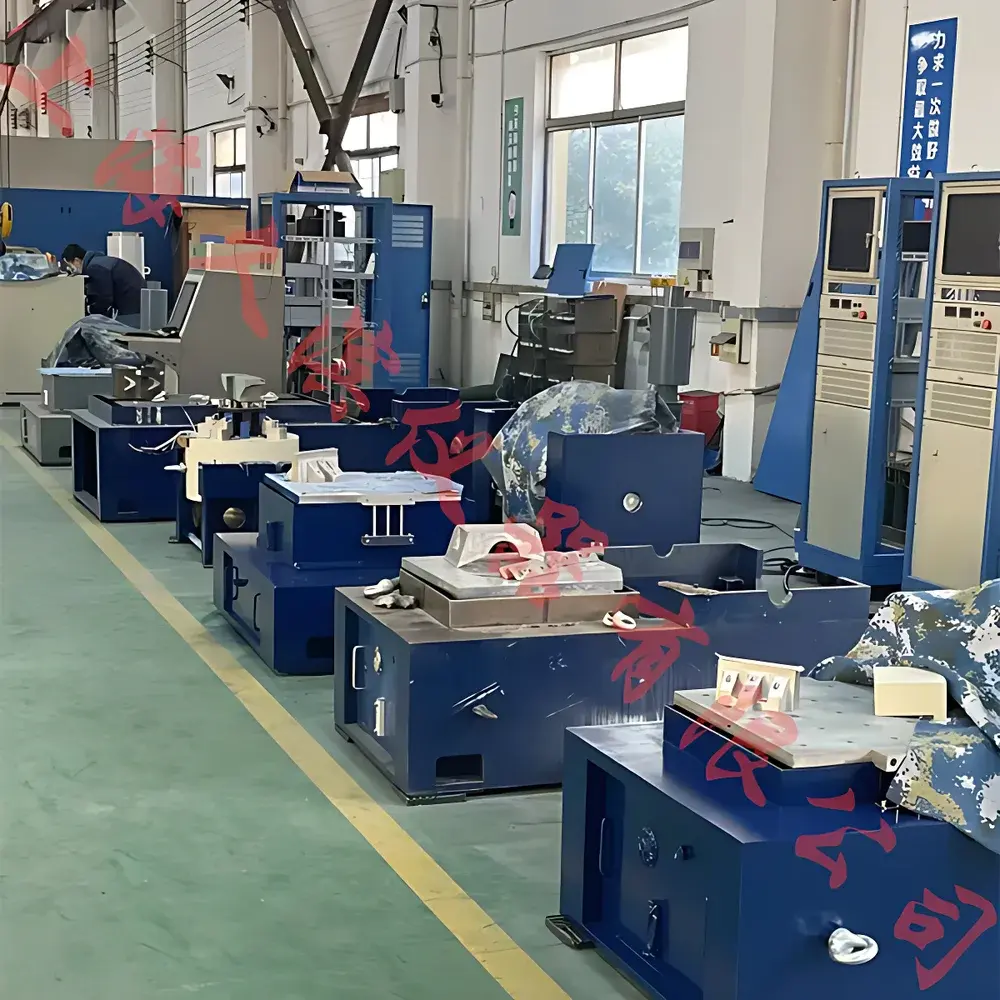
JB-Brookfield JB-600-5 Triaxial Electrodynamically Driven Vibration Testing System
| Brand | JB-Brookfield |
|---|---|
| Origin | Shanghai, China |
| Manufacturer Type | Authorized Distributor |
| Product Category | Domestic |
| Model | JB-600-5 |
| Instrument Type | Electrodynamically Driven Vibration Shaker |
| Control Architecture | DSP-Based Real-Time Controller (32-bit Floating-Point, 450 MHz) |
| ADC Resolution | 24-bit |
| Dynamic Range | 130 dB |
| Standard Compliance | IEC 60068-2-6, GB/T 2423, GJB 150A-2009, ISTA 1/2/3/6, MIL-STD-810D, QC/T 413-2002 |
| Software Modules | Random, Sine, Classical Shock, Resonance Search & Dwell, Sine-on-Random, Shock Response Spectrum (SRS), Long-Duration Waveform Replication |
Overview
The JB-Brookfield JB-600-5 Triaxial Electrodynamically Driven Vibration Testing System is a high-fidelity, closed-loop electrodynamic shaker platform engineered for precise mechanical excitation across three orthogonal axes (X, Y, Z). Unlike single-axis systems, this configuration enables simultaneous or sequential multi-directional vibration input—critical for simulating real-world transport, operational, and environmental stress conditions encountered by aerospace components, automotive electronics, military hardware, and industrial control systems. The system operates on fundamental electromagnetic force generation principles: current passing through the voice coil within a permanent magnetic field produces Lorentz-force-driven motion, enabling accurate acceleration, velocity, and displacement control per ISO 5347 and IEC 68-2-84 definitions. Its core controller integrates a dedicated 450 MHz 32-bit floating-point DSP with 24-bit analog-to-digital conversion and 130 dB dynamic range—ensuring low-noise signal fidelity, minimal phase distortion, and high reproducibility in both open-loop waveform playback and closed-loop feedback control modes.
Key Features
- Triaxial excitation capability via integrated horizontal slip table and vertical shaker assembly—enabling true 3D vibration synthesis without repositioning test articles.
- Modular mechanical interface: precision-machined aluminum slip tables (standard sizes from 300 × 300 mm to 2000 × 2000 mm) with mechanical alignment stops and self-centering mechanisms for repeatable coupling.
- Dedicated vertical extension table option: lightweight high-strength aluminum construction with guided load support, designed to maintain modal integrity up to 2 kHz while accommodating oversized payloads (>100 kg).
- Real-time DSP-based controller supporting concurrent execution of multiple test profiles—including random vibration (PSD-defined), swept-sine, fixed-frequency dwell, classical shock pulses (half-sine, trapezoidal, sawtooth), resonance search & dwell, sine-on-random, and time-domain waveform replication.
- Comprehensive mechanical integration readiness: standardized mounting interfaces for climate chamber coupling (temperature/humidity chambers), allowing combined environmental stress screening (ESS) per MIL-STD-810G Method 514.7 and ISTA 3A protocols.
Sample Compatibility & Compliance
The JB-600-5 accommodates test specimens ranging from small PCB assemblies (<1 kg) to large avionics enclosures or vehicle ECUs (up to 150 kg with appropriate slip table and extension table configuration). Payload mass distribution, center-of-gravity location, and moment-of-inertia constraints are evaluated during setup per ASTM D999 and IEC 60068-2-6 Annex B guidelines. All system performance metrics—including acceleration linearity (±0.5 dB over 5–2000 Hz), transverse motion suppression (<10% at rated force), and force output repeatability (±1.5% RMS)—are verified against GB/T 13310-91 and Q/320502SN001-2007 certification requirements. The system meets full compliance with international standards including IEC 60068-2-6 (vibration testing), GJB 150A-2009 (military environmental test methods), GB/T 4857.10–2005 and GB/T 4857.23–2003 (packaging vibration simulation), and ISTA Series 1–6 for logistics validation.
Software & Data Management
The JB-VCS (JB Vibration Control Suite) software suite provides ISO/IEC 17025-aligned test management functionality. It supports audit-ready data logging with timestamped metadata, user-access-controlled test templates, and configurable pass/fail criteria based on acceleration spectral density (ASD), peak G-levels, or time-history envelope thresholds. All test records include full traceability: operator ID, calibration certificate reference, sensor serial numbers, and firmware revision logs. Export formats include CSV, MATLAB .mat, and UFF58b for third-party analysis. The software architecture complies with FDA 21 CFR Part 11 requirements for electronic records and signatures when deployed in regulated quality assurance environments—supporting role-based permissions, electronic signatures, and immutable audit trails for GLP/GMP-compliant laboratories.
Applications
- Qualification testing of satellite subsystems under launch vibration spectra (per ECSS-E-ST-10-03C and NASA-HDBK-7005).
- Automotive ECU durability validation per ISO 16750-3 and QC/T 413-2002.
- Packaging integrity assessment using ISTA 3E and 3H protocols for e-commerce logistics simulation.
- Resonance identification and fatigue life estimation of structural assemblies via swept-sine dwell and SRS synthesis.
- Transportation simulation for defense electronics per MIL-STD-810D Method 514.5 and GJB 150.16A-2017.
- Development-stage modal analysis support through controlled excitation and response measurement synchronization.
FAQ
What is the maximum payload capacity for triaxial operation?
Payload limits depend on configured slip table size and extension table use; standard configurations support up to 100 kg on the horizontal plane and 150 kg vertically with guided extension tables.
Does the system support mixed-mode vibration profiles (e.g., sine-on-random)?
Yes—the controller natively executes sine-on-random, random-on-random, and shock response spectrum (SRS) synthesis with real-time convergence monitoring.
Is remote operation and monitoring supported?
Ethernet-based TCP/IP communication enables remote control, live spectrum streaming, and diagnostic telemetry via secure HTTPS interface compatible with enterprise SCADA and LIMS integration.
How often does the system require calibration verification?
Annual traceable calibration to national metrology standards (e.g., CNAS-accredited labs) is recommended; daily verification using internal reference accelerometers and shaker check routines ensures ongoing confidence in control fidelity.
Can the JB-600-5 be integrated into an environmental test chamber?
Yes—standardized flange interfaces and thermal isolation provisions allow seamless coupling with temperature/humidity chambers meeting IEC 60068-3-5 and MIL-STD-202G requirements.



