
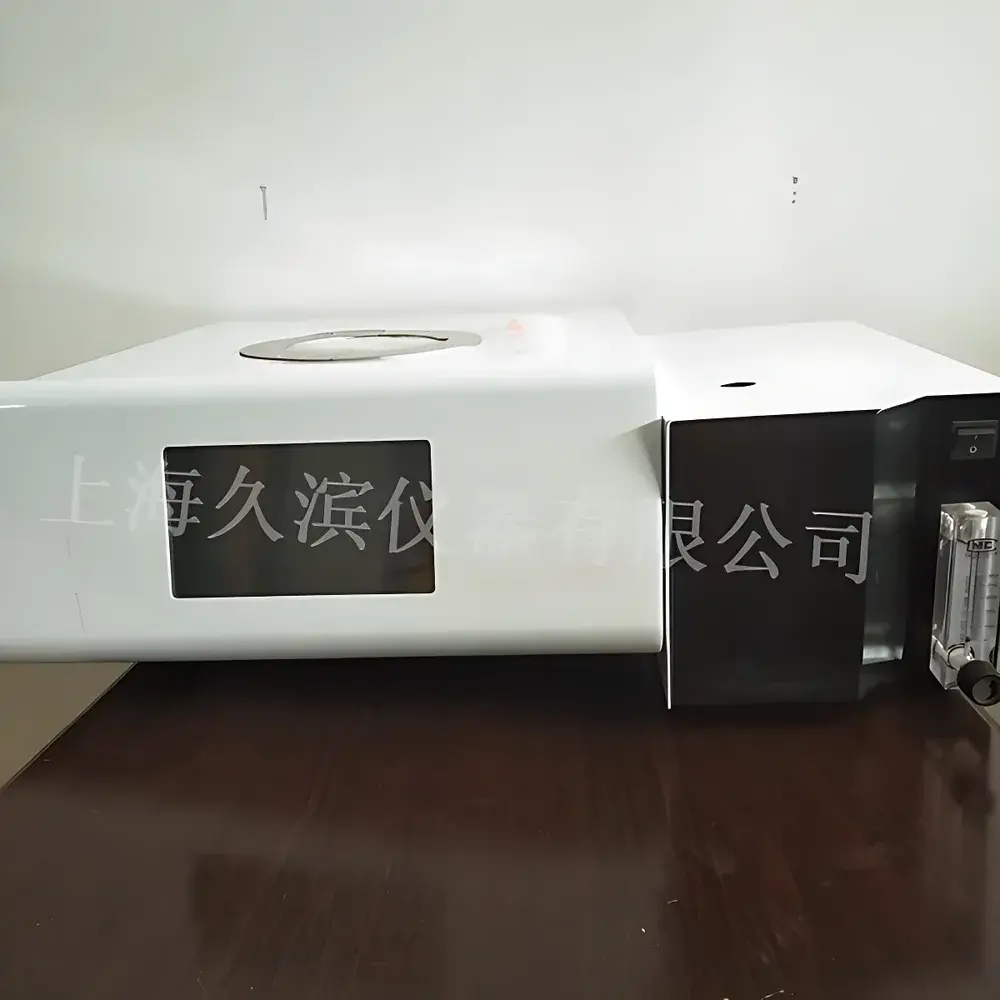
JB-STA-200 Simultaneous Thermal Analyzer (STA) – Jiubin Instruments
| Brand | Jiubin Instruments |
|---|---|
| Model | JB-STA-200 |
| Origin | Shanghai, China |
| Type | Benchtop Simultaneous DSC-TGA Analyzer |
| Temperature Range | Ambient to 1200 °C |
| Heating Rate | 0.1–100 °C/min |
| DSC Sensitivity | <0.1 µW |
| TGA Resolution | 0.1 µg |
| Atmosphere Control | Dual-gas (N₂/air) with mass flow controller |
| Sample Capacity | Up to 200 mg |
| Compliance | ASTM E1131, ISO 11358, USP <641>, GB/T 19466 |
Overview
The JB-STA-200 Simultaneous Thermal Analyzer is a benchtop dual-sensor thermal analysis system engineered for precision-coupled measurement of heat flow (Differential Scanning Calorimetry, DSC) and mass change (Thermogravimetric Analysis, TGA) under controlled atmospheric conditions. Based on the principle of symmetrical heat-flux DSC combined with high-resolution microbalance technology, the instrument delivers synchronized, real-time data acquisition across a wide temperature range (ambient to 1200 °C), enabling rigorous characterization of thermal transitions—including glass transition (Tg), crystallization (Tc), melting (Tm), decomposition onset, oxidative stability, and filler content quantification. Its modular furnace design ensures excellent temperature homogeneity and reproducibility, while the integrated dual-gas mass flow controller supports inert (N₂), oxidative (air), or custom gas environments—critical for polymer degradation kinetics, rubber vulcanization profiling, pharmaceutical excipient compatibility screening, and ceramic precursor decomposition studies.
Key Features
- Simultaneous DSC-TGA measurement with independent calibration paths for heat flow and mass signals, minimizing cross-talk and ensuring metrological traceability.
- High-stability ceramic furnace with optimized thermal shielding, delivering ±0.1 °C temperature accuracy and <0.01 °C/min heating rate stability over extended runs.
- Low-drift, quartz-filament microbalance with active buoyancy compensation and automatic tare correction—achieving sub-microgram resolution (0.1 µg) and long-term baseline stability (<5 µg/h).
- Modular sensor platform supporting interchangeable crucibles (alumina, platinum, gold-plated) and optional high-pressure cell (up to 10 bar) for reactive or volatile systems.
- Robust mechanical architecture with vibration-damped optical encoder positioning and sealed bearing mechanisms—designed for continuous operation in QC labs and university core facilities.
- Integrated purge gas manifold with digital mass flow controllers (MFCs) for N₂ and air, enabling precise atmosphere switching during dynamic experiments per ASTM E2070.
Sample Compatibility & Compliance
The JB-STA-200 accommodates solid powders, granules, films, elastomers, composites, and small-volume liquids (in hermetic pans). It is routinely deployed for rubber compound analysis (e.g., SBR, EPDM, silicone vulcanizates), polymer blend phase behavior, battery cathode material decomposition, pharmaceutical polymorph screening, and inorganic hydrate quantification. The system conforms to key international standards including ASTM E1131 (TGA), ASTM E1269 (DSC heat capacity), ISO 11358 (polymer thermogravimetry), ISO 11357 (DSC for plastics), and USP (thermal analysis in pharmaceutical development). Data integrity meets GLP/GMP requirements through audit-trail-enabled software, electronic signatures, and 21 CFR Part 11–compliant user access control.
Software & Data Management
Control and analysis are performed via STAControl™ v4.2—a Windows-based application featuring real-time multi-channel visualization, automated baseline subtraction, peak deconvolution (Gaussian/Lorentzian fitting), kinetic modeling (Friedman, Ozawa-Flynn-Wall), and quantitative residue calculation. Raw data export is supported in ASCII, CSV, and universal .QTX formats compatible with third-party tools (OriginLab, MATLAB, TA Universal Analysis). All method parameters, operator ID, instrument logs, and calibration records are embedded into each data file. Audit trails record timestamped actions—including parameter edits, calibration events, and report generation—with immutable hashing to prevent tampering.
Applications
- Rubber & Elastomer R&D: Cure kinetics analysis, filler dispersion assessment, aging behavior under thermal stress, and carbon black/silica loading verification.
- Polymers & Composites: Degradation onset temperature (Td), char yield prediction, flame-retardant efficiency evaluation, and moisture/volatile content quantification.
- Pharmaceuticals: Polymorphic transition mapping, excipient–API compatibility, residual solvent determination, and lyophilized product stability profiling.
- Energy Materials: Cathode/anode thermal runaway onset, SEI layer formation enthalpy, and binder decomposition thresholds in Li-ion battery formulations.
- Inorganics & Ceramics: Decomposition stoichiometry of precursors (e.g., nitrates, carbonates), dehydration steps in clays, and thermal expansion coefficient estimation via TGA-DSC coupling.
FAQ
What sample mass range is recommended for optimal signal-to-noise ratio in DSC-TGA coupling?
For most organic and polymeric samples, 5–20 mg provides optimal balance between sensitivity and thermal lag; inorganic oxides or high-density metals may require 10–50 mg for adequate mass signal resolution.
Does the JB-STA-200 support evolved gas analysis (EGA) integration?
Yes—the instrument features a dedicated quadrupole MS or FTIR coupling port (standard 6 mm O.D. stainless steel transfer line) with temperature-controlled interface (up to 300 °C) and synchronization trigger output for time-resolved gas speciation.
How frequently must the microbalance be calibrated, and what standards are used?
Full balance calibration is recommended before each analytical session using certified Ni and Al reference standards traceable to NIST SRM 720; drift verification is performed automatically at start-up using internal reference weights.
Is remote monitoring or networked data archiving supported?
The system supports TCP/IP communication and integrates with enterprise LIMS via ASTM E1384-compliant data exchange protocols; raw files can be auto-synced to secure NAS or cloud storage with configurable retention policies.
Can the JB-STA-200 operate under reducing atmospheres such as H₂ or CO?
Yes—when equipped with optional corrosion-resistant gas lines and high-purity H₂/CO MFC modules, the system supports fully programmable reducing ramp profiles compliant with ISO 11358-3 for metal oxide reduction studies.



