
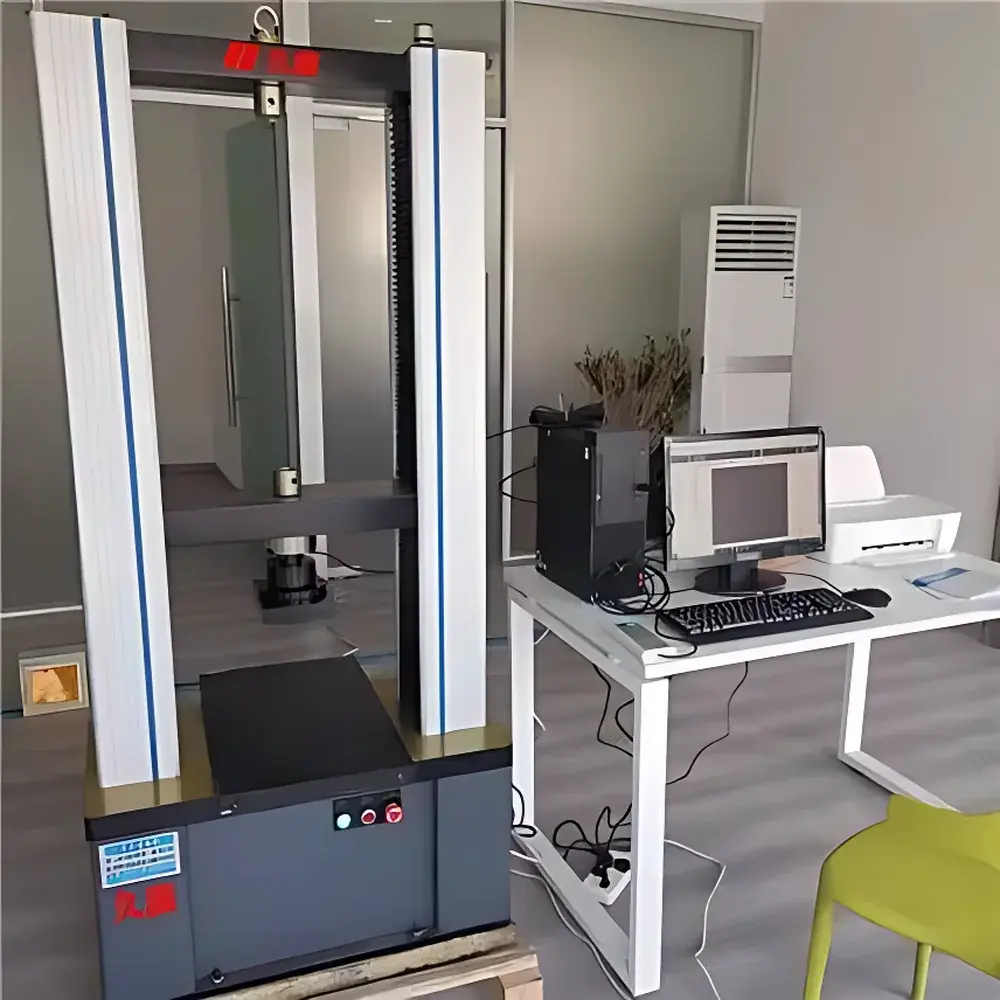
Jiubin JB-117 Electronic Tensile Testing Machine for Wood-Plastic Composites
| Brand | Jiubin |
|---|---|
| Origin | Shanghai, China |
| Model | JB-117 |
| Max Test Force | 5000 N |
| Force Accuracy | ±0.5% of reading |
| Load Cell Options | 50 N / 200 N / 500 N / 1000 N / 5000 N |
| Force Resolution | 1/500,000 FS |
| Displacement Resolution | 0.1 µm |
| Speed Range | 0.5–500 mm/min |
| Effective Test Width | 400 mm |
| Maximum Travel Distance (unloaded) | 1000 mm |
| Power Supply | 220 V AC, 50 Hz, 1 kW |
| Weight | ~200 kg |
Overview
The Jiubin JB-117 Electronic Tensile Testing Machine is a precision-engineered universal testing system designed specifically for mechanical characterization of wood-plastic composites (WPCs) and other heterogeneous structural materials. It operates on the principle of controlled uniaxial force application—measuring tensile, compressive, flexural, shear, peel, tear, and puncture responses under standardized quasi-static loading conditions. The system employs dual closed-loop digital control of load and displacement, driven by a high-torque AC servo motor coupled to a preloaded TBI precision ball screw transmission. Force measurement is performed via a calibrated MKCELLS load cell (traceable to NIST-equivalent standards), while position feedback is delivered through a high-resolution optical encoder (0.1 µm resolution). This architecture ensures long-term stability, repeatability ≤ ±0.5% of reading, and compliance with fundamental metrological requirements for ISO 7500-1 Class 0.5 verification. Its modular design supports adaptation across material classes—from rigid WPC panels and engineered wood products to polymer films, metallic foils, photovoltaic interconnect ribbons, and packaging substrates—making it suitable for R&D labs, QC departments, and third-party certification facilities operating under GLP or ISO/IEC 17025 frameworks.
Key Features
- Integrated 64-bit closed-loop controller with real-time data acquisition at ≥1 kHz sampling rate
- Seven programmable control modes: constant crosshead speed, constant load, constant strain, constant stress, constant load rate, constant strain rate, and constant stress rate
- Automatic range switching across five selectable load capacities (50–5000 N) to maintain optimal signal-to-noise ratio
- Self-calibrating zero-point initialization at test initiation to eliminate thermal drift and mechanical preload effects
- Configurable safety protocols including overload cutoff (2–10% above set limit), end-of-travel hard stops, and emergency stop circuitry compliant with IEC 60204-1
- Real-time dynamic plotting of force–displacement, stress–strain, and time-based curves with post-test curve traversal and point interrogation
- Open-formula calculation engine supporting user-defined mechanical property derivations (e.g., secant modulus, yield offset, energy absorption up to break)
- Bilingual software interface (English/Chinese/Simplified/Traditional) with audit-trail logging enabled for FDA 21 CFR Part 11 readiness
Sample Compatibility & Compliance
The JB-117 accommodates specimens up to 400 mm wide and 1000 mm in free-span length—sufficient for standard ASTM D638 Type I–V, ISO 527-2, EN 313-3, and GB/T 17657 tensile bars used in WPC evaluation. It supports grip types including wedge-action pneumatic clamps, hydraulic self-tightening fixtures, and custom-designed bending jigs for three-point flexure (ASTM D790) or shear testing (ASTM D5379). All test routines are fully compatible with international standards including ASTM D1037 (wood-based panels), ASTM D6109 (flexural properties of lumber), ISO 13061-2 (density and moisture-related mechanical behavior), and JIS A 5908 (particleboard tensile strength). Data output meets traceability requirements per ISO/IEC 17025:2017 Clause 7.7, with timestamped raw values, metadata tagging (operator ID, environmental conditions, calibration certificate ID), and exportable CSV/Excel formats.
Software & Data Management
The embedded Windows-based control software provides full test method configuration, parameter scripting, and automated report generation. Each test session generates a structured XML log containing raw sensor data, machine state flags, environmental metadata (optional external hygrometer/thermometer integration), and operator annotations. Reports comply with customizable templates aligned to internal SOPs or external regulatory submissions—supporting PDF export with embedded digital signatures and Excel-compatible tabular summaries. Audit trail functionality records all user actions (method edits, result overrides, calibration events) with immutable timestamps and user authentication. For enterprise deployment, optional OPC UA server integration enables seamless connection to LIMS or MES platforms without proprietary middleware.
Applications
- Mechanical validation of wood-plastic composite decking, railing, and cladding per ASTM D7032 and CSA O80.10
- Tensile strength and elongation-at-break assessment of recycled PVC-wood blends used in automotive interior trim
- Interlaminar shear strength evaluation of WPC laminates subjected to accelerated weathering cycles
- Peel resistance testing of adhesive bonds between WPC substrates and decorative overlays (e.g., PVC film lamination)
- Compression modulus determination for structural WPC beams under sustained loading per EN 14322
- Quality conformance testing of photovoltaic backsheet materials (PET/PE/EVA laminates) per IEC 61215 mechanical stress protocols
- Educational use in materials science laboratories for teaching fundamental concepts of Hooke’s law, plastic deformation, and fracture mechanics
FAQ
What standards does the JB-117 support out-of-the-box?
Preconfigured test methods include ASTM D638, D790, D1037, ISO 527-2, ISO 178, EN 313-3, GB/T 17657, and JIS A 5908—with additional standards implementable via user-defined protocol scripting.
Is the system compliant with FDA 21 CFR Part 11 requirements?
Yes—the software includes electronic signature capability, role-based access control, and tamper-evident audit trails; full Part 11 compliance requires site-specific validation documentation and network configuration per organizational IT policies.
Can the JB-117 perform cyclic or fatigue testing?
No—it is optimized for static and quasi-static mechanical testing only. For dynamic or high-cycle fatigue applications, a dedicated electrodynamic or servo-hydraulic system is recommended.
What maintenance intervals are recommended for long-term accuracy?
Annual recalibration of the load cell and displacement encoder is advised, along with quarterly verification using certified reference standards per ISO 7500-1; routine cleaning of the ball screw and lubrication per manufacturer guidelines every 500 operational hours.
Are third-party calibration certificates included with shipment?
A factory calibration certificate traceable to national metrology institutes is provided; ISO/IEC 17025-accredited calibration must be arranged separately through an accredited laboratory prior to first use.
Related Products



