
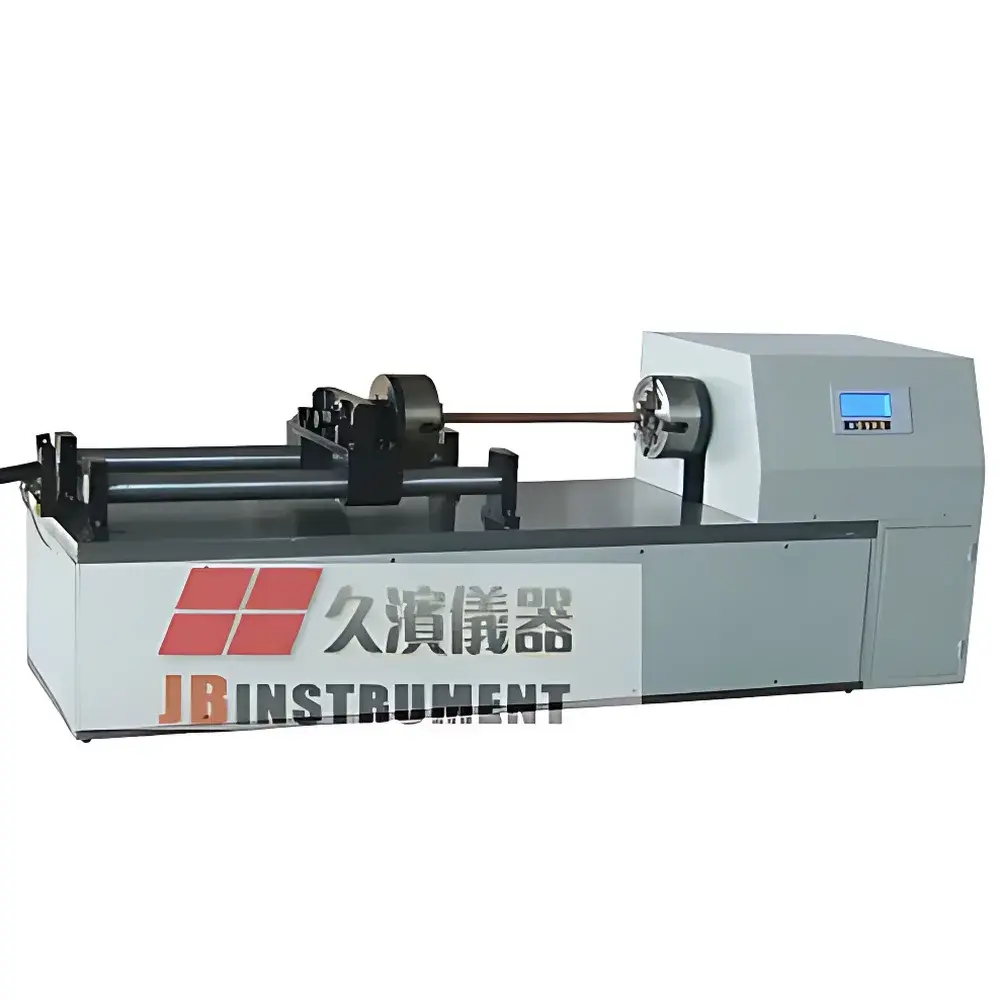
JB-Brookfield JB-X1 Metal and Non-Metal Wire Torsion Testing Machine
| Brand | JB-Brookfield |
|---|---|
| Origin | Shanghai, China |
| Manufacturer Type | Authorized Distributor |
| Country of Origin | China |
| Model | JB-X1 |
| Price Range | USD 2,800 – 7,200 |
| Wire Diameter Range | 0.1–10.0 mm |
| Gauge Length | 350 mm |
| Clamp Outer Diameter | 74 mm |
| Flat Jaw Capacity | 0–3 mm |
| Round Jaw 1 Capacity | 3–6 mm |
| Round Jaw 2 Capacity | 6–10 mm |
| Torsion Speeds | 60 / 90 / 120 / 180 / 300 rpm |
| Speed Accuracy | ±10% |
| Minimum Count Resolution | 0.1 turn |
| Coaxiality of Grips | < 0.4 mm |
| Parallelism of Linear Guide | < 0.2 mm |
| Jaw Hardness | 50–65 HRC |
| Dimensions (L×W×H) | 980 × 400 × 600 mm |
| Weight | 100 kg |
| Power Supply | 220 V, 50 Hz |
| Sound Pressure Level | < 50 dB(A) |
| Compliance | GB/T 239–1999, ISO 7800:1984, ISO 9649:1990, GB/T 2611, JB/T 614 |
Overview
The JB-Brookfield JB-X1 Metal and Non-Metal Wire Torsion Testing Machine is a precision-engineered mechanical testing system designed to evaluate torsional deformation behavior of metallic and non-metallic wire specimens under controlled unidirectional or bidirectional rotational loading. Based on the principle of angular displacement-controlled torque application, the instrument applies continuous, uniform rotational strain about the specimen’s longitudinal axis while monitoring angular position, rotation count, and failure mode. It operates in accordance with standardized torsion test protocols defined by GB/T 239–1999, ISO 7800:1984 (unidirectional), and ISO 9649:1990 (bidirectional), making it suitable for quality control laboratories, metallurgical R&D centers, and wire manufacturing facilities requiring traceable, repeatable torsional performance data.
Key Features
- Motor-driven, programmable torsion actuation with five discrete speed settings (60, 90, 120, 180, and 300 rpm), each calibrated to ±10% accuracy per ISO 9513 requirements for dynamic testing systems.
- Modular jaw assembly with three interchangeable gripping configurations: flat jaws (0–3 mm), round jaw set #1 (3–6 mm), and round jaw set #2 (6–10 mm), all hardened to 50–65 HRC for wear resistance and consistent clamping force distribution.
- High-precision optical encoder-based rotation counter with 0.1-turn resolution, enabling accurate cycle counting up to failure or specified termination criteria.
- Robust cast-iron base and linear motion guide system engineered to maintain coaxial alignment (< 0.4 mm) and parallelism (< 0.2 mm) between upper and lower grips throughout testing—critical for minimizing bending moments and ensuring pure torsional stress states.
- Integrated LCD interface with Chinese/English bilingual menu navigation, supporting real-time display of speed, accumulated turns, and status indicators without external PC dependency.
- Compliant mechanical architecture meeting GB/T 2611 general requirements for testing machine construction, including vibration damping, structural rigidity, and safety interlocks.
Sample Compatibility & Compliance
The JB-X1 accommodates wire specimens with nominal diameters from 0.1 mm to 10.0 mm across its full jaw range. Its 350 mm standard gauge length ensures compatibility with both fine-diameter specialty alloys (e.g., NiTi shape-memory wires, stainless steel sutures) and medium-section copper or aluminum conductors. All test procedures adhere strictly to the geometric and procedural constraints outlined in GB/T 239–1999—including mandrel diameter ratios, grip separation tolerances, and angular velocity limits. For international reporting, raw torsion counts and failure observations are directly translatable into ISO 7800 and ISO 9649 compliance documentation. The system’s mechanical design satisfies JB/T 614 packaging standards for export-grade instrumentation, ensuring transit integrity under IEC 60068 environmental handling conditions.
Software & Data Management
While the JB-X1 operates autonomously via its embedded controller, optional RS-232 or USB-to-serial interface enables connection to Windows-based data acquisition software (sold separately). This software supports timestamped logging of rotation count, elapsed time, and manual pass/fail annotations. Export formats include CSV and Excel-compatible .xls, facilitating integration into LIMS environments or statistical process control (SPC) workflows. Audit-trail functionality—including user login, parameter change history, and test session metadata—is available in validated software packages compliant with FDA 21 CFR Part 11 requirements when deployed in regulated GMP/GLP settings. Raw encoder signals remain accessible for third-party analysis using MATLAB or Python-based post-processing scripts.
Applications
- Assessment of ductility and surface defect sensitivity in drawn copper, aluminum, stainless steel, and titanium alloy wires used in electrical, aerospace, and medical device applications.
- Verification of heat treatment effectiveness (e.g., annealing uniformity) through comparative torsion fatigue life analysis across production batches.
- Evaluation of coating adhesion integrity on galvanized or polymer-coated wire substrates via observation of delamination onset during progressive twisting.
- Quality gate testing for automotive sensor cable assemblies, where torsional stiffness and hysteresis must remain within narrow specification bands over extended flex cycles.
- Research into microstructural evolution under cyclic torsion, particularly for ultrafine-grained or nanocrystalline wire forms where grain boundary sliding dominates plastic response.
FAQ
What standards does the JB-X1 fully support for calibration and validation?
The JB-X1 is designed and verified against GB/T 239–1999, ISO 7800:1984, and ISO 9649:1990 for test execution, and its mechanical construction conforms to GB/T 2611. Calibration certificates traceable to CNAS-accredited national metrology institutes are available upon request.
Can the JB-X1 perform both unidirectional and reverse-direction torsion sequences automatically?
Yes—the control firmware supports pre-programmed bidirectional test routines, including alternating direction reversal after specified turn counts, with automatic stop-on-fracture detection via torque drop thresholding.
Is operator training included with purchase?
Standard installation and operational training is provided remotely or on-site (travel fees apply for on-site sessions), covering safe setup, jaw selection logic, speed configuration, and interpretation of failure morphology per GB/T 239 Annex B guidelines.
What maintenance intervals are recommended for long-term repeatability?
Lubrication of the gear reducer and linear guide rails is advised every 500 operational hours; optical encoder windows should be cleaned quarterly; jaw hardness verification is recommended annually using certified Rockwell testers.
Does the system meet electromagnetic compatibility (EMC) requirements for laboratory deployment?
Yes—the JB-X1 complies with GB/T 18268.1–2010 (IEC 61326-1) for laboratory-use EMC, including radiated emissions ≤ 40 dBμV/m at 10 m and immunity to electrostatic discharge per IEC 61000-4-2 Level 3.



