
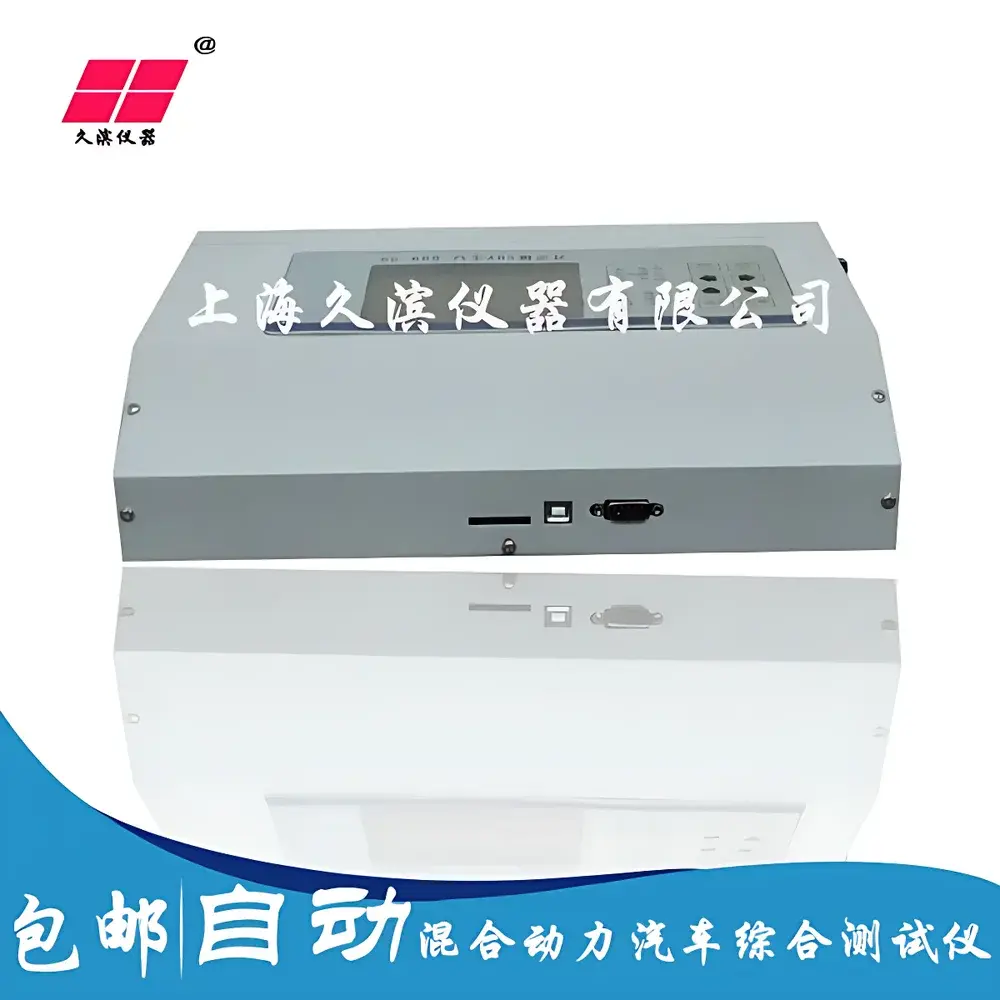
JB-850 Hybrid & Electric Vehicle Comprehensive Test System by Jiubin Instruments
| Brand | Jiubin Instruments |
|---|---|
| Model | JB-850 |
| Origin | Shanghai, China |
| Power Supply | DC 9.6 V (internal Ni-MH battery) / DC 12 V (external) |
| Dimensions | 330 × 220 × 75 mm |
| Weight | 1.2 kg (incl. battery) |
| Operating Temperature | −20 °C to +45 °C |
| Humidity Range | 30–80 % RH |
| Speed Range | 0–500.0 km/h (resolution: 0.01 km/h, accuracy: ±0.5 %) |
| Distance Range | 0–999999.999 m (resolution: 1 mm, accuracy: ±0.2 %) |
| Time Range | 0–99999.999 s (resolution: 1 ms, accuracy: ±0.1 %) |
| Deceleration Range | 0–14.9 m/s² (resolution: 0.01 m/s², accuracy: ±1 %) |
| MFDD Range | 0–9.999 m/s² (resolution: 0.001 m/s², accuracy: ±1 %) |
| Pedal Force Range | 0–999 N (resolution: 1 N, accuracy: ±1 %) |
| Fuel Consumption Range | 0–999.999 L/100 km (resolution: 0.001 L/100 km, accuracy: ±2 %) |
| Voltage Input | 0–300 V (resolution: 0.1 V, accuracy: ±0.5 %) |
| Current Input | 0–500 A (resolution: 0.1 A, accuracy: ±0.5 %) |
| Display | 240 × 128 dot-matrix LCD with Chinese UI |
| Data Storage | SD card (file-based, unlimited capacity) and USB export |
| Interfaces | Dual RS232, USB, SD slot, built-in thermal printer |
| Real-time OS | µC/OS-II |
| CPU Core | ARM Cortex-based 32-bit microcontroller |
Overview
The JB-850 Hybrid & Electric Vehicle Comprehensive Test System is an embedded instrumentation platform engineered for standardized, repeatable, and traceable evaluation of dynamic vehicle performance across conventional internal combustion engine (ICE), hybrid electric vehicle (HEV), and battery electric vehicle (BEV) architectures. At its core lies an ARM Cortex-based 32-bit microcontroller running the deterministic real-time operating system µC/OS-II—ensuring precise time-synchronized acquisition of multi-channel analog and digital signals during transient driving events. The system implements kinematic and energetic measurement principles grounded in ISO 8767 (braking performance), ISO 8584 (acceleration testing), ISO 15223-1 (vehicle speed measurement), and SAE J1269 (fuel economy), enabling compliance-ready test execution in both laboratory and on-road environments. Designed for integration into automotive R&D labs, type-approval testing facilities, technical supervision institutes, and university engineering curricula, the JB-850 delivers synchronized acquisition of speed, distance, time, deceleration, pedal force, voltage, current, and fuel/electric energy consumption—supporting full-cycle characterization from component-level validation to whole-vehicle certification.
Key Features
- High-resolution real-time data acquisition: 0.01 km/h speed resolution, 1 ms time stamping, and 1 mm distance quantization ensure metrological rigor for regulatory-grade reporting.
- Dual-mode speed sensing architecture: Supports optical non-contact sensors or GPS-based velocity input—enabling flexible deployment under varying environmental conditions without wheel slippage error.
- Multi-trigger braking analysis: Configurable trigger logic (pedal switch, threshold speed, or pedal force activation) ensures consistent event capture across diverse brake system designs and driver inputs.
- Comprehensive electric drivetrain monitoring: Simultaneous sampling of DC bus voltage (0–300 V) and current (0–500 A) enables accurate calculation of instantaneous power, cumulative energy discharge/charge (kWh), and state-of-energy profiling.
- Modular sensor interface design: Standardized analog/digital I/O channels accommodate optional pedal force transducers, high-precision fuel flow meters (including electronic injection-compatible variants), and CAN-based vehicle network gateways (via RS232 expansion).
- Onboard data integrity management: All calibration coefficients, test configurations, and user-defined parameters are stored in non-volatile memory—retained after power loss per IEC 60730 Class B requirements.
Sample Compatibility & Compliance
The JB-850 is validated for use with light-duty passenger vehicles (M1), light commercial vehicles (N1), and low-speed electric utility vehicles (L6e/L7e categories). Its measurement algorithms adhere to the uncertainty budgeting methodology defined in ISO/IEC 17025:2017 for testing laboratories. For braking assessment, it satisfies the timing and resolution requirements of UN Regulation No. 13-H and GB 12676-2014. Acceleration and coast-down tests align with ISO 2631-1 for ride quality correlation and GB/T 12543-2009 for road test procedures. When paired with certified fuel flow sensors (e.g., AVL FLOWSONIC or HORIBA MEXA series), the system supports emissions testing workflows compliant with EPA 40 CFR Part 1065 and EU Regulation (EU) 2017/1151. All firmware and calibration records maintain audit trails suitable for GLP/GMP-regulated environments.
Software & Data Management
Test data is written in plain-text CSV format directly to removable SD cards—eliminating proprietary binary dependencies and ensuring long-term readability. Each file includes embedded metadata: test ID, UTC timestamp, sensor configuration hash, and operator signature field. USB connectivity allows direct transfer to Windows/Linux workstations for post-processing in MATLAB, Python (Pandas/NumPy), or commercial tools such as AVL PUMA Open or ETAS INCA. Optional PC software provides automated report generation conforming to GB/T 27930-2023 (electric vehicle communication protocol documentation) and includes statistical summary modules for repeatability analysis (coefficient of variation < 1.2 % across five consecutive runs under identical conditions). Firmware updates are delivered via signed HEX files with SHA-256 verification to prevent unauthorized modification.
Applications
- Homologation support for Type I (urban cycle), Type II (cold start), and Type IV (evaporative emissions) testing per GB 18352.6-2016.
- Regenerative braking efficiency mapping in HEVs—correlating kinetic energy recovery rates with SOC, motor torque, and gear ratio.
- Real-world energy consumption benchmarking on public roads using GPS-referenced route logging and elevation correction.
- Brake system development—including EHB (electro-hydraulic brake) response latency analysis and pedal feel characterization.
- Academic research in vehicle dynamics education—providing students with hands-on access to raw CAN bus data, longitudinal acceleration profiles, and energy flow diagrams.
- Periodic inspection and maintenance diagnostics in authorized service centers—validating OEM-specified performance thresholds post-repair.
FAQ
Does the JB-850 support CAN FD or only classical CAN?
The base unit communicates via RS232; CAN FD integration requires an external gateway module (e.g., PEAK PCAN-USB FD) connected through the auxiliary serial port.
Can test data be exported in XML format for integration with enterprise LIMS?
Native XML export is not implemented; however, CSV output is fully scriptable—Python or PowerShell scripts included in the SDK enable automated transformation to ASTM E1461-compliant XML schemas.
Is the internal battery certified for air transport under IATA Dangerous Goods Regulations?
Yes—the 8-cell Ni-MH pack (9.6 V, 800 mAh) complies with IATA Section II provisions and carries UN 3499 marking for lithium-free rechargeable batteries.
How is traceability maintained for calibration certificates?
Each unit ships with a factory calibration certificate referencing NIM (National Institute of Metrology, China) traceable standards; users may perform field verification using certified speed simulators (e.g., Rohde & Schwarz SMBV100B) and load cells calibrated to ISO 376.
What cybersecurity measures are in place for firmware updates?
All firmware binaries are cryptographically signed using ECDSA secp256r1; the bootloader validates signatures prior to flash programming—preventing unauthorized code execution per IEC 62443-4-2 SL2 requirements.
Related Products






