
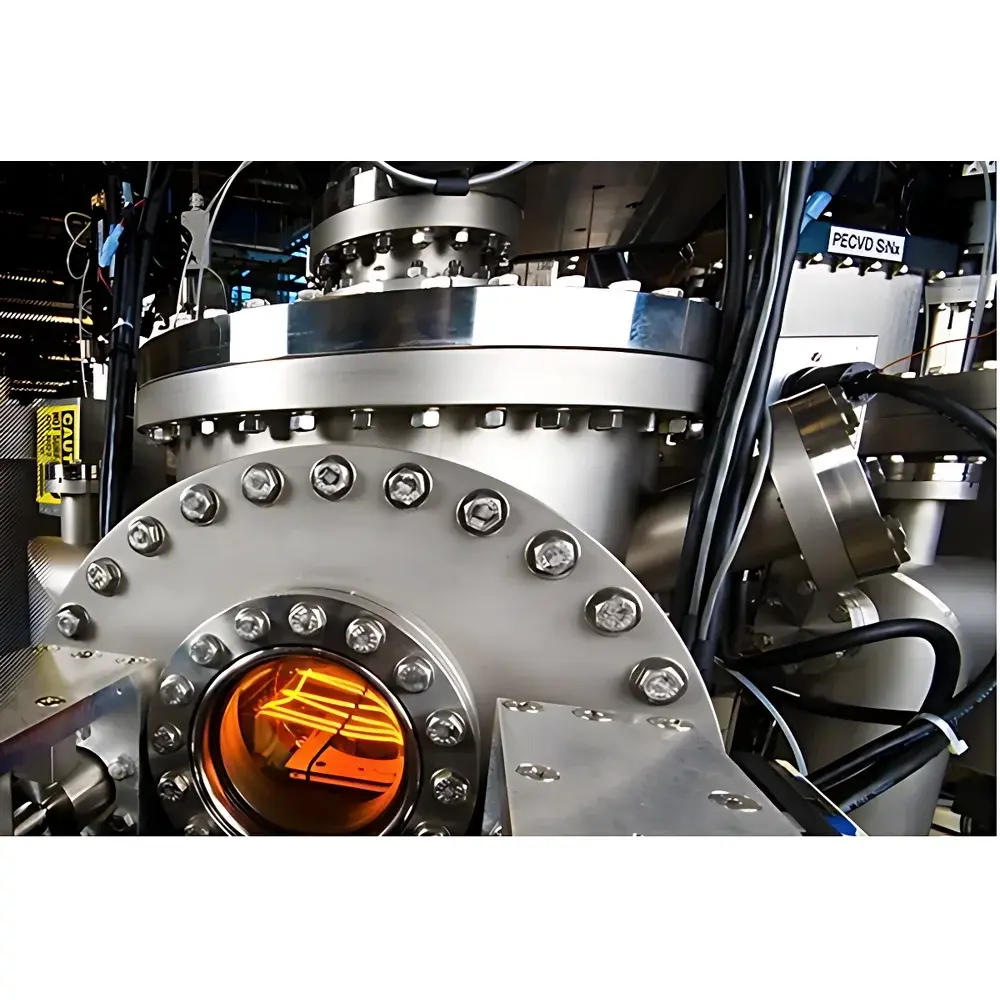
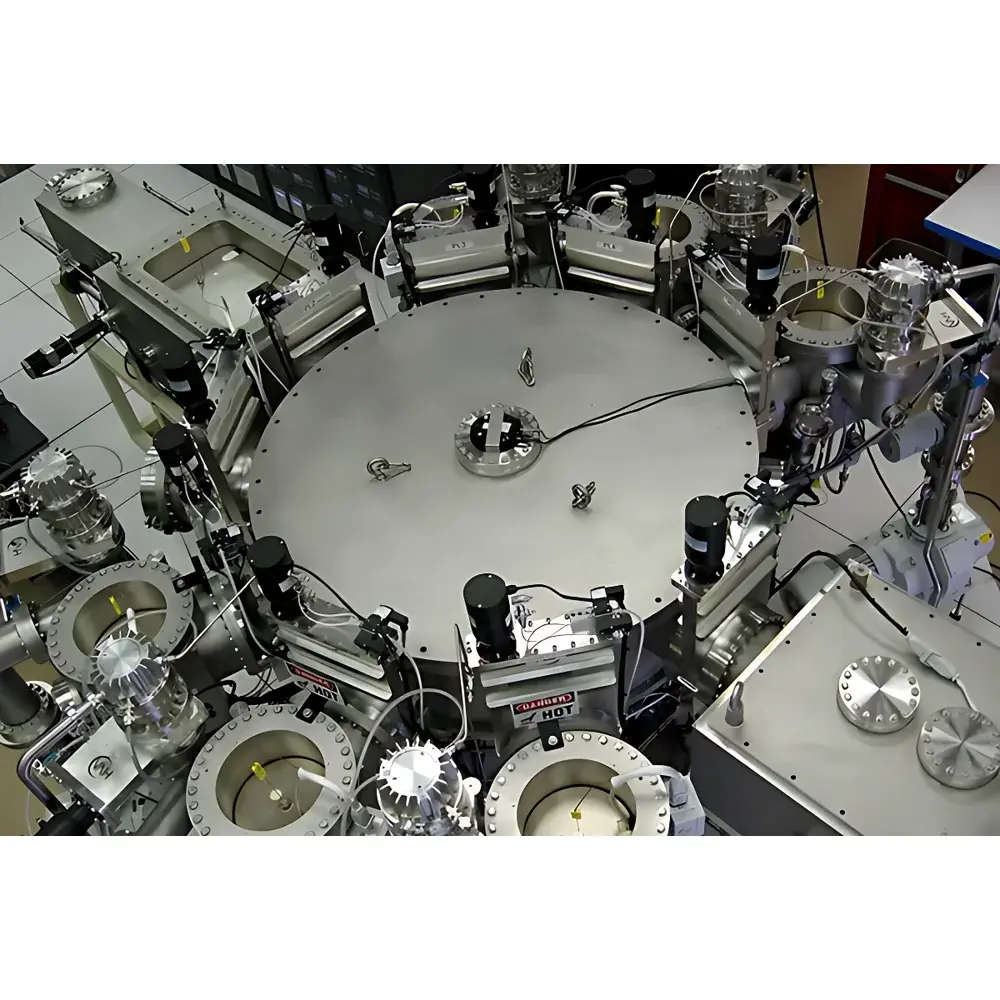
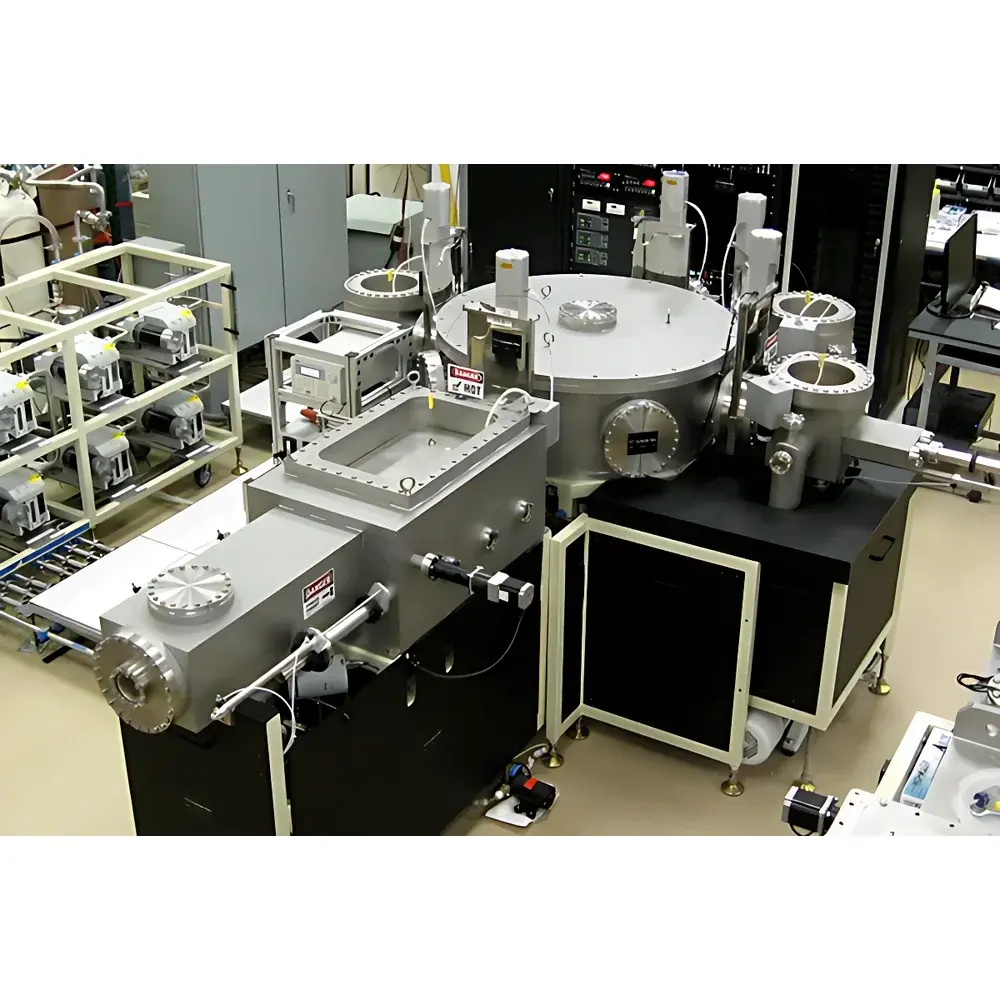
MVSystems MVS-PECVD Plasma-Enhanced Chemical Vapor Deposition System
| Brand | MVSystems |
|---|---|
| Origin | USA |
| Model | MVS-PECVD |
| Price | USD $1,000,000 |
| Chamber Configuration | Modular Cluster Tool (8–10 port), In-Line, or Single-Chamber Options |
| Substrate Compatibility | Rigid (15.6×15.6 cm, 30×40 cm) and Flexible Web (15–30 cm width) |
| Deposition Technologies | PECVD, HWCVD, Sputtering, Annealing |
| Vacuum Architecture | High-Vacuum (≤1×10⁻⁷ Torr base pressure) |
| Process Control | Fully Computer-Controlled with Real-Time Parameter Logging |
| In-Situ Characterization Option | Integrated UHV-compatible optical/electrical test module |
Overview
The MVSystems MVS-PECVD is a high-precision, modular plasma-enhanced chemical vapor deposition system engineered for research, process development, and pilot-scale manufacturing of thin-film semiconductor devices. Operating on the principle of low-pressure radio-frequency (RF) or very-high-frequency (VHF) plasma excitation, the system enables controlled dissociation of precursor gases (e.g., SiH₄, NH₃, PH₃, B₂H₆, O₂) to deposit uniform, stoichiometric, and low-defect-density dielectric and semiconductor layers—including silicon nitride (SiNx), silicon oxide (SiOx), silicon oxynitride (SiON), intrinsic and doped amorphous silicon (a-Si:H), nanocrystalline silicon (nc-Si), transparent conducting oxides (ITO, AZO, SnO₂:F), and fluorinated wide-bandgap p-type layers. Designed from the ground up by MVSystems, Inc.—a U.S.-based developer with foundational expertise in hydrogenated amorphous silicon and TFT physics—the MVS-PECVD integrates vacuum science, plasma diagnostics, and industrial-grade motion control to meet the reproducibility and traceability requirements of academic labs, national institutes, and pre-commercial photovoltaic and display technology developers.
Key Features
- Modular cluster-tool architecture supporting 8- or 10-port configurations with independent pumping and pressure control per chamber
- Multi-technology compatibility: integrated RF/DC/VHF PECVD, hot-wire CVD (HWCVD), DC/RF sputtering, and resistive thermal annealing modules
- Flexible substrate handling: accommodates rigid wafers (15.6×15.6 cm and 30×40 cm formats) and continuous flexible webs (15–30 cm width) via cassette-based reel-to-reel transport with robotic vacuum handler
- Full computer automation via proprietary real-time control software with scriptable recipe management, parameter ramping, and interlock safety logic
- Optional in-vacuum characterization module enabling immediate post-deposition optical transmission/reflection, dark I-V, or photoresponse measurements without air exposure
- Robust stainless-steel UHV-compatible construction with all-metal seals, bake-out capability (≤200 °C), and residual gas analysis (RGA) integration readiness
Sample Compatibility & Compliance
The MVS-PECVD supports deposition on glass, quartz, silicon, stainless steel, polymer foils (e.g., PET, polyimide), and metal foils—enabling fabrication of heterojunction solar cells (HIT), thin-film transistors (TFTs), X-ray imaging detectors, and memory devices. All hardware and software subsystems comply with CE electromagnetic compatibility (EMC) directives and meet mechanical safety standards per ISO 12100. The control architecture is designed for alignment with GLP/GMP documentation practices, including audit-trail-enabled user authentication, electronic signature support, and full data provenance logging—facilitating FDA 21 CFR Part 11 readiness when paired with validated IT infrastructure. Process recipes and calibration records are exportable in CSV and XML formats for third-party LIMS integration.
Software & Data Management
The system runs on a deterministic real-time operating environment with dual redundant controllers: one dedicated to hardware I/O synchronization (motion, RF matching, gas flow, temperature), and another managing GUI, recipe execution, and data acquisition. Software features include multi-level user access (operator, engineer, administrator), version-controlled recipe libraries, automated chamber conditioning sequences, and live plasma impedance monitoring (via VI probe). All sensor data—including RF forward/reflected power, chamber pressure, substrate temperature (±0.5 °C), mass flow controller setpoints, and shutter positions—are timestamped at 100 Hz and stored in a relational SQLite database with automatic daily backup. Raw logs are compatible with MATLAB, Python (Pandas), and JMP for statistical process control (SPC) and multivariate analysis.
Applications
- Development and optimization of passivation layers (SiNx, AlOx/SiNx) for multicrystalline and monocrystalline silicon solar cells
- Deposition of intrinsic/doped a-Si:H and nc-Si:H layers for heterojunction (HJT) photovoltaics and TFT backplanes
- Scalable fabrication of transparent conductive oxides (TCOs) with tunable carrier concentration and mobility for OLED and touch sensor applications
- R&D of fluorinated wide-bandgap p-type layers for tandem cell top junctions
- In-situ study of plasma-surface interactions using synchronized optical emission spectroscopy (OES) and Langmuir probe add-ons
- Process transfer from lab-scale R&D to near-production throughput via scalable reel-to-reel or linear PECVD configurations
FAQ
What vacuum level can the MVS-PECVD achieve?
Base pressure is typically ≤1×10⁻⁷ Torr after bake-out, enabled by turbomolecular pumping backed by dry scroll pumps and all-metal sealing.
Can the system be upgraded with additional deposition modules after installation?
Yes—modular design allows field-installation of new chambers (e.g., sputter, HWCVD, or characterization) without system requalification.
Is remote operation and monitoring supported?
Standard Ethernet interface enables secure remote desktop access and real-time telemetry via TLS-encrypted API endpoints.
Does MVSystems provide installation, training, and maintenance support?
Full turnkey commissioning—including site preparation review, vacuum leak checking, plasma calibration, and operator certification—is included; extended service contracts cover preventive maintenance, spare parts, and firmware updates.
Are custom substrate fixtures or gas delivery manifolds available?
Yes—MVSystems’ engineering team designs application-specific tooling, including shadow masks, heated chucks with edge exclusion control, and multi-zone gas injectors for graded film composition.



