
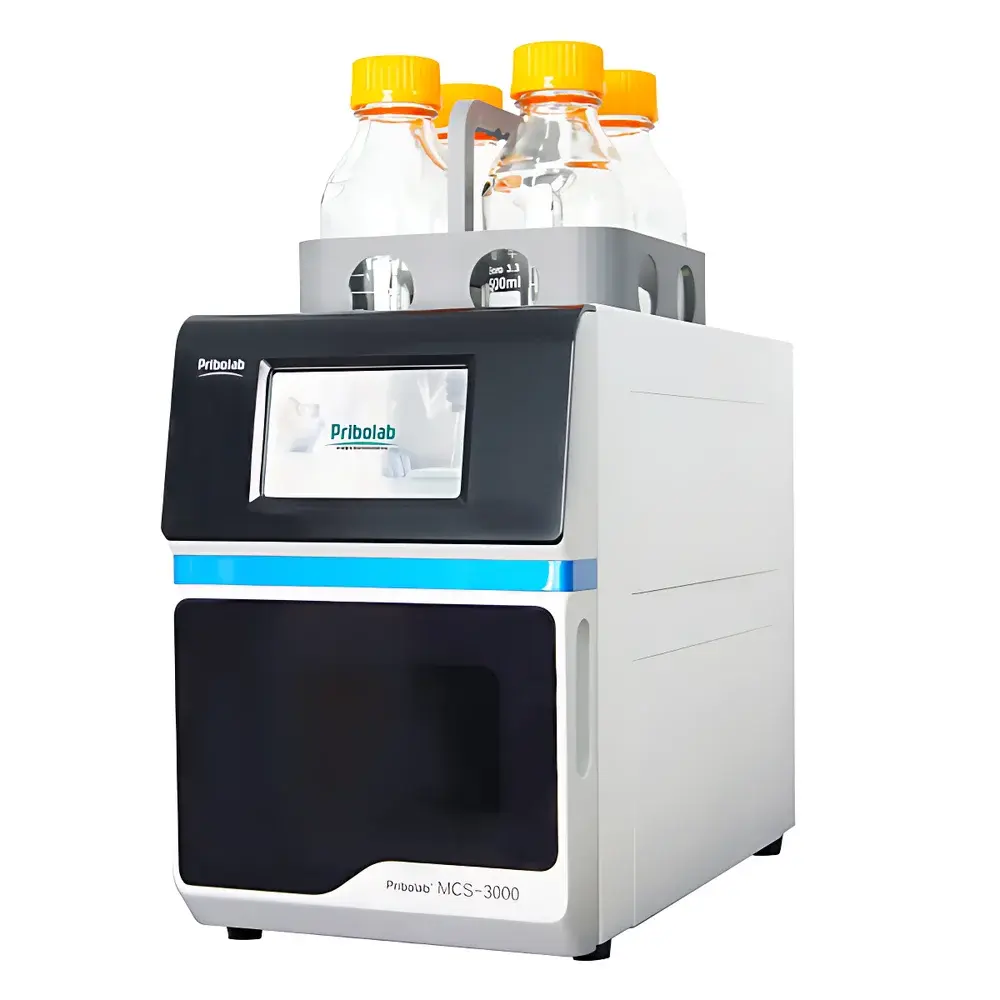
Pribolab MCS-3000 Multifunctional Chromatography Maintenance and Regeneration System
| Brand | Pribolab |
|---|---|
| Origin | Shandong, China |
| Manufacturer Type | Authorized Distributor |
| Country of Origin | China |
| Model | MCS-3000 |
| Pricing | Available Upon Request |
Overview
The Pribolab MCS-3000 Multifunctional Chromatography Maintenance and Regeneration System is an engineered automation platform designed to standardize, streamline, and document post-run maintenance procedures for liquid chromatography (LC), liquid chromatography–mass spectrometry (LC-MS), and ion chromatography (IC) systems. Unlike generic solvent delivery modules or standalone column washers, the MCS-3000 implements a closed-loop, pressure-controlled fluidic architecture grounded in principles of programmable gradient elution and sequential solvent displacement—enabling reproducible column regeneration, system flushing, and detector decontamination without manual intervention. Its operational scope includes column activation, equilibration, deep cleaning, performance verification (backpressure and efficiency monitoring), and long-term storage conditioning—all executed under defined flow rates, dwell volumes, and solvent compatibility constraints. The system is not a chromatographic analyzer but a dedicated ancillary platform intended to extend column lifetime, reduce system downtime, and support compliance with analytical method lifecycle management requirements per ICH Q5C and USP .
Key Features
- Six modular subsystems: precision dual-pump drive unit, temperature-stabilized column storage chamber (up to 300 mm column length, ambient to 60 °C), pre-column maintenance station (including guard column exchange and inline filtration), post-column maintenance manifold (with detector bypass and decontamination mode), intelligent control interface, and integrated waste management with auto-switching solvent traps.
- Full compatibility across major LC/LC-MS/IC platforms—including Agilent, Waters, Thermo Fisher, Shimadzu, and PerkinElmer—without hardware modification or vendor-specific firmware dependencies.
- Automated solvent selection logic: preloaded protocols map column chemistry (e.g., C18, HILIC, SEC, anion-exchange) to validated cleaning solvents (acetonitrile, methanol, isopropanol, ammonium acetate buffer, dilute acid/base), minimizing risk of phase collapse or silica dissolution.
- Unattended operation capability: scheduled maintenance cycles initiated via touchscreen or remote command; real-time pressure monitoring with configurable alarm thresholds; automatic shutdown upon abnormal backpressure or flow deviation.
- Column performance tracking: optional integration with third-party chromatography data systems (CDS) for logging column usage hours, flush cycles, and post-maintenance efficiency metrics (e.g., plate count, asymmetry factor).
Sample Compatibility & Compliance
The MCS-3000 supports all commercially available reversed-phase, normal-phase, ion-exchange, size-exclusion, and hydrophilic interaction chromatography columns with lengths ≤300 mm and internal diameters from 2.1 mm to 4.6 mm. It accommodates both stainless-steel and PEEK-bodied columns and interfaces seamlessly with standard 10-32 threaded fittings. From a regulatory standpoint, the system supports audit-trail-enabled operation when paired with compliant CDS software (e.g., Empower, Chromeleon, Analyst). Its maintenance logs—timestamped, user-attributed, and solvent-verified—align with GLP and GMP documentation expectations per FDA 21 CFR Part 11, provided electronic records are generated and retained within a validated environment. No direct ISO/IEC 17025 accreditation applies to the MCS-3000 itself, as it functions as a supporting utility rather than a measurement instrument.
Software & Data Management
The embedded control software features a 7-inch capacitive touchscreen with intuitive icon-driven navigation, multilingual UI (English, Chinese, Japanese), and non-volatile protocol storage (≥100 user-defined methods). Each method includes solvent sequence, flow rate ramping profiles, dwell time per step, column temperature setpoints, and waste port assignment. All execution events—start/stop timestamps, detected pressure values, solvent lot IDs (manually entered), and operator login—are recorded locally in CSV format and exportable via USB or Ethernet. Optional OPC UA connectivity enables integration into laboratory-wide MES or LIMS environments for centralized maintenance scheduling and predictive column lifecycle analytics.
Applications
- Routine post-run column reconditioning in QC laboratories performing pharmaceutical stability testing (ICH Q1–Q5).
- Recovery of overloaded or fouled columns in environmental analysis labs handling complex wastewater or soil extracts.
- Preventive maintenance for high-throughput clinical LC-MS assays where column longevity directly impacts assay robustness and cost-per-sample.
- Method transfer support: standardized regeneration protocols ensure consistent column history across instruments during cross-site validation.
- Research labs utilizing multi-dimensional LC or heart-cutting workflows requiring rapid column switching and on-the-fly equilibration.
FAQ
Does the MCS-3000 require connection to a specific brand’s CDS software to operate?
No. It operates independently with its native controller; CDS integration is optional and limited to event logging or remote start commands.
Can the system perform column efficiency testing without a connected detector?
It measures and logs system pressure and flow consistency but does not replace a UV or MS detector for peak-based efficiency calculation (e.g., N, As); such evaluation requires external chromatographic analysis.
Is the column storage chamber inert to aggressive solvents like THF or chloroform?
The chamber seals and fluid paths are constructed from chemically resistant PTFE, PEEK, and 316L stainless steel, rated for continuous exposure to common HPLC solvents, including THF. Chloroform use is not recommended due to potential elastomer degradation in valve manifolds.
What level of technical support and service coverage is provided outside China?
Pribolab partners with regional distributors offering local installation, preventive maintenance contracts, and certified technician response; service level agreements vary by territory and must be confirmed at time of purchase.
How is solvent consumption tracked and minimized during automated sequences?
Each protocol defines solvent volume per step; the system calculates cumulative usage and displays remaining capacity for each reservoir. Solvent-saving modes include low-flow equilibration and pressure-triggered solvent transition to reduce unnecessary flush volumes.



