
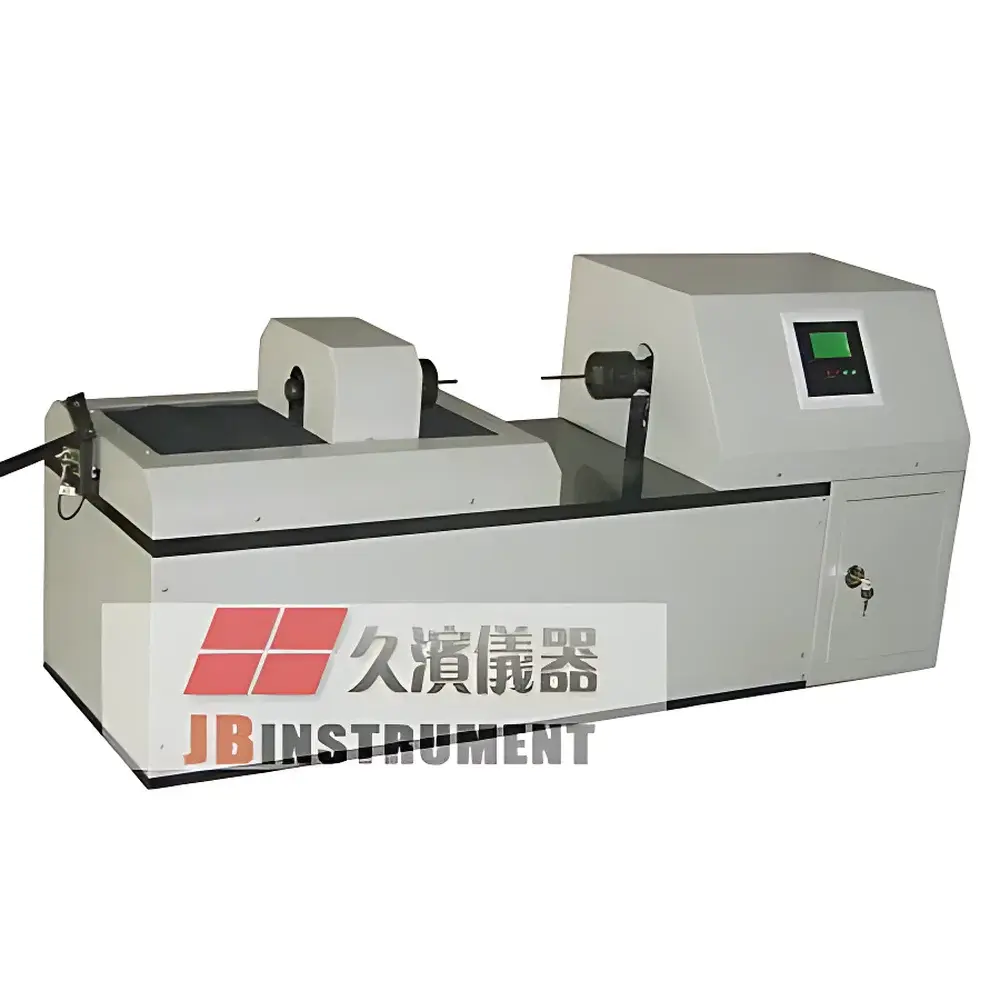
JB-Brookfield JB-X3 Metal and Non-Metal Wire Torsion Testing Machine
| Brand | JB-Brookfield |
|---|---|
| Origin | Shanghai, China |
| Model | JB-X3 |
| Specimen Diameter Range | 0.1–10.0 mm |
| Gauge Length | 350 mm |
| Clamping Options | Flat jaws (0–3 mm), Round jaws #1 (3–6 mm), Round jaws #2 (6–10 mm) |
| Torsion Speeds | 60 / 90 / 120 / 180 / 300 rpm |
| Speed Accuracy | < ±10% |
| Minimum Count Resolution | 0.1 turn |
| Coaxiality of Grips | < 0.4 mm |
| Parallelism of Sliding Guide Rail | < 0.2 mm |
| Jaw Hardness | 50–65 HRC |
| Dimensions (L×W×H) | 980 × 400 × 600 mm |
| Weight | 100 kg |
| Power Supply | 220 V, 50 Hz |
| Sound Pressure Level | < 50 dB(A) |
| Compliance | GB/T 239–1999, ISO 7800:1984, ISO 9649:1990 |
Overview
The JB-Brookfield JB-X3 Metal and Non-Metal Wire Torsion Testing Machine is a precision-engineered electromechanical system designed to evaluate the torsional ductility, surface integrity, and internal structural homogeneity of metallic and non-metallic wire specimens under controlled unidirectional or bidirectional rotational loading. Based on the principle of quasi-static angular displacement application with real-time rotation counting and mechanical resistance monitoring, the JB-X3 implements standardized torsion protocols defined in GB/T 239–1999, ISO 7800:1984 (uniaxial twist), and ISO 9649:1990 (reversing twist). It is not a fatigue tester nor a high-frequency dynamic torsion device; rather, it delivers repeatable, low-inertia torque application at discrete rotational speeds—making it suitable for quality control laboratories, wire manufacturing QA departments, and materials research facilities requiring compliance-aligned mechanical characterization of fine-diameter linear specimens.
Key Features
- Automated torsion actuation via industrial-grade TaiChuang reduction motor coupled with Delixi variable-speed control system for stable speed selection across five fixed rates (60, 90, 120, 180, and 300 rpm)
- High-precision optical encoder-based rotation counting with 0.1-turn resolution and error-compensated feedback loop
- Dual-mode operation: programmable unidirectional twisting to failure or preset cycle count, and symmetrical bidirectional twisting with automatic reversal logic
- Modular jaw assembly supporting three clamping configurations—flat jaws (0–3 mm), round jaw set #1 (3–6 mm), and round jaw set #2 (6–10 mm)—all hardened to 50–65 HRC for wear resistance and grip consistency
- Structural rigidity ensured by a monolithic base frame, parallel sliding guide rail (<0.2 mm deviation), and coaxially aligned grips (<0.4 mm misalignment)
- Human-readable LCD interface with Chinese-language menu navigation, eliminating dependency on external PCs during routine testing
- Acoustically optimized enclosure design meeting ISO 7779-compliant noise limits (<50 dB(A)) for shared laboratory environments
Sample Compatibility & Compliance
The JB-X3 accommodates wire specimens with nominal diameters from 0.1 mm to 10.0 mm, covering common categories including copper, aluminum, stainless steel, titanium alloys, phosphor bronze, and polymer-coated conductors. Its 350 mm gauge length ensures representative deformation behavior without end-effect interference. All mechanical tolerances—including grip coaxiality, rail parallelism, and jaw hardness—conform to GB/T 2611 requirements for general-purpose testing machines. The system supports full traceability in regulated environments: test parameters (speed, direction, cycle count), operator ID, date/time stamp, and failure mode (fracture vs. specified cycle termination) are retained in non-volatile memory. While the JB-X3 does not include electronic audit trail or 21 CFR Part 11–compliant user authentication natively, its operational logs meet GLP documentation prerequisites when paired with external lab notebook practices.
Software & Data Management
The JB-X3 operates as a standalone instrument with embedded firmware—no proprietary PC software is required for basic operation. Rotation data (total turns, direction sequence, stop condition) are displayed in real time and stored locally on EEPROM. Export functionality is limited to manual transcription or optional RS-232 interface (available upon request) for integration into custom LIMS or Excel-based reporting workflows. For laboratories requiring automated data capture, third-party serial-to-CSV converters or LabVIEW-compatible drivers may be deployed. Firmware updates are performed via USB interface using manufacturer-provided utilities; version history and calibration checksums are accessible through service menus.
Applications
- Verification of cold-drawn copper wire ductility prior to cable stranding or magnet winding
- Evaluation of galvanized steel wire coating adhesion and substrate cohesion under torsional shear
- Comparative assessment of heat-treated vs. annealed spring steel wire torsional resilience
- Screening of composite metal-polymer filaments for biomedical guidewire development
- Quality gate testing for automotive sensor wire harnesses per OEM-specific torsion specifications
- Teaching laboratories demonstrating ASTM E1445-equivalent torsional failure modes in undergraduate metallurgy courses
FAQ
Does the JB-X3 support continuous real-time torque measurement?
No. The JB-X3 is a displacement-controlled torsion tester; it records rotational position and counts but does not integrate load cells or torque transducers. Torque is inferred indirectly via motor current draw under constant-speed conditions—not recommended for quantitative torque analysis.
Can I test non-circular cross-sections such as flat strips or rectangular wires?
Only with flat-jaw configuration (0–3 mm thickness range); however, results deviate from ISO/GB standards, which mandate circular symmetry. Such tests are considered non-standard and require method validation.
Is calibration certification included with shipment?
Yes—a factory calibration report verifying gauge length, speed accuracy, and counter resolution is supplied with each unit. NIST-traceable recalibration services are available through authorized service centers in APAC regions.
What maintenance intervals are recommended?
Lubrication of guide rails and gearboxes every 6 months; optical sensor cleaning quarterly; jaw hardness verification annually. Full mechanical inspection per GB/T 2611 is advised every 24 months.
Is CE or UKCA marking applicable?
The JB-X3 complies with EMC Directive 2014/30/EU and Low Voltage Directive 2014/35/EU when equipped with CE-marked power supply modules. However, it is not CE-declared as a complete machine due to its classification as a laboratory-grade mechanical tester—not subject to Machinery Directive 2006/42/EC. UKCA conformity follows equivalent technical documentation pathways.



