
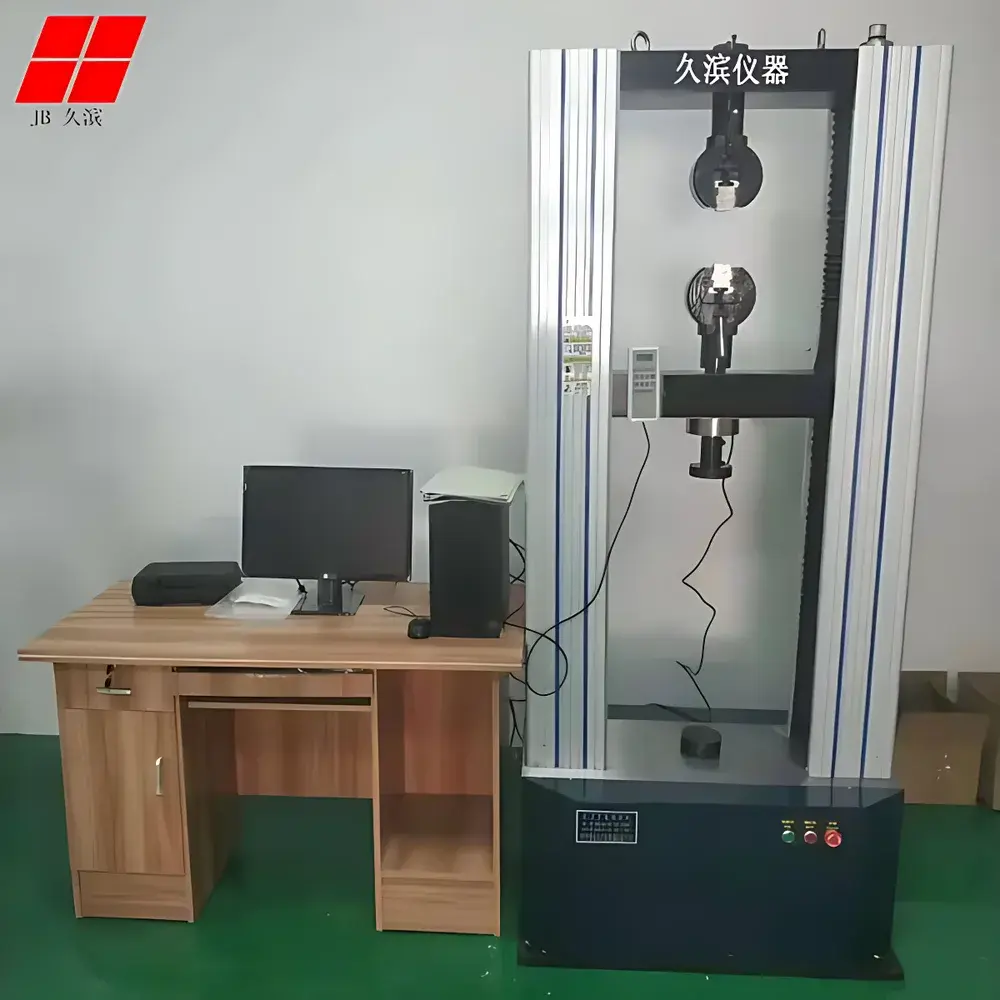
Jiubin JB-121A Universal Tensile Testing Machine for Steel Materials
| Brand | Jiubin |
|---|---|
| Model | JB-121A |
| Type | Electromechanical-Hydraulic Servo Universal Testing Machine |
| Origin | Shanghai, China |
| Compliance | GB/T 228.1–2010, GB/T 7314–2005, GB/T 232–2010, GB/T 25048–2010, GB/T 17104–1997, GB/T 3652–1983, HB 5415–1996 |
| Max Test Force | 50–1000 kN (configurable) |
| Accuracy Class | Class 1 / Class 0.5 |
| Force Measurement Range | 0.2–100% FS |
| Force Resolution | 1/3,000,000 full scale |
| Displacement Resolution | 0.001 mm |
| Strain Measurement | Electronic extensometer (±0.5% error) |
| Specimen Gripping | Hydraulic wedge-type clamps |
| Round Specimen Diameter | φ13–φ40 mm |
| Flat Specimen Thickness | 0–30 mm |
| Flat Specimen Width | 75 mm |
| Compression Platen Size | 204 × 204 mm |
| Bending Support Span | 600 mm |
| Crosshead Travel | 250 mm (tensile), 550 mm (compression) |
| Effective Tensile Space | 600 mm |
| Column Spacing | 650 mm |
| Control System | Tri-closed-loop servo control with programmable test sequencing |
| Safety Protections | Mechanical limit switches, hydraulic overload relief, force over-limit shutdown, automatic rupture protection, software-based emergency stop |
Overview
The Jiubin JB-121A Universal Tensile Testing Machine is a high-stiffness, electro-hydraulic servo-controlled system engineered for precise mechanical property characterization of ferrous and non-ferrous metallic materials—including bearing steel, spring steel, cold-rolled steel, structural steel, and alloy tubes. It operates on the principle of controlled uniaxial loading via a dual-acting piston cylinder, with force transduction through a calibrated load cell and displacement tracking via high-resolution optical encoders. The machine conforms to ISO 6892-1 (equivalent to GB/T 228.1–2010) for tensile testing at ambient temperature, as well as ISO 13384 (GB/T 7314–2005) for compression and ISO 7438 (GB/T 232–2010) for bending. Its rigid double-column, welded frame architecture ensures minimal deflection under load, supporting reproducible measurements across the full force range—configurable from 50 kN up to 1000 kN—while maintaining ≤ ±1% force indication error and ≤ ±0.5% strain measurement uncertainty.
Key Features
- Robust dual-column, portal-style frame fabricated from high-strength welded steel plates, delivering exceptional lateral stability and axial rigidity during high-force testing.
- Hydraulic actuation system featuring a high-bandwidth servo valve and precision differential piston cylinder, enabling smooth, low-noise, and responsive load application across speeds from 0.2 to 70 mm/min (infinitely variable).
- Full-opening wedge-type hydraulic grips with integrated 10 mm wear-resistant sliding plates—designed to extend jaw life and ensure uniform stress distribution during gripping of round (φ13–φ40 mm) and flat (0–30 mm thick × 75 mm wide) specimens.
- Tri-closed-loop digital control architecture: simultaneous real-time regulation of load, displacement, and strain—supporting seamless mode switching between tension, compression, bending, and cyclic protocols.
- Integrated high-resolution measurement subsystems: load cell (1/3,000,000 internal resolution), optical encoder (0.001 mm displacement resolution), and clip-on or contacting extensometer (±0.5% strain accuracy per GB/T 228.1 Annex E).
- Comprehensive hardware safety layer: mechanical column end stops, hydraulic pressure relief valves, electronic force over-range cutoff, automatic rupture detection, and software-enforced operational limits—all compliant with ISO 12100 risk assessment principles.
Sample Compatibility & Compliance
The JB-121A accommodates standardized metallic test specimens per ASTM E8/E8M and ISO 6892-1, including round bars, flat strips, sheet coupons, and tubular ring specimens (per GB/T 25048–2010 and GB/T 17104–1997). Optional environmental chambers (–70 °C to +300 °C) and custom fixtures enable elevated-temperature tensile testing (GB/T 3652–1983) and concrete tensile strength evaluation (via split-disk or axial pull configurations). All test procedures and data handling workflows align with GLP requirements; audit trails, user access controls, and electronic signature support are available via optional FDA 21 CFR Part 11–compliant software modules. Calibration certificates traceable to CNAS-accredited national standards are provided with each system shipment.
Software & Data Management
The proprietary Jiubin TestSuite™ v4.x software provides ISO/IEC 17025–aligned test automation: pre-defined method templates for GB/T 228.1, GB/T 7314, and GB/T 232 are embedded, with editable parameters for strain rate, hold time, crosshead speed ramping, and conditional branching. Real-time curve visualization supports dynamic zoom, overlay comparison of multiple tests, axis re-scaling (engineering vs. true stress-strain), and export to CSV, XML, or PDF formats. Data is stored in an ACID-compliant relational database (SQLite or Microsoft SQL Server), enabling role-based access, batch reporting, statistical process control (SPC) chart generation, and integration with LIMS or MES platforms via OPC UA or RESTful API. All test events—including operator login, parameter changes, calibration actions, and failure triggers—are timestamped and immutably logged.
Applications
This system serves as a primary mechanical characterization tool in metallurgical laboratories, quality control departments of steel mills and forging plants, third-party certification bodies (e.g., SGS, BV, TÜV), and academic research groups investigating microstructure–property relationships in advanced high-strength steels (AHSS), stainless alloys, and precipitation-hardened grades. Typical use cases include yield strength (Rp0.2), ultimate tensile strength (Rm), elongation at break (A%), reduction of area (Z%), Young’s modulus (E), proof strength under compression, and bending stiffness evaluation of structural profiles. It also supports R&D validation of heat treatment effects, weld integrity assessment, and fatigue pre-characterization via monotonic baseline testing.
FAQ
What standards does the JB-121A officially support out-of-the-box?
It natively implements GB/T 228.1–2010, GB/T 7314–2005, GB/T 232–2010, GB/T 25048–2010, and HB 5415–1996. ASTM E8, ISO 6892-1, and EN 10002-1 profiles can be loaded via custom method import.
Is the system compatible with external environmental chambers?
Yes—standardized flange interfaces and I/O signal mapping allow seamless integration with commercially available thermal, corrosion, or vacuum chambers.
Can test data be exported for regulatory submission?
Absolutely. Raw and processed datasets export in validated formats (CSV, PDF/A-2, XML/NIEM), with full metadata, operator ID, equipment ID, calibration dates, and digital signatures when Part 11 mode is enabled.
What maintenance intervals are recommended for hydraulic components?
Hydraulic oil and filter replacement every 2,000 operating hours or annually (whichever occurs first); servo valve recalibration every 12 months or after 5,000 test cycles.
Does the machine support closed-loop strain control using extensometers?
Yes—strain-controlled ramp-hold tests, including Lüders band propagation analysis and plastic strain ratio (r-value) determination, are fully supported via the tri-closed-loop controller and high-fidelity extensometer input channel.



