
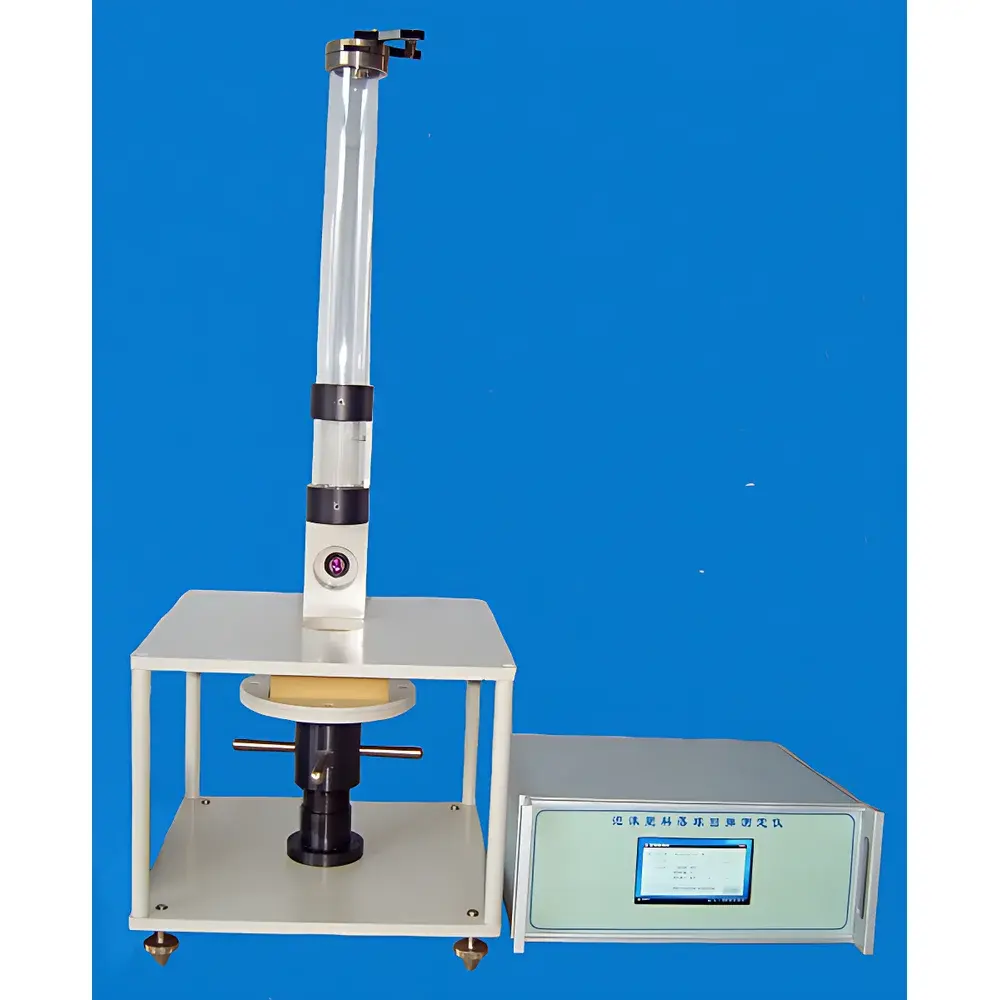
JB-400 Foam Resilience Tester (Jiubin Instruments)
| Brand | Jiubin Instruments |
|---|---|
| Origin | Shanghai, China |
| Manufacturer Type | Authorized Distributor |
| Region of Manufacture | Domestic (China) |
| Model | JB-400 |
| Pricing | Available Upon Request |
Overview
The JB-400 Foam Resilience Tester is an electromechanical instrument engineered for the standardized determination of resilience (ball rebound) in flexible polyurethane foam materials. It operates on the principle of free-fall impact dynamics: a precisely dimensioned and weighted steel sphere is released from a controlled height onto a horizontally mounted foam specimen; the rebound height is measured optically, and resilience is calculated as the ratio of rebound height to drop height—expressed as a percentage. This method conforms to fundamental energy dissipation principles in viscoelastic solids and is widely accepted for quality control and material specification validation in foam manufacturing, automotive seating, furniture, and packaging R&D laboratories.
Key Features
- Multi-standard compliance: Programmable test modes for GB/T 6670–1997 (460 mm drop height ±0.5%), ASTM D3574 (500 mm drop height ±0.5%), ISO 8307, and JASO/SES N 3296 (Japanese automotive seat foam standard)
- Microprocessor-based control system with real-time monitoring and automatic calculation of average rebound height and resilience percentage across up to 10 consecutive impacts
- Integrated optical distance sensor with high-resolution photogate detection for non-contact rebound height measurement
- Adjustable vertical release mechanism enabling precise, repeatable positioning of the steel ball at either 460 mm or 500 mm above the specimen surface
- Backlit LCD interface with intuitive Chinese-language menu navigation, parameter input, and on-screen result display
- Built-in thermal microprinter for immediate hardcopy output of test ID, specimen dimensions, drop height, individual rebound heights, mean rebound height, and final resilience value
- Robust mechanical architecture with safety guard enclosure and fail-safe release interlock to prevent unintended ball drop during setup or maintenance
Sample Compatibility & Compliance
The JB-400 accepts rectangular foam specimens measuring 100 mm × 100 mm × 50 mm (L × W × H), per all referenced standards. Specimens must be conditioned at 23 ± 2 °C and 50 ± 5% RH for minimum 16 hours prior to testing, in accordance with ISO 291 and ASTM D618. The instrument satisfies metrological traceability requirements for routine QC use and supports documentation practices aligned with GLP and internal QA protocols. While not inherently 21 CFR Part 11 compliant (as it lacks electronic signature and audit trail functionality), raw test data—including timestamps, operator ID fields (manually entered), and printed reports—can be archived to support FDA-regulated environments when integrated into validated laboratory information management systems (LIMS).
Software & Data Management
The JB-400 includes bundled PC software for data export via RS-232 serial interface. The application enables batch import of test records, generation of summary statistics (mean, SD, CV%), customizable report templates (PDF/CSV), and graphical plotting of resilience trends across production lots or formulation variants. All exported files retain native metadata: test date/time, selected standard, drop height, ball diameter/mass, specimen ID, and operator annotation field. Software installation requires Windows 7 or later and does not require administrative privileges.
Applications
- Quality assurance of flexible PU foams used in automotive seating, headrests, and interior trim components
- Formulation development and comparative analysis of crosslink density, catalyst type, and blowing agent effects on resilience
- Supplier qualification and incoming material inspection against OEM specifications (e.g., Ford WSS-M99P1111-A, GMW15634)
- Process validation for continuous slabstock or molded foam production lines
- Academic research on time–temperature superposition behavior and recovery kinetics in elastomeric polymers
FAQ
What steel ball specifications are required for compliance with ASTM D3574?
A 16.0 ± 0.05 mm diameter hardened steel sphere, mass 16.4 ± 0.1 g, is specified for all referenced standards.
Can the JB-400 accommodate specimens thicker than 50 mm?
No—the test fixture and optical path geometry are calibrated for 50 mm nominal thickness; deviations beyond ±1 mm may introduce measurement bias due to boundary condition effects.
Is calibration certification included with delivery?
The unit ships with factory verification documentation confirming drop height accuracy, sensor linearity, and repeatability (n = 5 at both 460 mm and 500 mm); third-party NIST-traceable calibration is available as an optional service.
Does the instrument support automated data transfer to LIMS without manual intervention?
Yes—via RS-232 serial output and configurable ASCII protocol, enabling integration with middleware or custom scripts for scheduled auto-export to networked databases.
What maintenance is recommended for long-term measurement stability?
Monthly visual inspection of guide rods and release solenoid; quarterly cleaning of optical sensor windows with lint-free isopropyl alcohol swabs; annual verification of drop height using certified gauge blocks.



