
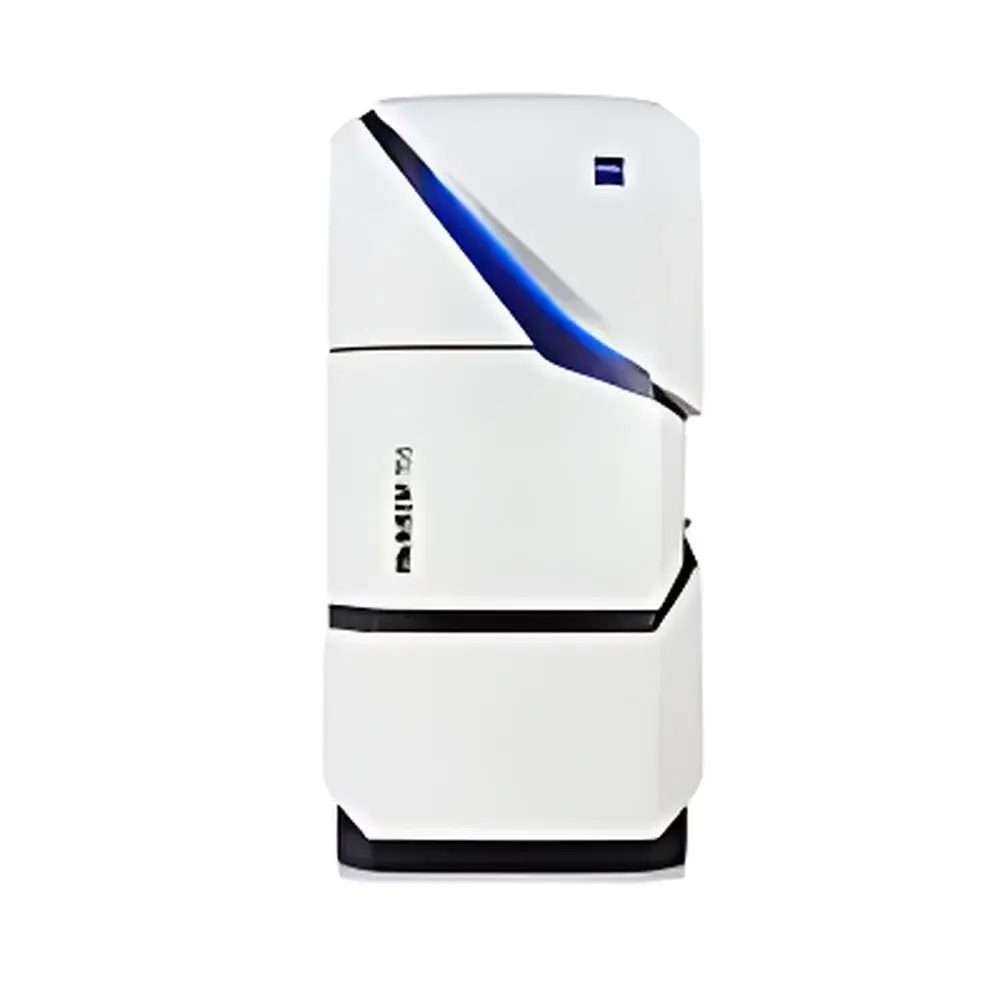
ZEISS MultiSEM 706 Multi-Beam Scanning Electron Microscope
| Brand | ZEISS |
|---|---|
| Origin | Germany |
| Model | MultiSEM 706 |
| Beam Count | 91 parallel electron beams |
| Imaging Speed | ~1.5 s per 132 μm × 114 μm hexagonal field of view |
| Resolution | Nanoscale (sub-5 nm typical at 1–3 kV) |
| Sample Capacity | Up to 100 mm wafers or large biological tissue blocks (e.g., 1 mm³ human cortical tissue) |
| Application Scope | High-throughput volumetric EM for semiconductor metrology, connectomics, and materials science |
| Compliance | Designed for integration into GLP/GMP-adjacent workflows |
Overview
The ZEISS MultiSEM 706 is a purpose-built multi-beam scanning electron microscope engineered for ultra-high-throughput, nanoscale volumetric imaging of large-area and thick specimens. Unlike conventional single-beam SEMs, the MultiSEM 706 integrates 91 independently controlled, synchronized electron beams operating in parallel within a single column architecture. This design leverages proven scanning electron microscopy principles—namely, beam-specimen interaction generating secondary electrons (SE), backscattered electrons (BSE), and characteristic X-rays—while distributing acquisition load across multiple probes. The result is deterministic acceleration of data collection without compromising spatial resolution or signal fidelity. It is specifically optimized for applications demanding statistically robust 3D ultrastructure datasets: semiconductor wafer defect review at sub-10 nm feature sizes, serial section electron microscopy (SSEM) of neural circuits, and high-fidelity nanomaterial morphology mapping over millimeter-scale fields.
Key Features
- 91-Beam Parallel Acquisition Architecture: Enables simultaneous scanning of distinct sub-regions, reducing total imaging time by up to two orders of magnitude compared to sequential single-beam approaches—e.g., acquiring a 132 μm × 114 μm hexagonal field in approximately 1.5 seconds.
- Large-Specimen Compatibility: Accommodates standard 100 mm semiconductor wafers and biological tissue blocks up to 1 mm³ volume (e.g., human cortical tissue slabs), with motorized stage navigation supporting automated tile-based stitching across centimeter-scale areas.
- Automated Workflow Integration: Embedded control logic supports unattended serial sectioning, drift-compensated image alignment, real-time contrast optimization, and adaptive dwell time adjustment per beam—minimizing manual intervention while maintaining quantitative repeatability.
- Modular Detector Configuration: Supports in-lens SE detectors, solid-state BSE arrays, and optional energy-dispersive X-ray spectroscopy (EDS) modules for correlative structural and compositional analysis.
- Thermally Stable Column Design: Precision-machined, low-vibration mechanical platform combined with active thermal regulation ensures long-term beam stability and sub-nanometer positional reproducibility across multi-hour acquisitions.
Sample Compatibility & Compliance
The MultiSEM 706 accepts conductive and non-conductive specimens—including silicon wafers, TEM grids, resin-embedded biological sections (e.g., osmium-tetroxide–stained brain tissue), and ceramic or polymer thin films—provided appropriate coating (e.g., Au/Pd or carbon) is applied where required. Its vacuum system meets ISO 20483:2021 standards for high-resolution electron microscopy environments. While the instrument itself is not certified as medical device hardware, its output data structure and metadata schema comply with FAIR (Findable, Accessible, Interoperable, Reusable) principles. When deployed with ZEISS Atlas 5 or third-party LIMS-integrated acquisition software, it supports audit trails, user access controls, and electronic signatures aligned with FDA 21 CFR Part 11 and ISO/IEC 17025 requirements for accredited testing laboratories.
Software & Data Management
Acquisition and reconstruction are managed via ZEISS SmartSEM and ZEISS Atlas software suites. SmartSEM provides real-time beam monitoring, live mosaic preview, and parameter synchronization across all 91 channels. Atlas enables automated serial section alignment, 3D volume rendering, segmentation-assisted neuron tracing, and export to standardized formats (e.g., HDF5, TIFF stack, N5). Raw data is stored with embedded calibration metadata (pixel size, dwell time, kV, working distance), facilitating traceable quantitative analysis. Optional API access allows integration with Python-based analysis pipelines (e.g., CloudReg, VAST, or custom PyTorch segmentation models) and enterprise data lakes compliant with DICOM-EM extensions for electron microscopy.
Applications
- Semiconductor Metrology: Rapid defect localization and overlay error mapping on full-die or multi-die wafers; cross-sectional imaging of FinFETs and GAA transistors with <5 nm resolution at 2 kV accelerating voltage.
- Connectomics & Neurobiology: Reconstruction of synaptic connectivity in mouse and human brain tissue—demonstrated on 165 μm × 143 μm regions imaged in 1.5 s, scaled to mm³ volumes via automated tape-collecting ultramicrotomy (ATUM) integration.
- Advanced Materials Characterization: Grain boundary analysis in polycrystalline battery cathodes, pore network quantification in MOFs, and interface imaging in metal–organic heterostructures—all at native resolution without destructive sample thinning.
- Quality Control in Additive Manufacturing: In-process porosity and microcrack detection in Ti-6Al-4V or Inconel 718 build layers, enabling correlation between process parameters and microstructural outcomes.
FAQ
How does the MultiSEM 706 achieve higher throughput without sacrificing resolution?
It employs 91 physically separate electron optical columns sharing a common source and vacuum environment, each with independent scan coils and detectors—enabling true parallel acquisition rather than time-multiplexed scanning.
Is the system compatible with existing SEM lab infrastructure?
Yes: It uses standard 208 V / 3-phase power, occupies a footprint comparable to a dual-column FIB-SEM, and interfaces with common cleanroom HVAC and vibration isolation platforms.
Can it be used for energy-dispersive X-ray spectroscopy (EDS)?
EDS capability is available as an optional add-on module per beam group, supporting elemental mapping at ≤100 nm lateral resolution when operated at ≥10 kV.
What level of training is required for routine operation?
Operators with foundational SEM experience require ≤3 days of ZEISS-certified training; fully automated workflows (e.g., wafer defect review) can be deployed using preconfigured recipe templates.
Does ZEISS provide long-term data archiving support?
While hardware-level archiving is customer-managed, ZEISS offers validated backup protocols and metadata indexing tools compatible with commercial object storage systems (e.g., AWS S3, Ceph) meeting ISO 16363 certification for trustworthy digital repositories.




