
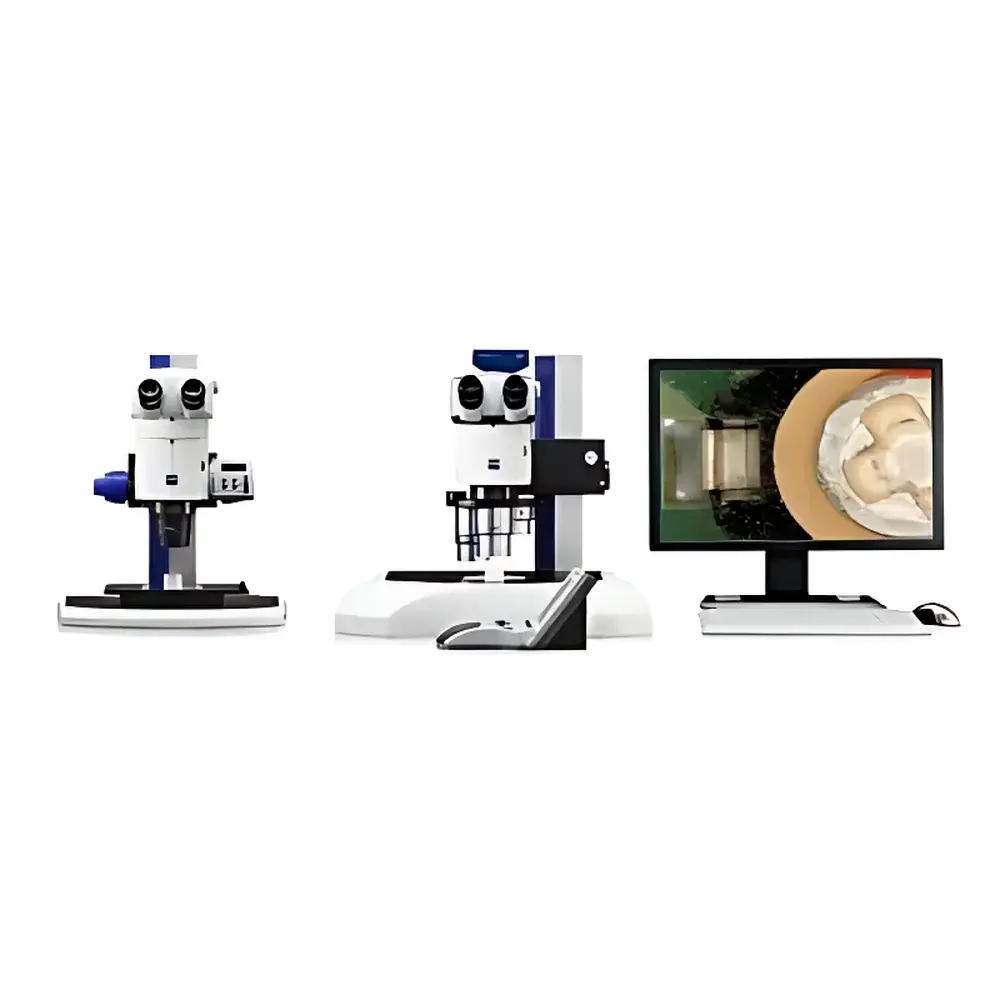
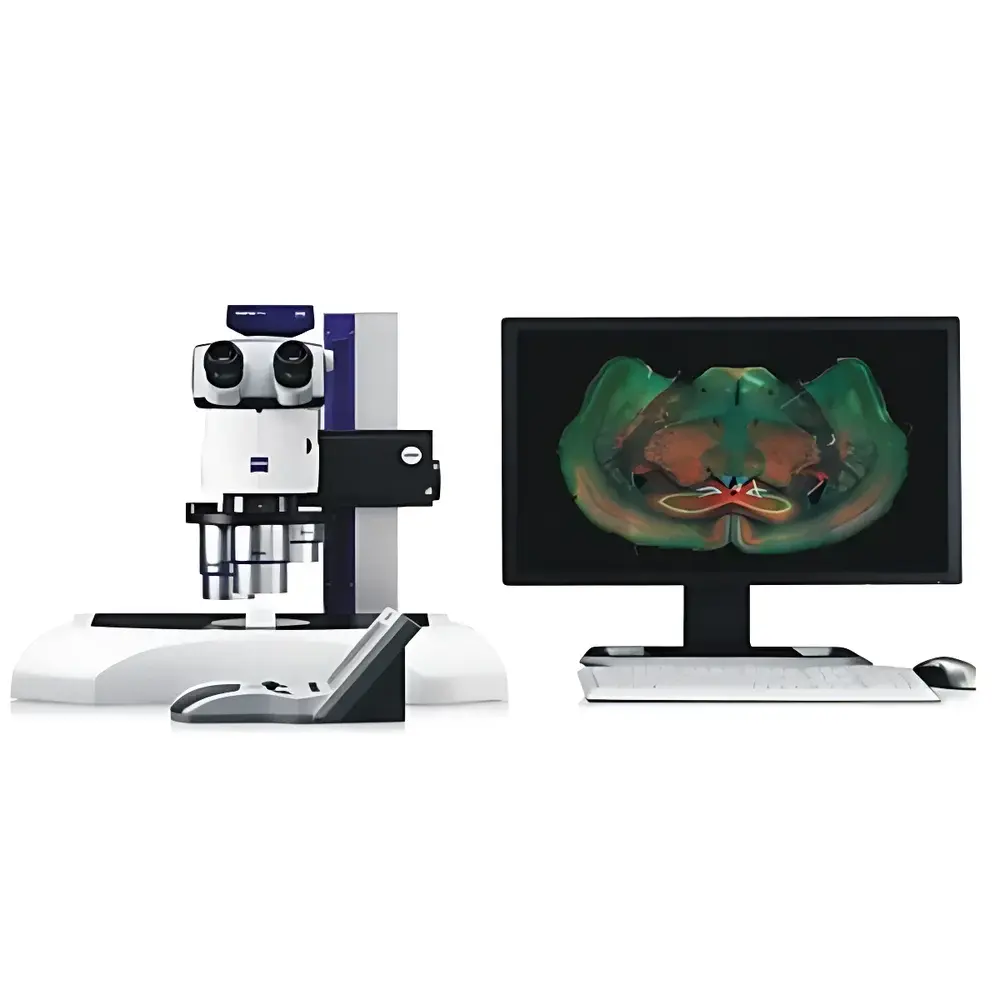
ZEISS SteREO Discovery Series Stereo Microscope
| Brand | ZEISS |
|---|---|
| Origin | Germany |
| Manufacturer Type | Authorized Distributor |
| Origin Category | Imported |
| Model | SteREO Discovery |
| Pricing | Upon Request |
Overview
The ZEISS SteREO Discovery Series is a research-grade stereo microscope engineered for high-fidelity three-dimensional visualization across life science, industrial quality control, and forensic investigation workflows. Built upon ZEISS’s proprietary Greenough optical architecture—featuring independently aligned objective and eyepiece paths—the system delivers natural depth perception, high-resolution surface topography, and exceptional contrast without reliance on digital reconstruction. Its core optical engine integrates ZEISS’s electronically controlled zoom lenses with continuous magnification curves, enabling seamless transition across the full magnification range while maintaining parfocality and telecentricity. Designed and manufactured in Oberkochen, Germany, each unit undergoes rigorous factory calibration against DIN ISO 10934-1 (optical microscopy — terminology and definitions) and conforms to CE marking requirements under the EU Medical Device Regulation (MDR 2017/745) where applicable for diagnostic support use.
Key Features
- Electronically synchronized zoom optics with precision-controlled magnification ratios of 8:1, 12.5:1, or 20:1—ensuring reproducible stepless magnification and stable image geometry across the entire range
- Z-axis mechanical resolution of 350 nm, achieved via a hardened, backlash-free focusing drive compatible with motorized focus modules (optional) for repeatable height mapping and serial sectioning alignment
- Ergonomic modular stand design featuring an ultra-stable cast-aluminum base with integrated vibration-damping mass and adjustable inclination (0–30°) for prolonged operator comfort during extended observation sessions
- Interchangeable nosepiece configurations: single-position fixed objective mount or 3-position revolving turret supporting PlanApo S objectives (e.g., 0.63×, 1.0×, 1.6×) with apochromatic correction and extended working distance
- Integrated illumination pathways supporting both transmitted brightfield (with Köhler illumination capability) and reflected brightfield modes—compatible with halogen, LED, and fiber-coupled cold-light sources
Sample Compatibility & Compliance
The SteREO Discovery accommodates specimens ranging from whole small-mammal embryos (e.g., E12.5 mouse embryos post-staining) to microelectronic assemblies (e.g., PCBs with white conformal coating), leveraging its long working distance (>60 mm at lowest magnification) and large field-of-view. It supports standardized sample handling per ASTM E2912–22 (Standard Guide for Stereomicroscopic Examination of Coated Surfaces) and ISO 14644-1 (cleanroom particulate monitoring). For regulated environments—including GLP-compliant histopathology labs and GMP-aligned medical device QA/QC—the system integrates with ZEISS ZEN Core software to enable audit-trail-enabled imaging sessions compliant with FDA 21 CFR Part 11 requirements when paired with validated user authentication and electronic signature protocols.
Software & Data Management
ZEN Core (v3.6+) provides native acquisition, annotation, measurement (length, area, angle, particle count), and multi-focus stacking for extended depth-of-field imaging. All metadata—including magnification, illumination mode, objective ID, exposure parameters, and stage coordinates—is embedded in TIFF and CZI file headers using MIAME-compliant schema. Export options include PDF reports with embedded calibration markers, CSV tables for statistical analysis, and DICOM-SR (Structured Reporting) for integration into PACS environments in veterinary or clinical pathology settings. Remote operation via ZEN Connect enables secure browser-based access for collaborative review and training—fully compliant with ISO/IEC 27001 information security standards.
Applications
- Developmental biology: live and fixed embryo staging, microinjection guidance, and tissue dissection under low-heat LED illumination
- Forensic document examination: ink differentiation, indented writing recovery, and trace evidence documentation per SWGDOC guidelines
- Microelectronics inspection: solder joint integrity assessment, conformal coating uniformity evaluation, and BGA rework verification
- Geological thin-section analysis: mineral grain boundary mapping and fossil surface morphology characterization
- Entomological taxonomy: high-magnification morphometric analysis of setae, wing venation, and mouthpart structures
- Phytopathology: fungal hyphae growth monitoring and nematode motility tracking on agar substrates
FAQ
What objective lenses are compatible with the SteREO Discovery V20 configuration?
The V20 variant accepts ZEISS PlanApo S objectives (0.63×, 1.0×, 1.6×) and optional long-working-distance PlanNeofluar 2×, all featuring apochromatic correction and anti-reflective broadband coatings optimized for visible and near-UV spectral ranges.
Can the system be integrated into automated production line inspection?
Yes—via ZEISS Automation Interface (ZAI), the microscope supports PLC-triggered image capture, stage positioning, and illumination switching, meeting SEMI E10 and E120 standards for semiconductor equipment interoperability.
Is fluorescence capability available?
Fluorescence observation is supported through optional filter cubes (e.g., DAPI/FITC/TRITC) and external LED light sources with spectral stability <±0.5 nm over 1,000 hours, compliant with ISO 10934-2 for fluorescence microscopy performance testing.




