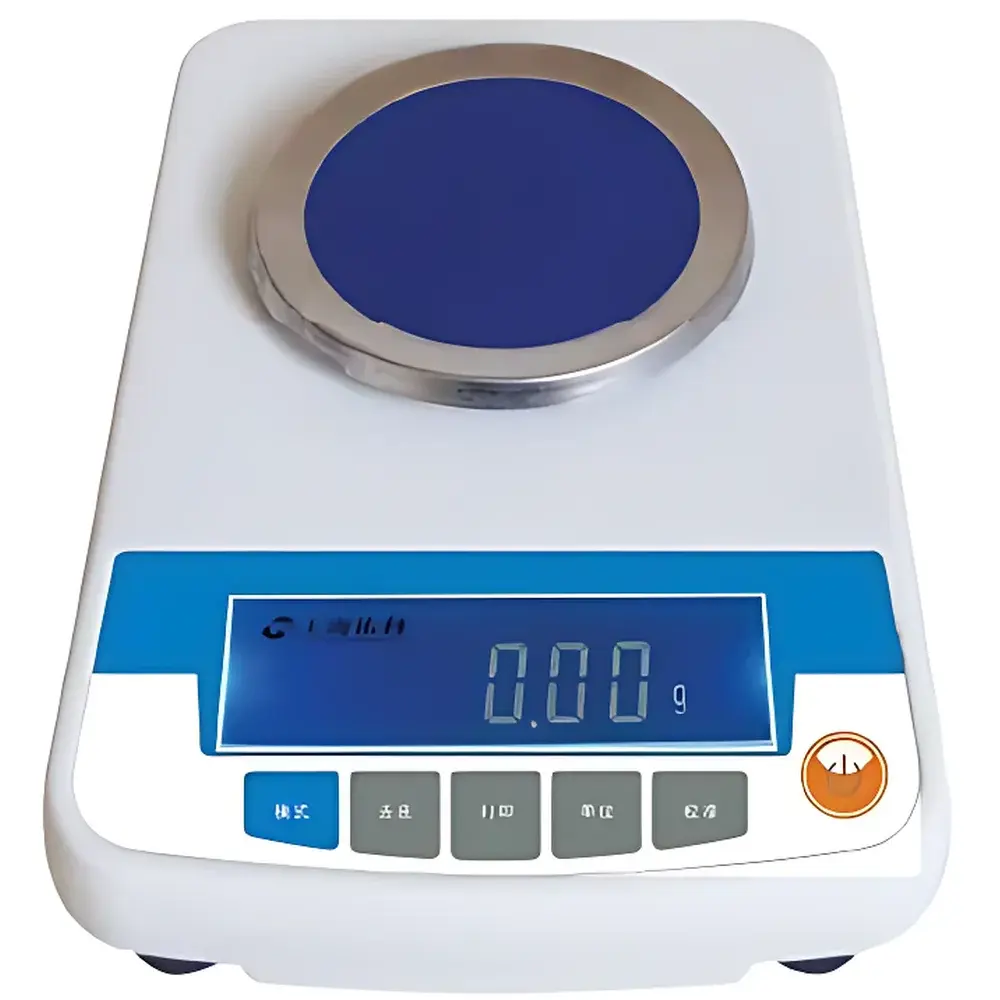
Chu Ding Technology YP10001 / YP20001 / YP60001 Precision Electronic Balance
| Key | Brand: Chu Ding Technology |
|---|---|
| Origin | Shanghai, China |
| Model | YP10001 / YP20001 / YP60001 |
| Capacity | 1000 g / 2000 g / 6000 g |
| Readability | 100 mg |
| Pan Size | Φ130 mm (YP10001/YP20001), 165 × 165 mm (YP60001) |
| Dimensions | 320 × 280 × 150 mm (YP10001/YP20001), 320 × 280 × 150 mm (YP60001) |
| Power Supply | AC/DC dual-mode |
| Interface | RS232C serial output |
Overview
The Chu Ding Technology YP10001, YP20001, and YP60001 are precision electronic balances engineered for reliable mass measurement in laboratory, educational, and light industrial environments. These models operate on electromagnetic force compensation (EMFC) principle — the industry-standard method for high-stability analytical and precision weighing — ensuring consistent repeatability and linearity across their full capacity range. Designed with a focus on operational robustness, each unit integrates a rigid metal base and optimized mechanical architecture to minimize drift under ambient thermal fluctuations or minor floor vibrations. The series supports dual AC/DC power operation, enabling flexible deployment in field settings or locations with unstable mains supply. While not certified for Class I or II metrological compliance per OIML R76 or NIST Handbook 44, the YP-series meets general-purpose laboratory accuracy requirements aligned with ISO/IEC 17025–recommended verification protocols for non-regulated weighing tasks.
Key Features
- High-reproducibility electromagnetic force compensation sensor with automatic internal calibration routine (user-initiated)
- Sturdy die-cast metal base and reinforced chassis design for enhanced mechanical stability and reduced sensitivity to external perturbations
- RS232C serial interface compliant with standard ASCII command protocol, enabling direct data transfer to PCs, printers, or LIMS systems
- Multi-function weighing modes: standard mass, piece counting (with sample count input), animal/dynamic weighing (with damping algorithm), and unit conversion (g, oz, ct, lb, etc.)
- Backlit LCD display with intuitive icon-driven menu navigation; real-time stability indicator and overload warning
- Auto-zero tracking and auto-tare functions with programmable delay to accommodate slow-responding samples or draft shield usage
Sample Compatibility & Compliance
The YP10001 (1000 g / 0.1 g), YP20001 (2000 g / 0.1 g), and YP60001 (6000 g / 0.1 g) models accommodate a broad spectrum of sample types — from powders and granules to irregular solids and small containers — within their respective pan dimensions (Φ130 mm for YP10001/YP20001; 165 × 165 mm for YP60001). All units comply with CE marking requirements for EMC Directive 2014/30/EU and Low Voltage Directive 2014/35/EU. They are suitable for use in GLP-aligned laboratories where traceable documentation is maintained manually or via external software; however, they do not incorporate FDA 21 CFR Part 11–compliant audit trails, electronic signatures, or role-based access control. For applications requiring regulatory-grade validation, users should perform periodic performance verification per ASTM E898–22 or ISO 9001 clause 7.1.5.
Software & Data Management
Data export is supported exclusively via the built-in RS232C port using standard baud rates (9600 bps default) and ASCII text format. No proprietary software is bundled; integration relies on third-party terminal emulators (e.g., Tera Term, PuTTY) or custom scripts written in Python, LabVIEW, or MATLAB. Each weighing event transmits timestamp-free ASCII strings containing net weight, unit code, and status flags (e.g., “STABLE”, “OVERLOAD”). For automated logging, users must implement external timestamping and file management logic. The balance does not support USB, Bluetooth, or Ethernet connectivity, nor does it store historical records internally.
Applications
These balances serve routine mass determination needs across multiple domains: formulation and batching in chemistry teaching labs; raw material intake verification in food processing QA; sample preparation in environmental testing facilities; inventory reconciliation in warehouse operations; and student experiments in physics and biology curricula. Their 100 mg readability and wide capacity range make them particularly suited for applications involving bulk reagents, packaged goods, or medium-density solids where sub-10 mg resolution is not required. The dynamic weighing mode supports live-weight monitoring of restless specimens (e.g., small animals or plants), while the counting function enables rapid estimation of uniform parts — provided a representative sample count is entered prior to batch measurement.
FAQ
Is internal calibration performed automatically?
No. Calibration requires manual initiation via front-panel key sequence; no motorized or temperature-compensated auto-calibration mechanism is present.
Can this balance be connected to a modern Windows 11 PC?
Yes — using an RS232-to-USB adapter and appropriate COM port drivers; native USB or wireless connectivity is not supported.
Does it meet USP <41> requirements for pharmaceutical weighing?
No. It lacks documented repeatability ≤ 0.1 RSD at 5% capacity and does not provide test records meeting USP <41> minimum weight validation criteria.
What is the warm-up time before first use?
Minimum 30 minutes recommended after power-on to achieve thermal equilibrium of the load cell and electronics.
Are calibration weights included with purchase?
No. External Class M2 or better reference weights must be procured separately for initial setup and periodic verification.