
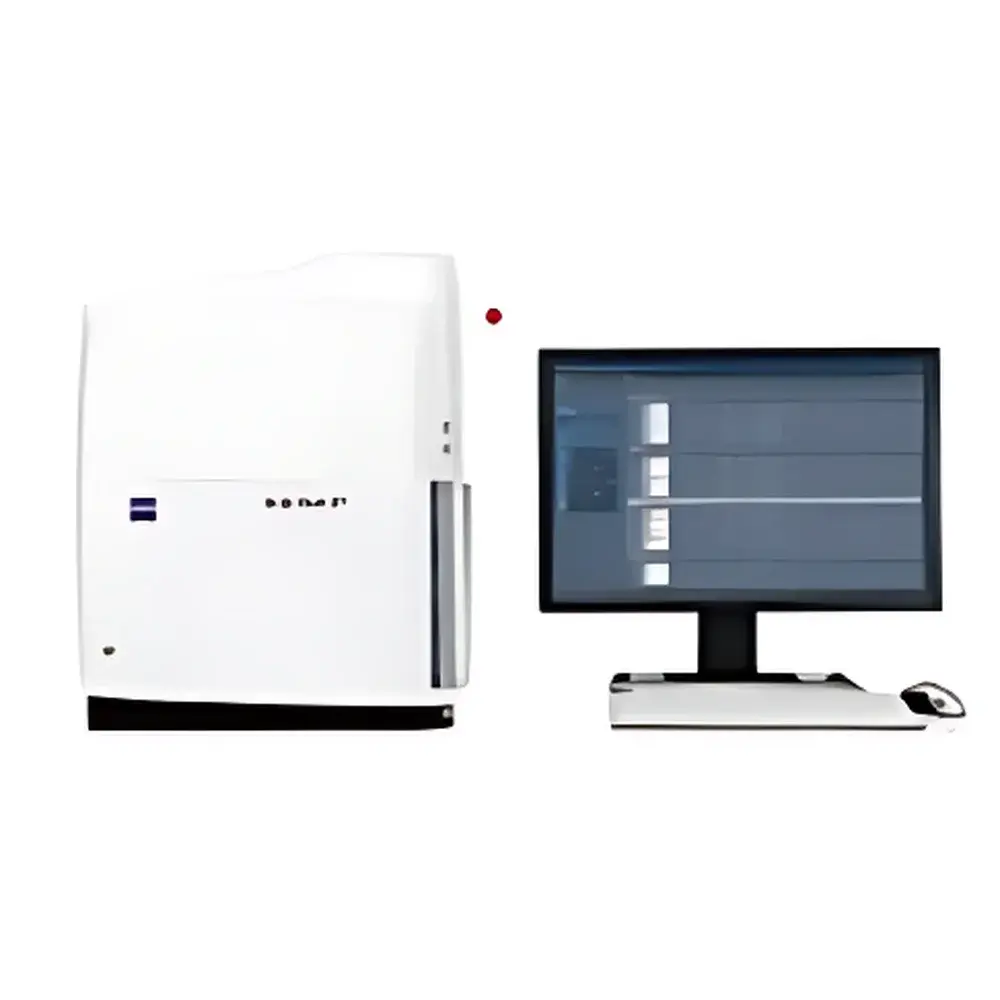
ZEISS Axioscan 7 Fully Automated Digital Slide Scanner
| Brand | ZEISS |
|---|---|
| Origin | Germany |
| Model | Axioscan 7 |
| Imaging Modes | Brightfield, Fluorescence (up to 9 channels), Polarization |
| Objective Compatibility | Plan-Apochromat objectives (e.g., 20×/0.8 NA) |
| Automation | Fully automated slide loading, focus calibration, geometric & chromatic correction, multi-layer scanning |
| Compliance | Designed for GLP/GMP-adjacent workflows |
| Software Platform | ZEN Connect with integrated image management, annotation, and export to DICOM, OME-TIFF, and SVS formats |
Overview
The ZEISS Axioscan 7 is a high-throughput, fully automated digital slide scanner engineered for precision histopathology and life science research applications. Built upon ZEISS’s legacy in optical metrology and microscope system integration, the Axioscan 7 employs a motorized, multi-axis stage combined with a high-stability illumination path and telecentric optical design to ensure sub-micron spatial fidelity across large-format tissue sections. Its core imaging principle relies on sequential point-scanning with synchronized stage movement and real-time focus tracking—enabling consistent z-stack acquisition and extended focal imaging (EFI) without mechanical drift. Unlike tile-based stitching systems prone to seam artifacts, the Axioscan 7 utilizes continuous scan motion with pixel-level synchronization between camera exposure and stage velocity, resulting in seamless, distortion-free whole-slide images at resolutions up to 0.22 µm/pixel (with 40× objective). The system is optimized for long-duration unattended operation—critical for high-volume core facilities and translational research labs processing hundreds of slides per week under standardized protocols.
Key Features
- Integrated auto-calibration suite: Real-time geometric alignment and chromatic aberration correction ensure inter-slide and inter-session reproducibility—essential for longitudinal studies and multi-center trials.
- Multi-modal imaging engine: Simultaneous support for brightfield (including enhanced contrast mode for unstained or lightly stained sections), fluorescence (up to nine spectral channels with LED or laser excitation options), and polarization—enabling correlative analysis within a single platform.
- Advanced objective compatibility: Optimized for ZEISS Plan-Apochromat objectives (e.g., 20×/0.8 NA, 40×/0.95 NA), delivering flat-field correction and minimal spherical/chromatic distortion across the full field of view.
- Intelligent autofocus architecture: Combines contrast-based coarse focusing with infrared-based fine focus detection, enabling robust performance on uneven or folded tissue sections—including decalcified bone or thick cryosections.
- Modular hardware expansion: Optional slide barcodes readers, humidity-controlled chamber modules, and integrated environmental sensors support ISO 15189-compliant laboratory workflows.
Sample Compatibility & Compliance
The Axioscan 7 accommodates standard glass slides (1″x3″, 1mm thickness), frosted-end slides, and specialized substrates including charged poly-L-lysine or silanized surfaces. It supports both conventional H&E, IHC, and special stains (e.g., Sirius Red for collagen quantification), as well as multiplexed fluorescence panels (e.g., UltiMapper I/O PD-L1 assays). All scanning parameters—including exposure time, gain, z-step interval, and channel registration—are stored as metadata within each image file, ensuring traceability required by CLIA, CAP, and ISO 15189 accreditation frameworks. The system’s firmware and ZEN Connect software are validated for use in regulated environments, with full audit trail functionality, electronic signature support, and user-access controls aligned with FDA 21 CFR Part 11 and EU Annex 11 expectations.
Software & Data Management
ZEN Connect serves as the central interface for acquisition, review, annotation, and export. It natively supports OME-TIFF and DICOM-SR standards—facilitating PACS integration and computational pathology pipeline ingestion (e.g., QuPath, HALO, Visiopharm). Batch processing includes automatic background subtraction, color deconvolution (H-DAB, FastRed), and multi-layer registration for serial section alignment. Export options include pyramid TIFF, SVS, and NDPI formats with embedded pyramidal tiling for web-based viewing via OpenSeadragon or commercial viewers. All metadata—including instrument configuration, operator ID, timestamp, and calibration logs—is embedded using MIAS-compliant schema, enabling FAIR data principles implementation.
Applications
The Axioscan 7 is deployed across academic core imaging facilities, biopharma discovery units, and diagnostic reference laboratories. In neurodegenerative disease research, it enables quantitative amyloid plaque burden mapping in Alzheimer’s models using Thioflavin-S fluorescence with subcellular resolution. In tumor immunology, its 9-channel capability supports spatial phenotyping of immune infiltrates (e.g., CD163+ macrophages vs. epithelial Cox-1+ clusters in Crohn’s colon tissue). For developmental biology, time-series embryo sectioning is digitized with EFI to reconstruct 3D morphogenetic gradients. Pharmacology labs leverage its consistency for high-content screening of drug-induced cellular damage—such as tubular injury scoring in murine kidney wound-healing models post-Sirius Red staining.
FAQ
Does the Axioscan 7 support whole-slide fluorescence scanning at high magnification without photobleaching?
Yes—the system uses pulsed LED illumination with adjustable duty cycle and real-time intensity feedback to minimize phototoxicity while maintaining signal-to-noise ratio at 40× magnification.
Can ZEN Connect integrate with existing LIMS or LIS platforms?
Yes—via RESTful API and HL7/FHIR adapters; custom middleware development is supported under ZEISS Professional Services agreements.
Is remote monitoring and queue management available?
Yes—ZEN Connect includes web-based dashboard access for real-time scan progress tracking, estimated completion time, and error alerting via email or SMS gateway.
What validation documentation is provided for regulated environments?
A comprehensive IQ/OQ/PQ protocol package—including test scripts, acceptance criteria, and raw validation data—is supplied with each installation, compliant with ISO/IEC 17025 and GxP expectations.
How does the system handle tissue folding or curling during scanning?
The autofocus system dynamically adjusts Z-position per tile using multi-point surface profiling, and optional pressure-controlled slide clamping minimizes mechanical deformation during high-speed acquisition.



