
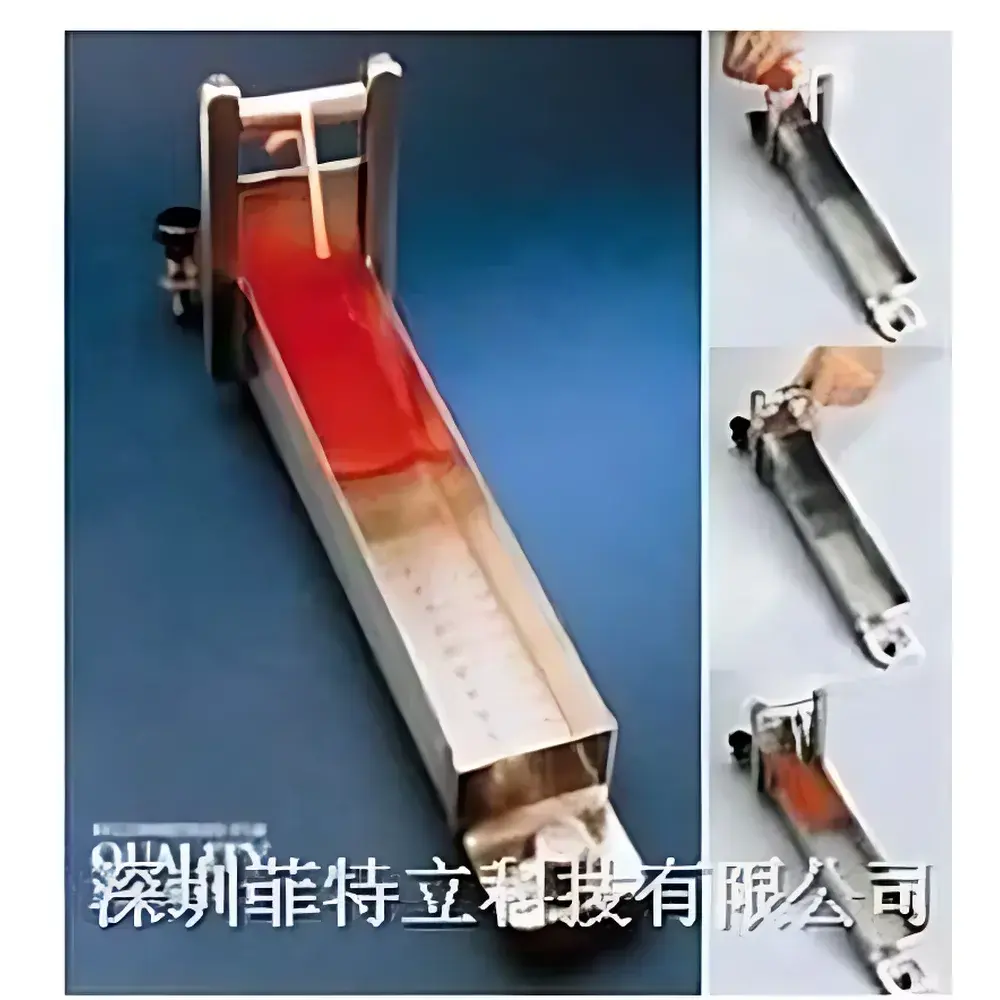
CSC Bostwick Consistometer for Tomato Paste and Food Product Consistency Testing
| Brand | CSC |
|---|---|
| Origin | USA |
| Model | Bostwick Consistometer |
| Instrument Type | Flow-Through Consistometer (Capillary-Free Gravitational Flow Viscometer) |
| Construction | Stainless Steel Body with Electrolytically Polished 2 mm Steel Ramp |
| Sample Volume | 75 mL |
| Dimensions (L×W×H) | 14 in × 3.5 in × 5.5 in |
| Scale Resolution | 0.5 cm graduations |
| Leveling | Dual adjustable leveling screws + bubble level |
| Flow Gate | Spring-loaded instantaneous release gate |
| Compliance | SNT 1036–2002 (China Export Standard for Tomato Paste), ASTM D1824–22 (Standard Test Method for Consistency of Semisolid Materials), ISO 10985:2021 (Foodstuffs — Determination of Flow Behaviour Using Bostwick Consistometer) |
Overview
The CSC Bostwick Consistometer is a precision-engineered, gravity-driven flow measurement instrument designed specifically for rapid, repeatable assessment of consistency, yield behavior, and structural integrity of semi-solid food products. Unlike rotational or capillary viscometers that rely on shear-rate-controlled deformation, the Bostwick method quantifies bulk flow under controlled gravitational force—making it uniquely suited for materials exhibiting yield stress, thixotropy, or time-dependent structural breakdown, such as tomato paste, ketchup, fruit preserves, yogurt, sour cream, and dairy spreads. The device operates on the principle of measuring the distance (in centimeters) a defined volume of sample flows across a precisely inclined stainless steel ramp within a standardized time interval—typically 30 seconds—under ambient conditions. This empirical yet highly reproducible metric—reported as “Bostwick units” (cm/30 s)—correlates directly with product processability, pumpability, filling accuracy, and consumer-perceived texture. Its simplicity, mechanical robustness, and absence of moving parts or electronics ensure long-term calibration stability and minimal operator dependency—critical attributes for routine QC in both laboratory and high-volume production environments.
Key Features
- Stainless steel construction with electrolytically polished 2 mm ramp surface—resistant to corrosion, abrasion, and residue buildup from acidic or particulate-laden food matrices
- Precision-machined 0.5 cm scale etched directly onto the base plate—enabling direct visual readout without interpolation error
- Integrated bubble level and dual micrometer-adjustable leveling screws—ensuring consistent 4° ramp inclination per ASTM D1824 and ISO 10985 specifications
- Spring-loaded gate mechanism with instantaneous release—eliminating manual timing variability and preventing premature flow initiation
- Compact footprint (14″ × 3.5″ × 5.5″)—designed for benchtop deployment in constrained lab spaces or inline near-production lines
- No power supply, software, or calibration fluids required—reducing operational overhead and eliminating drift-related recalibration cycles
- Validated for use with 75 mL sample volume—minimizing material consumption while maintaining statistical representativeness for heterogeneous suspensions
Sample Compatibility & Compliance
The CSC Bostwick Consistometer is validated for use across a broad spectrum of non-Newtonian, particulate-containing, and pH-variable food systems—including but not limited to tomato-based sauces (per SNT 1036–2002), fruit jams, jellies, condiments, fermented dairy products, baby foods, and plant-based spreads. Its design conforms to internationally recognized test standards: ASTM D1824–22 (Consistency of Semisolid Materials), ISO 10985:2021 (Foodstuffs — Determination of Flow Behaviour), and AOAC Official Method 950.45 (Ketchup Consistency). As a mechanical reference instrument, it supports GLP-compliant documentation workflows when paired with standardized SOPs and operator training records. While not electronically audit-trail capable, its physical traceability—via engraved serial number, documented leveling verification, and time-stamped manual log entries—meets minimum regulatory expectations for routine QC in FDA-regulated food manufacturing facilities operating under 21 CFR Part 11–aligned quality systems.
Software & Data Management
The CSC Bostwick Consistometer is a fully analog, operator-executed instrument requiring no embedded firmware, drivers, or proprietary software. All measurements are recorded manually into laboratory notebooks or LIMS-integrated spreadsheets using standardized templates. For digital integration, users may employ third-party data capture tools (e.g., tablet-based SOP checklists with timestamped photo documentation of scale readings) to satisfy traceability requirements under GMP or HACCP frameworks. Calibration verification is performed annually via ramp angle validation using certified inclinometers and dimensional inspection against NIST-traceable calipers—documentation retained per internal QA protocols. No firmware updates, cybersecurity patches, or software validation (e.g., IQ/OQ/PQ) are applicable.
Applications
- Batch release testing of tomato paste and ketchup against SNT 1036–2002 viscosity thresholds (e.g., ≥10 cm/30 s for export-grade Class A)
- Monitoring structural degradation during thermal processing or extended storage—detecting syneresis, phase separation, or enzymatic thinning
- Raw material qualification of pectin, starch, or xanthan gum batches based on consistency response profiles
- Formulation development support—quantifying impact of pH adjustment, salt addition, or particle size distribution on flow onset
- In-process control at filling stations—verifying pump feed consistency to prevent nozzle clogging or underfill events
- Supplier qualification audits—providing objective, equipment-independent consistency benchmarks across global manufacturing sites
FAQ
What is the difference between Bostwick consistency and dynamic viscosity?
Bostwick measures bulk gravitational flow over fixed time and geometry—reflecting yield stress and structural collapse under low-shear conditions. Dynamic viscosity (e.g., mPa·s at 10 s⁻¹) quantifies resistance to steady-state shear deformation. They are complementary, not interchangeable metrics.
Can the Bostwick Consistometer be used for non-food materials?
Yes—provided the material exhibits cohesive yield behavior and flows as a plug under gravity (e.g., certain adhesives, ceramic slips, pharmaceutical ointments). Validation per ASTM D1824 is recommended prior to adoption.
How often does the instrument require calibration?
Ramp angle and scale linearity should be verified annually using traceable metrology tools; no routine recalibration is needed if mechanical integrity and leveling functionality remain intact.
Is temperature control integrated?
No—the standard model operates at ambient temperature. For temperature-sensitive materials, users must precondition samples and conduct tests in climate-controlled rooms per ASTM D1824 Section 7.2.
Does CSC provide NIST-traceable certification?
CSC supplies a Certificate of Conformance with each unit; NIST-traceable calibration certificates are available upon request through authorized metrology partners.



