
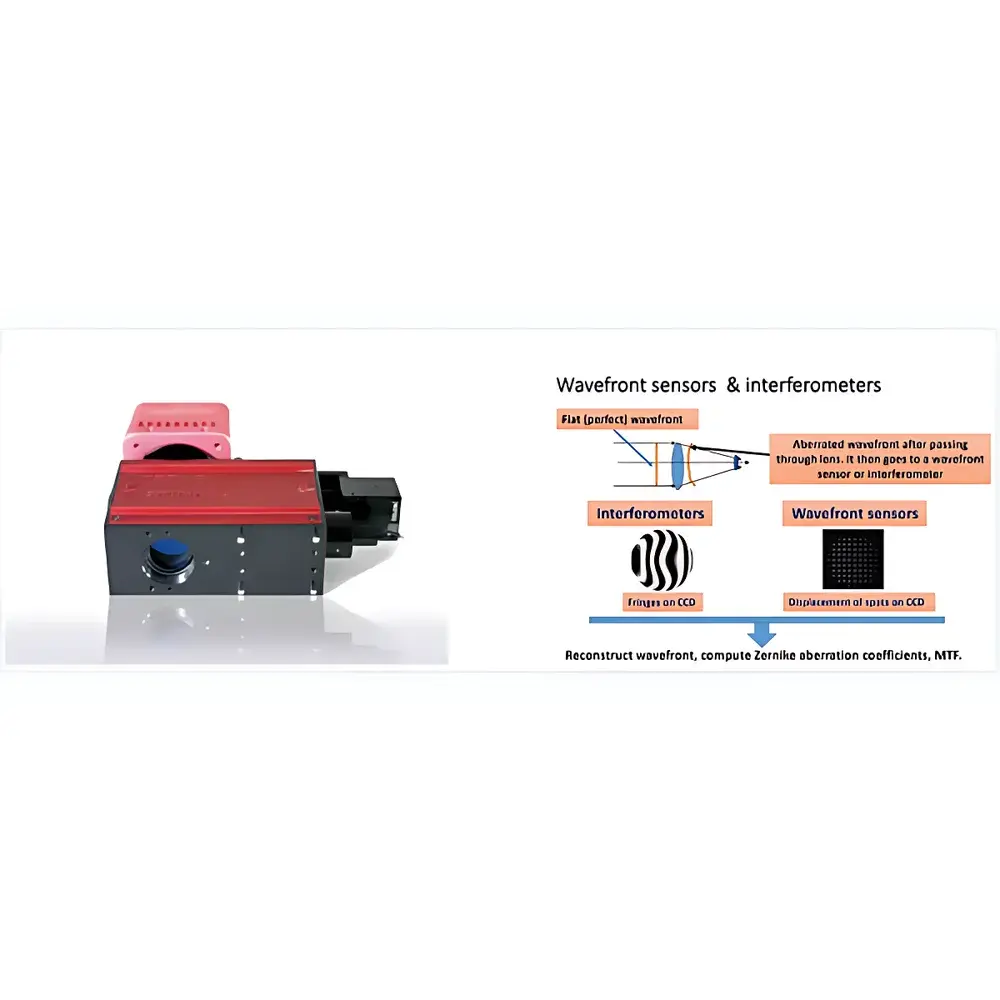
SpotOptics SH-WFS Series Shack-Hartmann Wavefront Sensor
| Brand | SpotOptics |
|---|---|
| Country of Origin | Italy |
| Model | SpotOptics SH-WFS Series |
| Spectral Range | UV (157–400 nm) / VIS-NIR (400–1064 nm) / SWIR (900–1700 nm) / MWIR (2–5.4 µm) / LWIR (8–14 µm) |
| Aperture Flexibility | Unlimited (with collimating objective matching NA) |
| Measurement Configurations | On-axis, off-axis, full-field scan, multi-field simultaneous acquisition |
| Pupil Shape Support | Circular, elliptical, centrally obscured (with central hole), hexagonal |
| Optical Path Options | Single-pass and double-pass configurations |
| Dual-Channel Variant | IOPTINO series integrates Shack-Hartmann sensor + electronic autocollimator (150 × 100 × 50 mm, 400 g) |
| Microlens Array | Interchangeable for wavelength-specific optimization |
| Frame Rate | Up to 8 kHz (real-time display) |
| Applications | Laser beam characterization (mW to MW, including 10.6 µm CO₂), astronomical telescope phasing (e.g., 6.5 m mm-wave telescope), adaptive optics, active optics, aspheric surface metrology, non-destructive refractive index profiling, thermal-dependent FFL/MTF analysis |
Overview
The SpotOptics SH-WFS Series Shack-Hartmann Wavefront Sensor is an engineered optical metrology platform designed for high-fidelity, quantitative wavefront measurement across an exceptionally broad spectral domain—from deep ultraviolet (157 nm) through visible and near-infrared, up to long-wave infrared (14 µm). Based on the well-established Shack-Hartmann principle—where a microlens array samples local wavefront slopes via centroid displacement of focused sub-aperture spots—the system delivers direct, absolute wavefront phase reconstruction with high spatial resolution and temporal stability. Unlike intensity-based beam profilers, this sensor captures complete phase information, enabling rigorous assessment of optical aberrations (Zernike or modal decomposition), beam propagation dynamics, and system-level alignment errors. Its modular architecture supports both laboratory R&D and industrial integration, with native compatibility for laser systems ranging from low-power diode sources to multi-megawatt pulsed CO₂ lasers at 10.6 µm.
Key Features
- Multi-band spectral coverage: Five distinct operational windows—UV (157–400 nm), VIS-NIR (400–1064 nm), SWIR (900–1700 nm), MWIR (2–5.4 µm), and LWIR (8–14 µm)—enabled by user-replaceable microlens arrays optimized for transmission, diffraction efficiency, and focal length per band.
- Aperture-agnostic design: No intrinsic pupil size limitation; accommodates beams from 300 mm diameter when paired with appropriate collimating objectives matched to the sensor’s numerical aperture.
- Flexible field geometry support: Measures wavefronts from arbitrarily shaped exit pupils—including circular, elliptical, centrally obscured (e.g., Cassegrain telescopes), and segmented hexagonal apertures—without geometric interpolation artifacts.
- Dual-path optical configuration: Supports both single-pass (transmission/reflection) and double-pass (interferometric null testing) arrangements for applications such as optical component verification and cavity alignment.
- Compact dual-channel variant (IOPTINO series): Integrates a high-resolution Shack-Hartmann sensor and an electronic autocollimator in a monolithic 150 × 100 × 50 mm housing (400 g), enabling concurrent wavefront sensing and precision optical axis alignment during setup or in-situ calibration.
- High-speed acquisition: Real-time frame rates up to 8 kHz allow dynamic wavefront monitoring of fast-response elements—including liquid lenses, MEMS deformable mirrors, and thermally induced optical path variations.
Sample Compatibility & Compliance
The SH-WFS Series is compatible with diverse optical systems and environmental conditions. It supports measurements under ambient, vacuum, and controlled-temperature environments. For regulated industries—including aerospace optics qualification, medical laser device validation, and defense-grade EO/IR system testing—the platform complies with foundational metrological traceability requirements. While the sensor itself does not carry CE or FDA certification, its raw data output format (IEEE 754-compliant floating-point arrays, timestamped HDF5 or ASCII) enables seamless integration into GLP/GMP-compliant workflows. When used with calibrated reference sources and documented uncertainty budgets, it meets ISO 10110-5 (surface form tolerances) and ISO 14132-3 (optical test methods) guidelines for wavefront error reporting. Traceable calibration services are available through SpotOptics’ authorized metrology partners in Europe and North America.
Software & Data Management
SpotOptics provides the proprietary WaveFront Studio software suite (Windows/Linux), supporting real-time visualization, Zernike polynomial fitting (up to 64 terms), RMS/PV wavefront error reporting, MTF synthesis, and time-series trending. All acquired datasets include embedded metadata (wavelength, exposure time, lens array ID, temperature, timestamp), satisfying audit-trail requirements under FDA 21 CFR Part 11 when deployed with validated IT infrastructure. Export options include CSV, MATLAB .mat, and industry-standard FITS (for astronomical use cases). API access (C/C++, Python bindings) enables integration into custom automation frameworks—e.g., closed-loop adaptive optics control loops or production-line pass/fail decision engines.
Applications
- Laser beam diagnostics: Quantitative M², Strehl ratio, and far-field divergence prediction via reconstructed complex amplitude; validated for CO₂ (10.6 µm), Nd:YAG (1064 nm), and excimer (193 nm) sources.
- Astronomical instrumentation: Phasing of segmented primary mirrors (e.g., 6.5 m mm-wave telescope), atmospheric turbulence correction feedback, and secondary mirror alignment verification.
- Active & adaptive optics: Real-time input for deformable mirror control algorithms; supports latency-critical operation down to <125 µs loop time.
- Optical manufacturing metrology: Non-contact evaluation of aspheric surfaces, lenslet array uniformity, and refractive index gradients in gradient-index (GRIN) materials.
- Thermo-optic characterization: Monitoring focal length shift (FFL) and modulation transfer function (MTF) drift across −40 °C to +85 °C temperature ramps with synchronized thermal chamber control.
FAQ
What spectral calibration standards are provided with the system?
Each microlens array is supplied with NIST-traceable spectral responsivity curves and focal length verification reports at three representative wavelengths within its designated band.
Can the sensor operate in vacuum environments?
Yes—standard models feature all-metal housings and outgassing-compliant adhesives; optional vacuum-rated versions (ISO-KF flange interface, <10⁻⁶ mbar rating) are available upon request.
Is temperature stabilization required for high-accuracy measurements?
The core sensor module includes passive thermal mass design and active compensation algorithms; for sub-nm RMS stability over >1-hour sessions, external air- or water-cooling is recommended.
How is pupil registration handled for off-axis or irregular apertures?
The software employs iterative centroid mapping and geometric pupil masking—users define the physical boundary via image-based thresholding or CAD import (STEP/IGES), ensuring accurate slope-to-phase conversion without interpolation bias.
Does SpotOptics offer OEM integration support?
Yes—custom firmware partitioning, mechanical mounting interfaces, and SDK documentation (including thread-safe C++ libraries and Python wrappers) are included in OEM licensing agreements.





