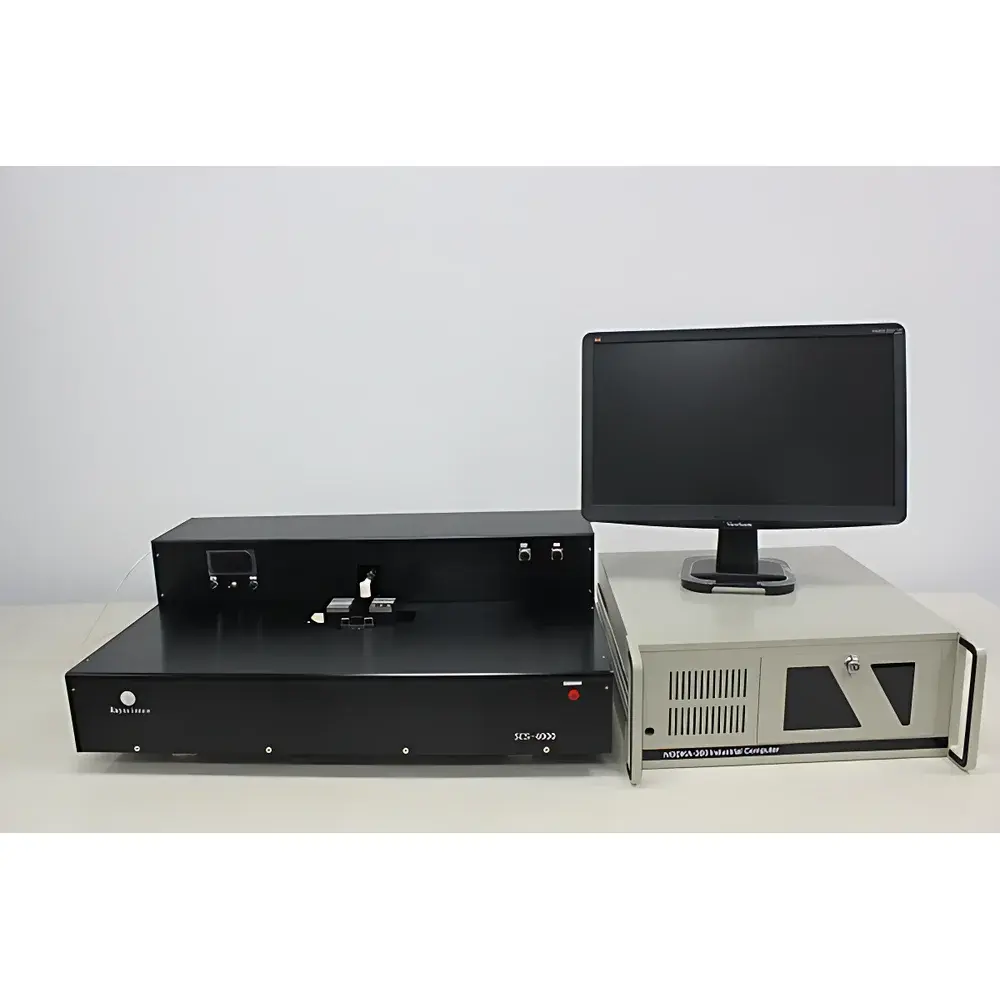
Oelabs SCS-4000 Fiber Fusion Tapering System
| Brand | Oelabs |
|---|---|
| Origin | Shanghai, China |
| Model | SCS-4000 |
| Stretching Accuracy | ±0.2 µm |
| Max. Stretch Distance | 50 mm |
| Stretch Speed Range | 0.2–10,000 µm/s |
| Fiber Clamping Diameter | φ0.1–0.5 mm |
| Torch Axial Scan Amplitude | 0–20 mm |
| Torch Scan Speed | 0–4 mm/s |
| H₂ Flow Rate | 0–200 sccm (adjustable) |
| O₂ Flow Rate | 0–200 sccm (adjustable) |
| Detector Options | InGaAs (850–1600 nm), Si (400–1000 nm) |
| Light Source Options | 1310/1550 nm FP Laser, 1 mW |
| Packaging Temperature Range | 0–130 °C |
| Power Supply | 220 V, 6 A |
Overview
The Oelabs SCS-4000 Fiber Fusion Tapering System is a high-precision, fully automated manufacturing platform engineered for the reproducible fabrication of fused fiber optic couplers, wavelength division multiplexers (WDM), polarization-maintaining (PM) couplers, and multimode fiber combiners. Based on the principle of flame-heated fusion and controlled axial stretching—commonly referred to as the fused biconical taper (FBT) process—the system enables precise manipulation of evanescent field coupling between two or more stripped optical fibers under programmable thermal and mechanical conditions. During operation, hydrogen–oxygen flame heating softens the silica cladding and core region while synchronized motorized stages apply calibrated tensile force, inducing adiabatic tapering and controlled mode coupling. The resulting waveguide structure supports deterministic power splitting ratios, broadband spectral response, low excess loss (20 dB for PM variants), making it suitable for R&D and pilot-scale production in photonics laboratories and component manufacturing facilities.
Key Features
- Sub-micron stretching resolution (±0.2 µm) with closed-loop feedback control ensures nanoscale repeatability across consecutive taper cycles.
- Programmable dual-gas flame delivery system featuring independently adjustable H₂ and O₂ mass flow controllers (0–200 sccm each), enabling stable, uniform heating profiles optimized for both standard SMF and specialty fibers (e.g., Panda PM, large-core multimode).
- Custom-designed coaxial H₂/O₂ burner head eliminates thermal drift associated with conventional top-bottom oxygen configurations, delivering improved temperature homogeneity and reduced PDL in final devices.
- Modular mechanical architecture includes parallel-fiber clamping fixtures, vacuum-assisted fiber positioning stages, motorized torch translation (0–4 mm/s), and integrated packaging heater with 0–130 °C thermal ramping capability.
- Real-time optical monitoring via dual-wavelength photodetectors (InGaAs: 850–1600 nm; Si: 400–1000 nm) synchronized with data acquisition at up to 1 kHz sampling rate for dynamic coupling ratio tracking.
- Pre-stretch and adaptive scan-width modulation algorithms allow optimization of taper profile for single-window (±20 nm), dual-window (±40 nm), and ultra-broadband coupler fabrication.
Sample Compatibility & Compliance
The SCS-4000 accommodates a broad range of fiber geometries and material systems, including standard telecom-grade SMF-28 (125/250 µm), PM fibers (Panda, Bow-tie), graded-index and step-index multimode fibers (core diameters from 100 µm to 600 µm, NA 0.11–0.48), and specialty fibers such as photosensitive, erbium-doped, or hollow-core fibers (with custom fixture adaptation). All hardware and software modules comply with CE safety directives and electromagnetic compatibility (EMC) Class B requirements. The system supports GLP-compliant operation through audit-trail-enabled software logging, user-access controls, and timestamped parameter archiving—facilitating traceability for ISO/IEC 17025-accredited labs and FDA-regulated photonic device development workflows.
Software & Data Management
The proprietary SCS Control Suite runs on Windows-based industrial PCs and provides intuitive graphical workflow sequencing, real-time parameter visualization, and automated report generation compliant with ASTM F2657-20 (Standard Guide for Optical Fiber Coupler Characterization). Each fabrication run stores full configuration metadata—including stretch trajectory, gas flow profiles, detector signals, and thermal setpoints—into encrypted SQLite databases. Export options include CSV, PDF, and XML formats compatible with LIMS integration. Firmware updates are delivered via secure HTTPS channels with SHA-256 signature verification. Optional 21 CFR Part 11 compliance package includes electronic signatures, role-based permissions, and immutable audit logs for regulated environments.
Applications
- Fabrication of telecom-grade 1×2, 2×2, and NxM fused couplers (N = 2–7) for passive optical networks (PON), FTTH, and DWDM infrastructure.
- R&D of polarization-maintaining couplers for interferometric fiber sensors, quantum optics experiments, and coherent detection systems.
- Development of high-power multimode combiners used in fiber laser pump/signal combining, medical laser delivery, and industrial material processing.
- Prototyping of tapered fiber sensors for refractive index, temperature, strain, and biochemical detection based on evanescent field interaction.
- Production of wavelength-flattened couplers and asymmetric splitting devices for optical signal conditioning in testbeds and instrumentation platforms.
FAQ
What fiber types can be processed on the SCS-4000?
Standard single-mode (SMF-28), polarization-maintaining (Panda/Bow-tie), multimode (50/125 µm, 62.5/125 µm, 100–600 µm core), and specialty fibers—including doped, photosensitive, and microstructured fibers—with appropriate custom fixtures.
Is the system compatible with cleanroom environments?
Yes—the SCS-4000 meets ISO Class 5 particulate limits when operated with optional HEPA-filtered exhaust ducting and non-outgassing materials; footprint (540 × 390 × 270 mm) allows integration into standard laminar flow hoods.
Can I export raw optical monitoring data for post-processing?
Yes—real-time photodetector voltage traces, stretch position, gas flows, and temperature readings are logged synchronously and exportable in ASCII-compatible formats for MATLAB, Python, or LabVIEW analysis.
Does the system support remote diagnostics and firmware updates?
Yes—integrated Ethernet port enables secure remote access via SSH or VNC; firmware patches and calibration updates are digitally signed and deployed over TLS-encrypted connections.
What documentation is provided for regulatory submissions?
Full technical manuals, IQ/OQ protocols, traceable calibration certificates (NIST-traceable detectors and flow meters), and validation templates aligned with IEC 61300-3-35 (fiber optic connector testing) and Telcordia GR-1209-CORE.