
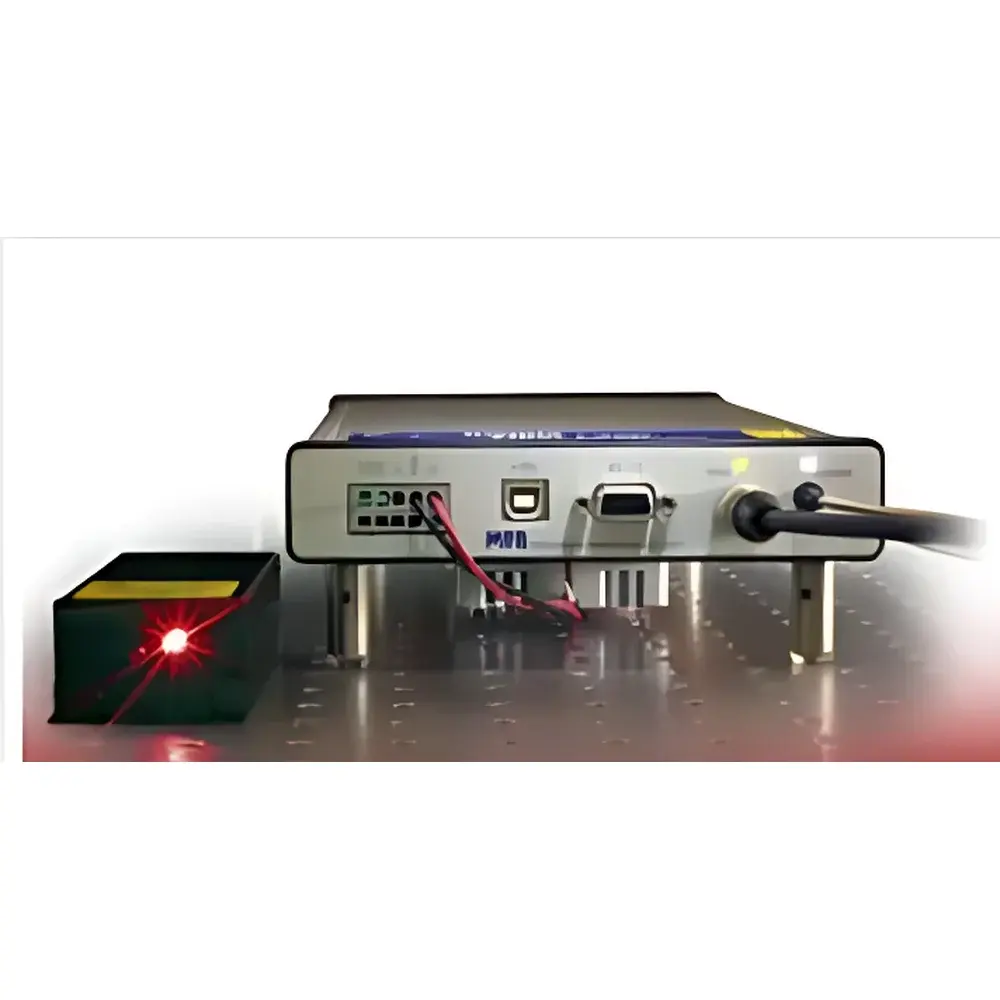
MPB VFL-P-200-642 Continuous-Wave 642 nm Fiber-Coupled Laser System
| Brand | MPB |
|---|---|
| Origin | Canada |
| Model | VFL-P-200-642 |
| Wavelength | 642 nm |
| Output Power | 200 mW |
| Beam Mode | TEM₀₀ |
| M² | ≤1.1 |
| Polarization | Linear, vertical to baseplate |
| Beam Divergence (full angle) | <5 mrad |
| Power Stability (rms, 8h) | ±0.5% |
| Wavelength Stability | ±0.02 nm |
| Cooling | Air-cooled |
| Interface | RS232 & USB |
| Safety | Interlock-enabled (benchtop), Emergency Stop & Integrated Transformer (rack-mount) |
Overview
The MPB VFL-P-200-642 is a high-stability, continuous-wave (CW) fiber-coupled diode laser system engineered for precision optical applications requiring narrow-linewidth visible light at 642 nm. Unlike free-space diode modules, this system integrates a semiconductor gain medium with a polarization-maintaining single-mode fiber output, delivering diffraction-limited beam quality (TEM₀₀, M² ≤1.1) and exceptional pointing stability. Its wavelength falls within the orange-red spectral band—optimal for excitation of common fluorophores including Alexa Fluor 647, Cy5, and Atto 647N—making it especially suited for quantitative fluorescence-based assays where spectral fidelity and photostability are critical. The laser operates in true CW mode with no modulation-induced intensity noise, supporting long-duration measurements without thermal drift or mode hopping. Designed and manufactured in Canada by MPB Communications—a Tier-1 supplier to national labs and OEM integrators—the VFL-P series complies with IEC 60825-1:2014 Class 3B laser safety requirements and incorporates redundant hardware-level interlocks for fail-safe operation.
Key Features
- Stable CW output at precisely 642 nm with ±0.02 nm wavelength stability over 8-hour operation
- Fiber-coupled delivery via PM980 single-mode fiber (FC/APC connector), enabling seamless integration into confocal, spectroscopic, or microfluidic platforms
- TEM₀₀ spatial profile with M² ≤1.1 and beam divergence <5 mrad (full angle), ensuring high coupling efficiency into objective back-apertures or interferometric setups
- Dual control interface: RS232 for automated system integration and USB for local GUI-based configuration and real-time monitoring
- Active air cooling with intelligent thermal management—no external chiller required, minimizing footprint and acoustic noise
- Benchtop and 2RU rack-mount configurations available; all rack versions include integrated 100–240 VAC transformer and certified emergency stop circuit per IEC 60204-1
- Power adjustability from 20% to 100% of rated output via analog voltage input or digital command, with <0.5% RMS power fluctuation over 8 hours
Sample Compatibility & Compliance
The VFL-P-200-642 is compatible with standard optical tables, inverted and upright fluorescence microscopes, flow cytometers with custom excitation ports, and thin-film ellipsometry stations. Its linear vertical polarization aligns with polarization-sensitive detection schemes such as polarized Raman or Mueller matrix imaging. All units undergo full factory calibration traceable to NRC Canada standards. Regulatory compliance includes CE marking (EMC Directive 2014/30/EU, LVD Directive 2014/35/EU), RoHS 2011/65/EU, and adherence to FDA 21 CFR Part 1040.10 for laser product reporting. For GLP/GMP environments, optional audit-ready firmware logs timestamped power readings, temperature telemetry, and interlock status changes—supporting 21 CFR Part 11 electronic record integrity when paired with validated acquisition software.
Software & Data Management
MPB provides the LaserControl Suite—a cross-platform application (Windows/macOS/Linux) supporting real-time power monitoring, scheduled ramp profiles, and remote diagnostics via USB or RS232. The SDK includes C/C++, Python, and LabVIEW drivers with full API documentation, enabling integration into NI TestStand, MATLAB Instrument Control Toolbox, or custom Python-based automation pipelines. All communication protocols are ASCII-based and deterministic, ensuring synchronization with TTL-gated detectors or camera triggers. Firmware updates preserve user-configured parameters and support secure signed image verification. Audit trails export in CSV/JSON format with ISO 8601 timestamps, facilitating traceability during method validation or regulatory submissions.
Applications
- Confocal and super-resolution fluorescence microscopy—especially STED and RESOLFT modalities requiring stable, diffraction-limited 642 nm depletion beams
- Quantitative flow cytometry with multi-laser excitation panels, where precise wavelength matching minimizes spillover into adjacent detection channels
- Ophthalmic biometry and retinal imaging systems leveraging 642 nm’s low melanin absorption and high hemoglobin contrast
- UV-Vis-NIR spectrophotometer calibration sources and cavity ring-down spectroscopy (CRDS) seed lasers
- Laser-assisted thin-film processing—including selective annealing of ITO layers and photochemical vapor deposition initiation
- Biophotonics research involving optogenetic actuation of red-shifted opsins (e.g., ChrimsonR, ReaChR) under controlled irradiance conditions
FAQ
Is the 642 nm output polarization-maintaining?
Yes—the laser emits linearly polarized light oriented vertically relative to the baseplate, and the integrated PM fiber preserves extinction ratios >20 dB across the operating temperature range.
Can this laser be modulated externally?
No—this is a strictly CW system without analog modulation input. For pulsed or amplitude-modulated operation, MPB offers the VFL-M series with TTL-compatible modulation ports.
What is the maximum allowable back-reflection into the output fiber?
<–30 dB is recommended; exceeding this may induce power instability or damage the internal isolator. An external Faraday isolator is advised for interferometric or high-reflectivity sample configurations.
Does the 2RU version meet ETSI 300 119-2 rack clearance specifications?
Yes—both 19″ and 23″ rack variants comply with ETSI EN 300 119-2 Category A2 (telecom-grade thermal envelope) and include front-to-back airflow ducting for forced-air-cooled data center deployment.
Is factory recalibration required annually?
MPB recommends performance verification every 12 months using a NIST-traceable power meter and wavemeter; full recalibration is only necessary if measurement deviation exceeds ±0.03 nm or ±2% power accuracy thresholds.





