
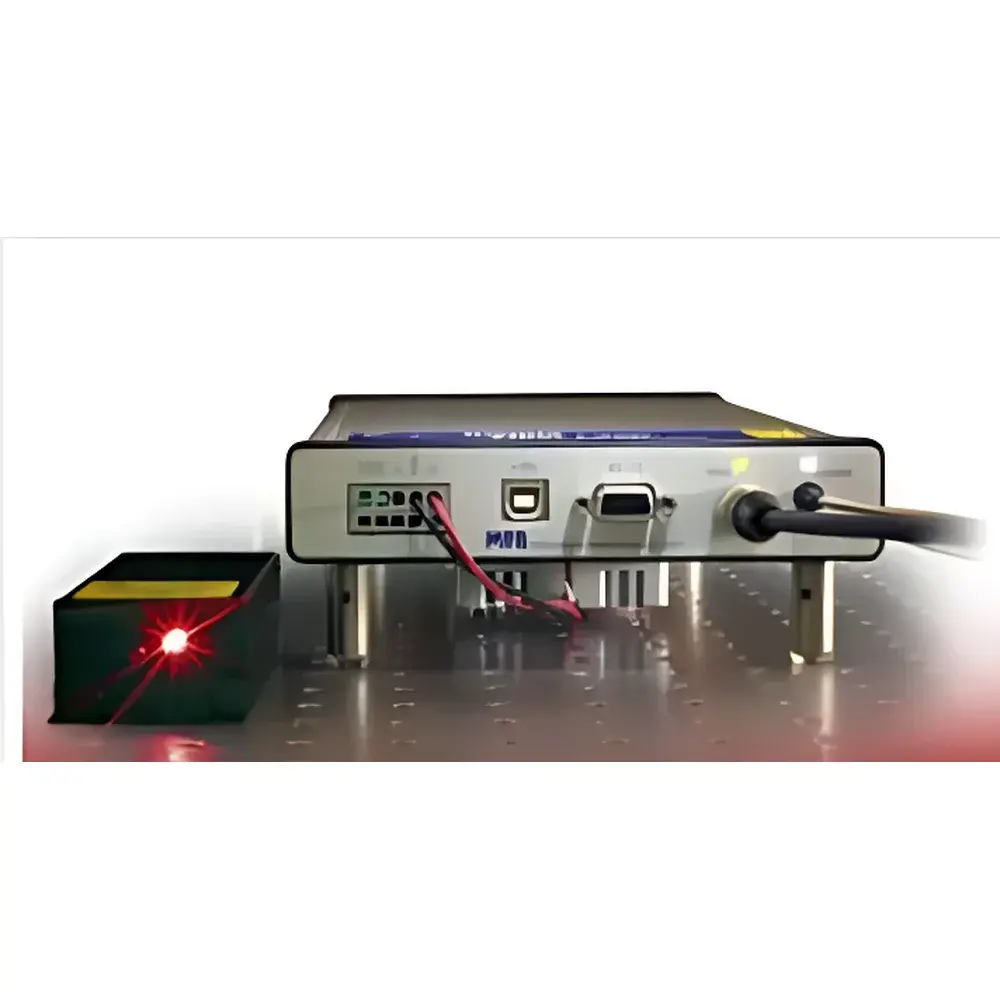
MPB VFL-P-300-750 Continuous-Wave 750 nm Fiber-Coupled Laser System
| Brand | MPB |
|---|---|
| Origin | Canada |
| Model | VFL-P-300-750 |
| Output Power | 300 mW (CW) |
| Wavelength | 750 nm |
| Beam Mode | TEM₀₀ |
| M² | ≤1.1 |
| Polarization | Linear, vertical to baseplate |
| Beam Divergence (full angle) | <5 mrad |
| Power Stability (rms, over 8 hrs) | ±0.5% |
| Wavelength Stability | ±0.02 nm |
| Cooling | Air-cooled |
| Interfaces | RS232, USB |
| Safety | Interlock-enabled (desktop), Emergency Stop & Built-in Transformer (rack-mount) |
Overview
The MPB VFL-P-300-750 is a high-stability, continuous-wave (CW), single-mode fiber-coupled laser system engineered for precision optical instrumentation in life science, analytical spectroscopy, and industrial photonics applications. Operating at a precisely controlled wavelength of 750 nm—strategically positioned within the near-infrared (NIR) window where biological tissue exhibits reduced scattering and water absorption—the laser delivers 300 mW of output power through a polarization-maintaining (PM) single-mode fiber. Its design follows fundamental principles of diode-pumped solid-state (DPSS) and semiconductor laser architecture, optimized for long-term amplitude and spectral stability. The system employs active temperature stabilization of the gain medium and feedback-controlled current regulation to maintain <±0.5% RMS power drift over 8-hour operational periods and ±0.02 nm wavelength deviation under ambient thermal fluctuations. This level of reproducibility supports quantitative, calibration-critical workflows including fluorescence excitation, Raman pump sources, and interferometric alignment tasks.
Key Features
- TEM₀₀ spatial mode with M² ≤1.1 ensures diffraction-limited focusability and high coupling efficiency into single-mode optical fibers or microscope illumination paths.
- Linear polarization oriented vertically relative to the mechanical baseplate enables straightforward integration with polarizing beam splitters, waveplates, and electro-optic modulators.
- Air-cooled thermal management eliminates dependency on external chillers or liquid cooling infrastructure—reducing footprint, maintenance overhead, and acoustic noise in sensitive laboratory environments.
- Dual digital interfaces (RS232 and USB 2.0) support both legacy instrument control architectures and modern PC-based automation via SCPI-compliant command sets.
- Embedded GUI software provides real-time monitoring of laser diode current, thermistor readings, output power history, and interlock status—enabling full traceability during GLP/GMP-aligned validation protocols.
- Rack-mount (2RU) and desktop configurations are available; rack versions integrate an internal transformer and certified emergency stop circuitry compliant with IEC 61000-6-2/6-4 and UL 61010-1 safety standards.
Sample Compatibility & Compliance
The VFL-P-300-750 is compatible with standard FC/APC or SMA905 fiber connectors (customizable per OEM requirement) and designed for direct integration into ISO-standard optical tables, confocal platforms, and flow cytometry signal chains. Its 750 nm emission falls within the Class 3B laser hazard classification per IEC 60825-1:2014, requiring appropriate engineering controls (e.g., interlocked enclosures, beam path shielding) and administrative procedures (e.g., designated laser safety officer oversight). The system meets RoHS 3 and REACH material compliance requirements and supports audit-ready documentation packages aligned with FDA 21 CFR Part 11 for electronic records and signatures when used in regulated biopharmaceutical development labs.
Software & Data Management
MPB’s proprietary LaserControl Suite provides cross-platform (Windows/macOS/Linux) configuration, remote diagnostics, and automated logging of operational parameters—including timestamped power measurements, thermal sensor outputs, and fault event logs. All data exports to CSV or HDF5 format for downstream analysis in MATLAB, Python (NumPy/Pandas), or LabVIEW. Audit trails record user actions, parameter changes, and session start/stop events with SHA-256 hashing for integrity verification—meeting ALCOA+ (Attributable, Legible, Contemporaneous, Original, Accurate, Complete, Consistent, Enduring, Available) data integrity expectations in regulated environments.
Applications
- Fluorescence microscopy: Excitation source for Cy5.5, Alexa Fluor 750, and IRDye 800CW-labeled probes in widefield, confocal, and light-sheet modalities.
- Flow cytometry: Stable NIR excitation channel enabling multiplexed detection with minimal autofluorescence interference in primary cell suspensions.
- Ophthalmic diagnostics: Used in adaptive optics scanning laser ophthalmoscopy (AOSLO) systems for retinal imaging with enhanced depth penetration.
- Thin-film metrology: Probe beam in ellipsometers and reflectometers measuring thickness and refractive index of dielectric stacks in semiconductor fabrication.
- Laser-assisted sintering: Preheating and selective melting control in additive manufacturing processes involving polymer composites and low-melting-point alloys.
- Spectroscopic calibration: Reference source for wavelength calibration of FTIR, NIR, and UV-Vis spectrometers operating in the 700–800 nm range.
FAQ
Is the 750 nm output wavelength tunable?
No—the VFL-P-300-750 is a fixed-wavelength laser system optimized for spectral stability; wavelength tuning is not supported.
What fiber connector types are standard?
Standard configurations include FC/APC; SMA905 and custom connectors (e.g., QD, FPC) are available upon request.
Does the system support analog modulation?
Yes—0–5 V TTL-compatible analog modulation input is provided for intensity control up to 100 kHz bandwidth.
Can this laser be integrated into a cleanroom environment?
Yes—air-cooled operation, zero oil or coolant leakage risk, and optional stainless-steel housing make it suitable for ISO Class 5–7 cleanrooms.
What documentation is provided for regulatory submissions?
MPB supplies a full Design History File (DHF)-aligned package including risk analysis (ISO 14971), test reports (power stability, EMI/EMC), and calibration certificates traceable to NIST standards.





