
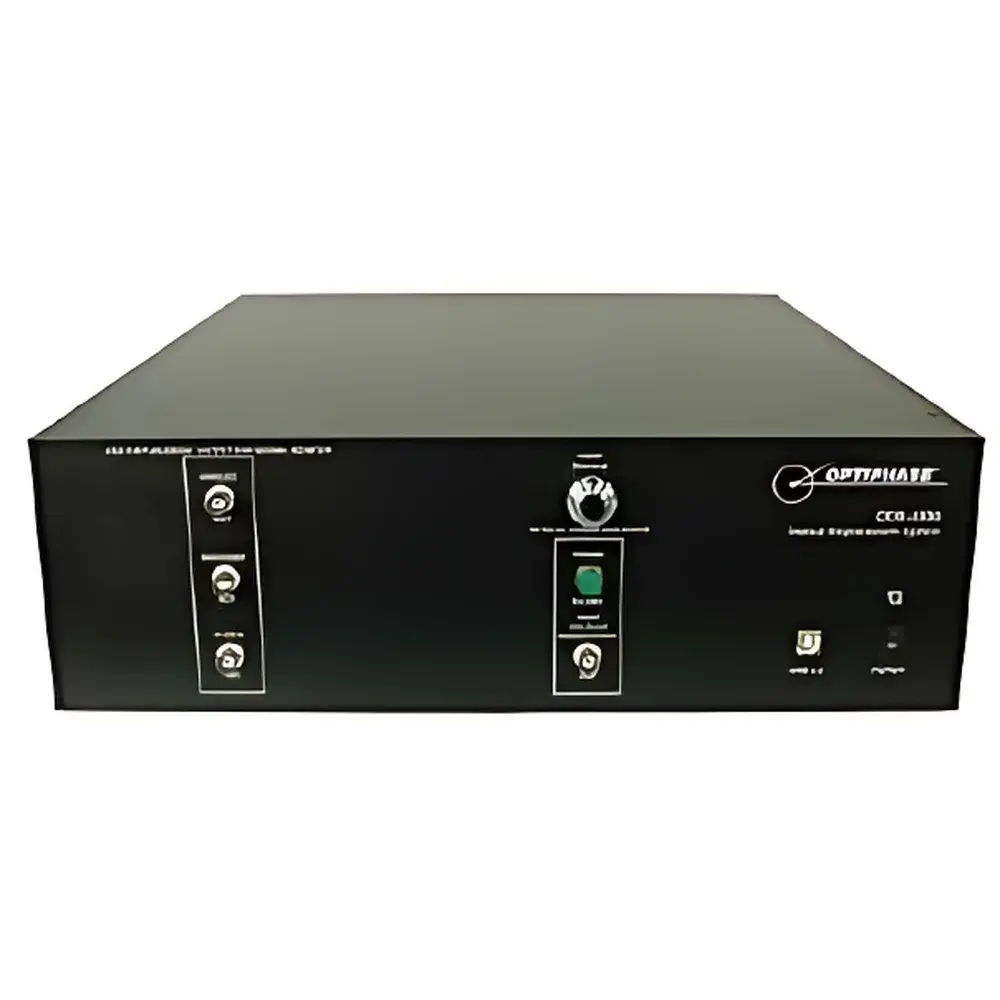
Fiber Optic Displacement System Model 248
| Origin | Imported |
|---|---|
| Manufacturer Type | Authorized Distributor |
| Model | 248 |
| Pricing | Available Upon Request |
Overview
The Fiber Optic Displacement System Model 248 is a non-contact, interferometric-grade optical measurement instrument engineered for high-resolution displacement sensing in electromagnetically hostile, hazardous, or space-constrained environments. It operates on the principle of intensity-modulated fiber optic transduction: incident light propagates through a single-mode or multimode optical fiber probe; displacement of the target surface alters the coupling efficiency between the emitting and receiving fibers (or between core and cladding modes), resulting in a monotonic, repeatable change in detected optical power. This intensity-based modulation—distinct from phase-sensitive interferometry—is optimized for robustness, ease of integration, and immunity to environmental perturbations such as EMI, RF noise, high voltage, ionizing radiation, and corrosive atmospheres. The system delivers sub-micrometer resolution over typical ranges of 10 µm to 2 mm, with linearity better than ±0.5% FS across calibrated spans. Its all-dielectric probe head eliminates grounding loops and intrinsic spark hazards, making it suitable for intrinsically safe (IS) Zone 0/1 deployments per IEC 60079-0 and ATEX directives.
Key Features
- Non-contact, wear-free measurement with no mechanical loading on delicate or moving targets
- Fully passive probe head: no electronics, no power, no metallic components—ideal for MRI suites, high-voltage switchgear, and explosive atmospheres
- EMI/RFI immunity: immune to >10 kV/m field strength up to 1 GHz, verified per IEC 61000-4-3
- Operating temperature range: −40 °C to +125 °C (probe); −10 °C to +60 °C (electronics unit)
- Hermetically sealed stainless-steel or ceramic probe housings compatible with IP67 and NEMA 4X enclosures
- Real-time analog output (0–10 V or 4–20 mA) with digital RS-485/Modbus RTU interface for PLC integration
- Configurable sensitivity, zero offset, and filtering via front-panel DIP switches or PC utility software
Sample Compatibility & Compliance
The Model 248 accommodates reflective, diffusive, or semi-transparent targets—including polished metals, anodized aluminum, silicon wafers, polymer films, and biological tissues—without requiring surface preparation. Surface roughness down to Ra < 0.1 µm yields optimal signal-to-noise ratio. It complies with ISO/IEC 17025 calibration traceability requirements when used with NIST-traceable reference standards. The system meets CE marking criteria under the EU Electromagnetic Compatibility Directive 2014/30/EU and Low Voltage Directive 2014/35/EU. For pharmaceutical and medical device manufacturing, its analog output architecture supports validation under FDA 21 CFR Part 11 when paired with compliant data acquisition systems featuring audit trail and electronic signature functionality.
Software & Data Management
The included Windows-based configuration and acquisition software provides real-time waveform display, multi-channel synchronization (up to 8 channels per controller), and batch export to CSV, MATLAB (.mat), or HDF5 formats. All calibration coefficients, sensor ID, and date/time stamps are embedded in exported files. The software supports GLP-compliant operation: user access levels (Operator, Technician, Administrator), session logging, and automatic generation of IQ/OQ documentation templates aligned with ASTM E2500 and ISO 13485 Annex A. Raw intensity data is stored with 16-bit resolution at sampling rates up to 10 kHz, enabling post-hoc analysis of transient events such as impact response or thermal expansion dynamics.
Applications
- Precision machining: In-process monitoring of tool deflection, workpiece thermal expansion, and chucking force-induced displacement
- Power transmission: Vibration and axial displacement monitoring of turbine blades, generator rotors, and HV bushing movement under load
- Nuclear instrumentation: Fuel rod gap measurement inside spent fuel pools; control rod position feedback in reactor containment zones
- Biomechanics: Non-invasive tracking of joint articulation, tissue deformation, and micro-indentation response during ex vivo testing
- Aerospace: Strain-induced curvature mapping on composite airframe panels during fatigue cycling
- Microelectronics: Wafer-level warpage detection during flip-chip bonding and reflow profiling
FAQ
What is the minimum measurable displacement resolution of the Model 248?
Resolution depends on optical setup and target reflectivity; typical values range from 10 nm to 50 nm RMS under controlled lab conditions with high-reflectivity targets.
Can the system operate in vacuum or high-radiation environments?
Yes—the fiber probe and passive coupler assembly are rated for UHV (10⁻⁹ mbar) and total ionizing dose (TID) tolerance up to 10⁶ rad(Si), validated per MIL-STD-883H Method 1019.
Is calibration required before each use?
No—factory calibration is stable for ≥24 months under normal operating conditions; annual recalibration is recommended for GxP applications.
Does the system support synchronization with external triggers or motion controllers?
Yes—via TTL-compatible trigger input (rising-edge) and programmable delay (0–100 ms), enabling lock-in acquisition synchronized to servo motion profiles or laser pulse trains.
How is probe-to-electronics distance limited?
Standard multimode fiber cables support up to 30 m without signal degradation; single-mode variants extend range to 200 m with optional amplification stages.




