
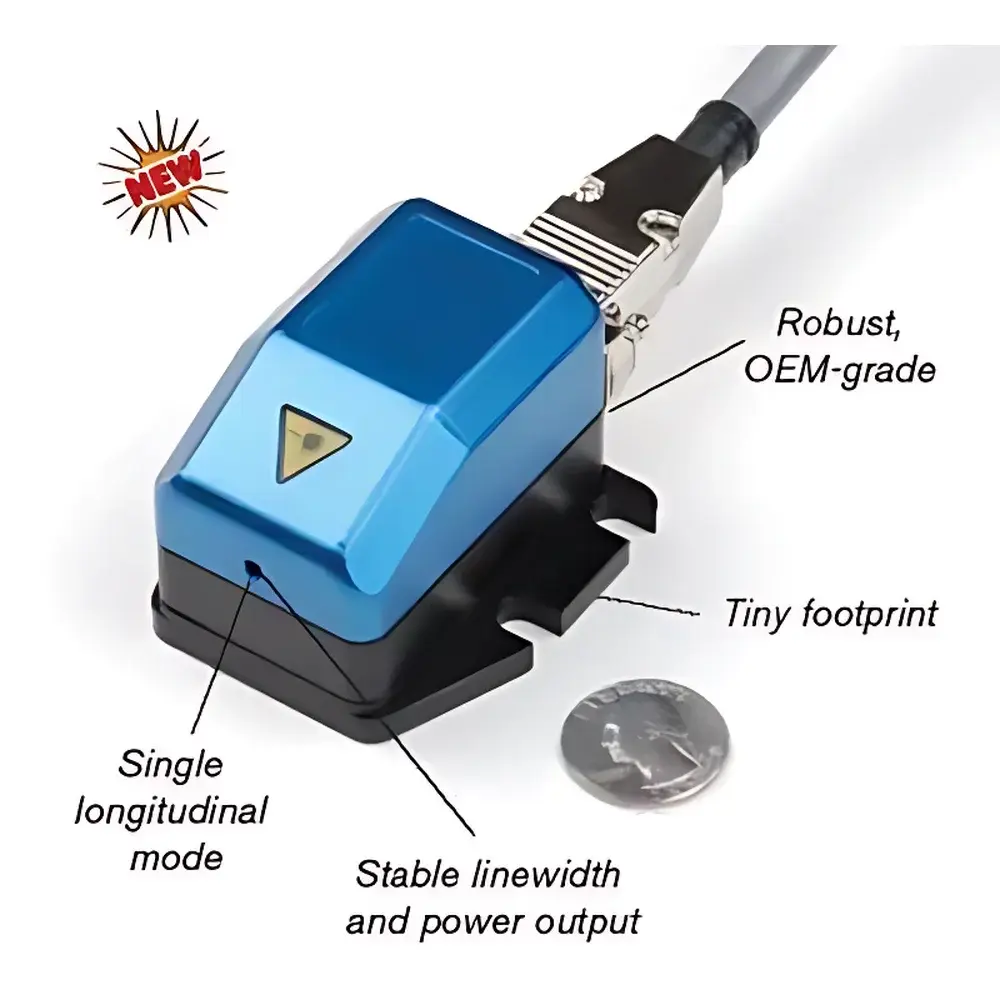
SWL-7500 Integral™ Single-Wavelength External-Cavity Diode Laser
| Wavelength | 633 nm / 660 nm / 780 nm / 785 nm |
|---|---|
| Linewidth | <200 kHz |
| Power Stability (p-p) | <2% |
| Center Wavelength Stability | ±1.5 pm (12 h, ±3 °C) |
| ASE Suppression | <–65 dBc |
| SMSR | >50 dB |
| Lifetime | >5000–6000 hrs |
| Dimensions | 2.5" × 1.25" × 1.25" |
| Operating Temp | 15–35 °C |
| Wavelength Selectability | 50 pm |
| Compliance | RoHS, CE |
Overview
The SWL-7500 Integral™ is a high-stability, single-longitudinal-mode (SLM), external-cavity diode laser engineered for precision optical metrology, coherent spectroscopy, and demanding OEM integration. Based on Littrow-configuration external cavity architecture, it delivers ultra-narrow spectral linewidth (<200 kHz) with exceptional long-term frequency stability—enabling applications where phase coherence, minimal mode-hopping, and sub-picometer wavelength repeatability are critical. Unlike standard Fabry–Pérot diodes, the SWL-7500 employs a diffraction-grating feedback mechanism combined with thermally stabilized optomechanical mounting to suppress spontaneous emission and maintain continuous SLM operation over thousands of operating hours. Its compact form factor—smaller than a standard business card—facilitates seamless integration into space-constrained platforms including portable Raman spectrometers, fiber-optic gyroscopes, and chip-scale interferometric sensors.
Key Features
- Factory-set, user-specified wavelength selection across four primary bands: 630–635 nm (e.g., SWL-7504), 650–660 nm (e.g., SWL-7505), and 765–785 nm (e.g., SWL-7513), with custom wavelengths available upon request and traceable calibration documentation.
- Sub-200 kHz intrinsic linewidth achieved through rigid cavity design, low-noise current drivers, and active thermal stabilization of grating and gain chip alignment.
- Long-term power stability <2% peak-to-peak over 24-hour periods under controlled ambient conditions (±3 °C), verified per IEC 61228 Annex B protocols.
- Center wavelength stability of ±1.5 pm over 12 hours—measured using a high-finesse scanning Fabry–Pérot interferometer referenced to an iodine-stabilized HeNe laser—ensuring compatibility with sub-wavenumber-resolution Raman or Doppler-shifted LIDAR systems.
- Amplified spontaneous emission (ASE) suppressed to <–65 dBc (0.1 nm resolution bandwidth), with side-mode suppression ratio (SMSR) exceeding 50 dB, guaranteeing unambiguous single-mode identification in heterodyne detection schemes.
- RoHS-compliant, CE-marked module with industrial-grade thermal management; operates continuously from 15 to 35 °C without active cooling or TEC modulation—reducing system-level power budget and EMI footprint.
Sample Compatibility & Compliance
The SWL-7500 is designed for direct coupling into single-mode fibers (SMF-28, HI1060) via integrated FC/APC or free-space collimation optics (optional). It complies with ISO/IEC 17025-accredited calibration practices for wavelength and power output verification, and supports GLP/GMP audit trails when paired with compatible data acquisition hardware. While not inherently FDA 21 CFR Part 11 compliant, its analog monitoring outputs (photodiode voltage, temperature sensor ADC) and digital control interface (RS-232 or TTL-compatible modulation input) enable full traceability in regulated environments when integrated with validated software layers. The laser meets EN 60825-1:2014 Class 3B safety requirements, and includes interlock-ready enable/disable circuitry for system-level safety integration.
Software & Data Management
The SWL-7500 operates in open-loop configuration by default but supports closed-loop wavelength tuning via optional factory-installed piezoelectric grating actuation (±50 pm range, 50 pm step resolution). Control is implemented through ASCII command protocol over RS-232 or USB-to-serial bridge, with documented SCPI-like syntax for integration into LabVIEW, Python (PySerial), MATLAB, or EPICS-based control systems. All operational parameters—including drive current, thermistor readings, photodiode monitor output, and error flags—are accessible in real time. Firmware logs timestamped thermal and power history for post-acquisition drift analysis, supporting ISO 10110-7 and ASTM E2912 compliance reporting for instrument qualification in analytical laboratories.
Applications
- Raman spectroscopy & imaging: Enables high signal-to-noise ratio Stokes/anti-Stokes detection with minimized fluorescence background due to narrow linewidth and high SMSR.
- Optical interferometry: Serves as a stable local oscillator in Michelson, Mach–Zehnder, and fiber-optic interferometers for displacement metrology down to λ/100 resolution.
- Fiber optic gyroscopes (FOGs): Provides coherent light source for Sagnac effect sensing with reduced bias drift attributable to frequency instability.
- LIDAR & atmospheric sensing: Supports coherent Doppler LIDAR systems requiring long coherence length (>150 m) and precise wavelength referencing against molecular absorption lines.
- Terahertz generation: Used in photoconductive antenna pumping schemes where temporal pulse fidelity depends critically on pump laser linewidth and jitter performance.
- Quantum optics & cryptography: Functions as a stable seed source in entangled photon pair generation and quantum key distribution (QKD) testbeds requiring high spectral purity.
FAQ
Is the SWL-7500 suitable for vacuum or hermetic packaging?
Yes—the mechanical housing and internal optomechanics are designed for bake-out compatibility up to 70 °C and can be sealed under dry nitrogen or argon for long-term deployment in vacuum chambers or sealed optical modules.
Can output power be modulated at high frequency?
The laser supports analog current modulation up to 10 MHz (–3 dB) via the dedicated modulation input pin, enabling direct intensity or frequency chirping for lock-in detection or swept-source OCT applications.
What calibration documentation is provided?
Each unit ships with a factory calibration certificate listing measured center wavelength (±0.5 pm uncertainty), output power (±3%), linewidth (via delayed self-heterodyne measurement), and 12-hour stability data—traceable to NIST-traceable reference standards.
Does the SWL-7500 require warm-up time before achieving spec performance?
Stabilization to full specification occurs within 30 minutes of power-on under nominal ambient conditions; however, optimal long-term stability is achieved after 2 hours of thermal equilibrium, as confirmed by internal thermistor telemetry.
Are there options for fiber-pigtailed versions?
Yes—FC/APC and FC/PC single-mode fiber pigtails are available as configurable options (SWL-7500-FP series), with polarization extinction ratio >20 dB and return loss >60 dB specified.





