
Duma Optronics BA7-IR3 Multiple Scanning Knife-Edge Beam Profiler
| Brand | Duma Optronics |
|---|---|
| Origin | Israel |
| Model | BA7-IR3 |
| Spectral Range | 190–1800 nm |
| Beam Size Range | 3 µm – 9 mm |
| Spatial Resolution | 0.1 µm |
| A/D Resolution | 12-bit |
| Interface | USB 2.0, RS232, TCP/IP |
| Measurement Principle | Multi-angle scanning knife-edge with tomographic reconstruction |
| Compliance | CE, RoHS |
| Software | BeamGage Pro (Windows), SDK included |
Overview
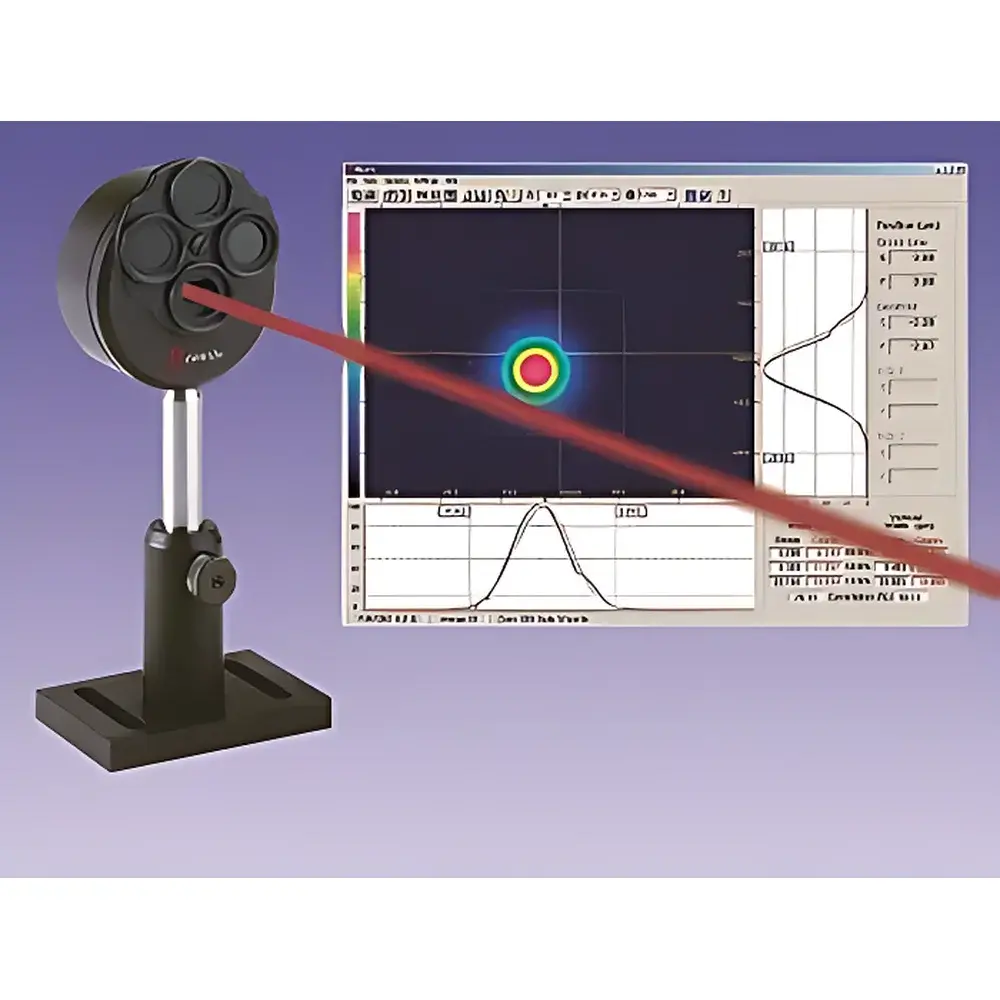
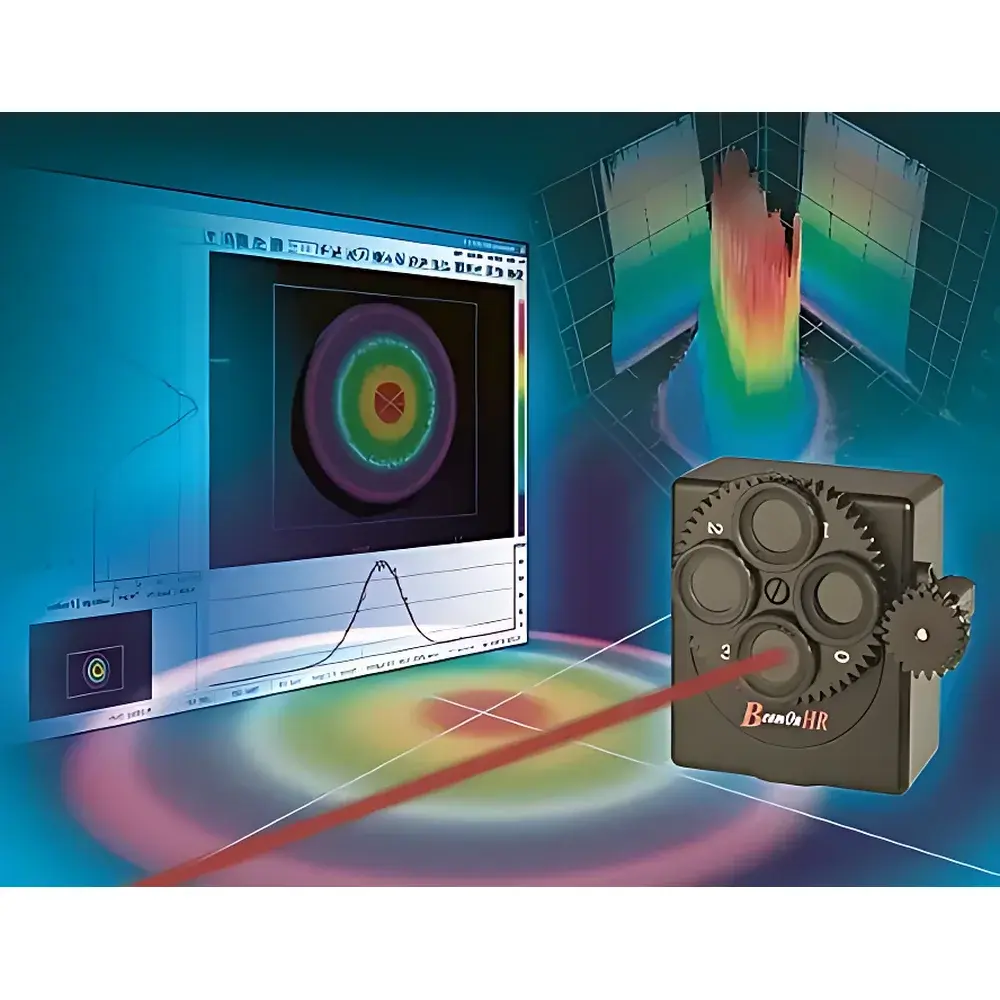
The Duma Optronics BA7-IR3 is a high-precision, multiple scanning knife-edge beam profiler engineered for quantitative characterization of continuous-wave (CW) laser beams across an exceptionally broad spectral range—from deep ultraviolet (190 nm) to near-infrared (1800 nm). Unlike conventional CCD- or CMOS-based profilers limited by pixel size, saturation, and dynamic range constraints, the BA7-IR3 employs a patented mechanical tomographic acquisition method. Its core measurement principle relies on seven orthogonally oriented knife-edges mounted on a rotating drum. As the drum spins, each knife-edge scans the beam cross-section along a unique angular trajectory perpendicular to the propagation axis. A stationary, large-area photodetector captures intensity transmission data in real time. This multi-directional projection dataset serves as input to a robust filtered back-projection algorithm—identical in mathematical foundation to medical CT imaging—that reconstructs a high-fidelity 2D intensity map and, optionally, a volumetric 3D intensity distribution. This architecture enables sub-micron spatial resolution (down to 0.1 µm), a >106 dynamic range, and accurate profiling of highly non-Gaussian, multimode, or clipped beams where pixelated sensors fail due to aliasing or blooming.
Key Features
- Seven independent knife-edge scanning geometry ensures superior fidelity in reconstructing complex, asymmetric, or irregular beam profiles compared to three-edge alternatives (e.g., BA3 series)
- Real-time acquisition and display of beam width (at user-defined clip levels), centroid position, ellipticity (major/minor axes), angular orientation, and total power
- Simultaneous 12-bit A/D conversion across all scanning channels supports high signal-to-noise ratio and minimal quantization error in both low- and high-power regimes
- Integrated distortion-free neutral density filter wheel for automatic attenuation—preserving wavefront integrity and avoiding thermal lensing or polarization artifacts
- Native USB 2.0 interface with optional RS232 and TCP/IP streaming for integration into automated test benches or industrial control systems
- Real-time Gaussian fit overlay with numerical correlation coefficient (R²) and fit residuals for quantitative mode analysis
- Zoom-enhanced viewing mode for precise localization of small features (<10 µm) within the beam footprint
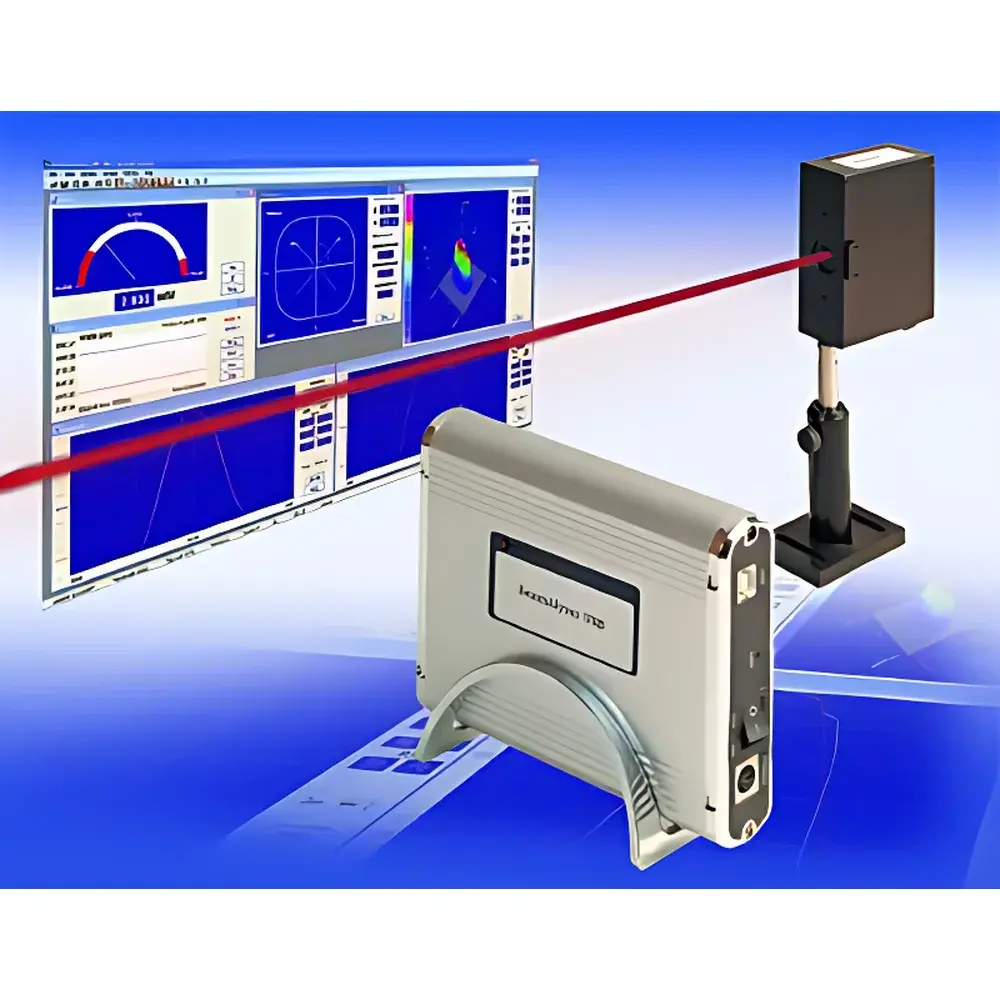
- Comprehensive Windows-based BeamGage Pro software with full SDK (C/C++, .NET, LabVIEW, MATLAB) for custom application development and GLP/GMP-compliant deployment
Sample Compatibility & Compliance
The BA7-IR3 accommodates free-space CW laser beams from UV to NIR without requiring coupling optics or fiber interfaces—making it suitable for alignment-critical setups, cavity diagnostics, and OEM integration. It supports beam diameters from 3 µm (e.g., single-mode fiber outputs) up to 9 mm (e.g., expanded HeNe or diode-pumped solid-state beams), with consistent sub-micron resolution maintained across the full range. The instrument complies with CE marking requirements for electromagnetic compatibility (EMC Directive 2014/30/EU) and low-voltage safety (LVD Directive 2014/35/EU), and conforms to RoHS 2011/65/EU restrictions on hazardous substances. While not certified to ISO 11146-1:2019 (laser beam width, divergence and M² measurement) out-of-the-box, its traceable knife-edge geometry and reconstruction algorithm enable metrologically sound implementation of ISO-defined beam parameters—including D4σ, 1/e², and knife-edge integral methods—when used with NIST-traceable power meters and calibrated filters.
Software & Data Management
BeamGage Pro provides a validated, audit-ready environment supporting FDA 21 CFR Part 11 compliance when configured with electronic signatures, role-based access control, and immutable audit trails. All measurements—including raw scan curves, reconstructed 2D/3D intensity maps, centroid trajectories, and power logs—are timestamped and stored in vendor-neutral formats (CSV, TIFF, PNG, XML). Real-time data streaming to Excel via direct OLE automation eliminates manual export steps. Chart Mode enables long-duration stability monitoring (hours/days) of beam width or centroid drift, with configurable alarm thresholds and optional audio alerts. Automatic Pass/Fail reporting generates PDF or HTML summary reports containing annotated plots, statistical summaries (mean, std dev, min/max), and conformance flags against user-defined specification limits—essential for incoming inspection, process validation, and quality audits under ISO 9001 or IATF 16949 frameworks.
Applications
- Characterization of diode, DPSS, fiber, and CO₂ lasers during R&D, production calibration, and field service
- M² factor determination using sequential measurements at multiple propagation distances (with optional translation stage)
- Quantitative assessment of beam shaping optics (e.g., diffractive optical elements, axicons, homogenizers)
- Alignment verification and mode instability detection in ultrafast amplifier chains and regenerative cavities
- Validation of beam delivery systems in laser material processing (cutting, welding, additive manufacturing)
- Optical component testing—including wavefront sensor calibration, lens aberration mapping, and aperture clipping analysis
- Academic and industrial metrology labs requiring traceable, high-dynamic-range beam diagnostics compliant with international standards
FAQ
How does the BA7-IR3 differ from CCD-based beam profilers?
The BA7-IR3 avoids pixel-limited resolution, saturation-induced nonlinearity, and fixed dynamic range inherent to area-sensor cameras. Its scanning knife-edge approach delivers uniform sensitivity across intensity orders of magnitude and resolves features below the diffraction limit of typical CCD pixels.
Can the BA7-IR3 measure pulsed lasers?
It is optimized for CW sources. For nanosecond- or picosecond-pulsed lasers, average power profiling is possible only if pulse repetition rate exceeds ~1 kHz and duty cycle permits stable thermal equilibrium in the detector; single-shot profiling requires alternative technologies (e.g., pyroelectric arrays or streak cameras).
Is the tomographic reconstruction algorithm accessible for third-party integration?
Yes—the BeamGage Pro SDK includes documented C++ libraries and source code examples for implementing the reconstruction pipeline externally, enabling custom GUIs or embedded system deployment.
What calibration documentation is provided?
Each unit ships with a factory calibration certificate referencing traceable standards for spatial scale (via precision reticle) and responsivity (using NIST-traceable power meter), valid for 12 months under normal operating conditions.
Does the system support vacuum or cleanroom environments?
The standard BA7-IR3 is rated for ambient laboratory use (IEC 60529 IP20). Custom enclosures with stainless-steel housings, bake-out compatibility, and particle-controlled airflow are available upon request for semiconductor or aerospace applications.



